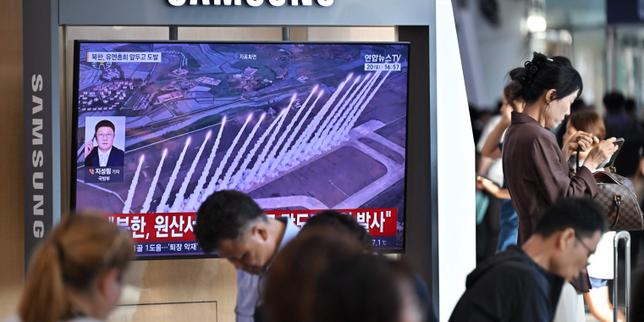
The media runs the exact same headline every single time Pyongyang fires a test missile. IAEA passes a toothless resolution. North Korea rejects it with fiery rhetoric. A missile clears the horizon. Western pundits hyperventilate about instability, reckless provocation, and the imminent collapse of regional security.
It is lazy analysis. It treats international relations like a moral playground instead of a cold, transactional market of leverage.
For decades, foreign policy establishment voices have peddled a comforting illusion: that isolation and sanctions will eventually force North Korea to abandon its nuclear program through sheer economic exhaustion. That framework is dead. It has failed for thirty years. Every time Pyongyang reacts to an IAEA censure with a ballistic launch, analysts scream about irrational actors. But look closer at the mechanics of the Korean peninsula. They are not acting out of spontaneous rage. They are executing a ruthlessly consistent doctrine of nuclear deterrence designed by a regime that watched what happened to Saddam Hussein and Muammar Gaddafi.
Let us dismantle the core misconceptions driving Western coverage of these IAEA standoffs.
The IAEA Resolution Fallacy
The International Atomic Energy Agency exists to monitor nuclear non-proliferation and verify safeguards. It is an administrative watchdog, not an enforcement army. Yet every resolution passed in Vienna against North Korea is treated by mainstream journalism as a turning point in international law.
Why do these resolutions get rejected with immediate missile tests? Because from Pyongyang's perspective, the IAEA is not an objective auditor. It is an instrument of Western diplomatic pressure designed to strip away the regime’s sole insurance policy.
When the IAEA votes to condemn North Korean nuclear activities, it is signaling diplomatic hostility wrapped in technical language. Pyongyang responds in the only currency Washington and Seoul understand: empirical proof of operational capability. A missile test is a physical reply to a piece of paper. It says: your resolutions do not reach our launchpads, and your monitoring does not constrain our engineers.
To call this irrational is to misunderstand what North Korea is optimizing for. They are not trying to win a popularity contest at the United Nations. They are preserving regime survival at all costs. Every launch is a stress test of their solid-fuel engines, guidance systems, and mobile launchers under actual operational conditions. They are getting real-world telemetry while the West drafts another strongly worded condemnation.
The Myth of the Irrational Dictator
Western newsrooms love the caricature of the unpredictable madman with his finger on a nuclear button. It makes for good television, but it is strategically illiterate.
Kim Jong Un is not erratic. He is hyper-rational within the brutal constraints of his geopolitical reality. Consider the alternative. If North Korea traded away its nuclear arsenal for promises of sanctions relief—the perennial dream of State Department negotiators—what stops a subsequent US administration from tearing up the agreement, just as Washington did with the Iran nuclear deal? Nothing. North Korea’s leadership knows history. They saw Ukraine give up Soviet-era nuclear weapons in exchange for sovereignty guarantees under the Budapest Memorandum, only to face invasion decades later.
Nuclear weapons are the ultimate equalizer for a state with a decaying conventional economy and zero allies capable of fighting a modern war on its behalf. Every missile test following an IAEA rejection serves a domestic and international audience. Domestically, it projects strength and technological competence to a population fed on a diet of perpetual siege mentality. Internationally, it raises the cost of any kinetic intervention so high that no rational Pentagon planner will recommend a first strike.
We need to stop confusing brutality with incompetence. The North Korean state apparatus operates with terrifying efficiency. Their cyber operations steal billions in cryptocurrency to fund black-budget weapons research. Their artillery doctrine holds Seoul hostage with thousands of conventional tubes pointed across the demilitarized zone. And their missile development cycle has accelerated past Western intelligence predictions, moving from liquid-fueled liquid-nightmare rockets to rapid-deployment solid-fuel intercontinental ballistic missiles.
What Sanctions Actually Achieve
Sanctions are treated as a moral good in themselves—a way to punish bad behavior without starting a hot war. But in practice, comprehensive economic isolation has achieved the exact opposite of its stated intent.
When you lock a country out of global trade, you remove any incentive for its leadership to integrate with the international order. North Korea has nothing left to lose economically. They have already adapted to extreme poverty and international blacklisting. By forcing autarky upon them decades ago, the international community eliminated trade leverage. You cannot threaten to cut off an economy that is already entirely detached from Western financial systems.
Furthermore, sanctions have created a black-market ecosystem where North Korea learns to survive and innovate. They trade weapons technology with rogue states, refine illicit supply chains through maritime smuggling networks, and optimize their domestic manufacturing to rely on zero Western components. Every new round of UN or IAEA-backed economic restrictions simply teaches the regime how to be more resilient against the next one.
It is time to admit that the maximum pressure campaign was a failure of imagination. It did not starve the nuclear program; it hardened it.
The Danger of Escalation Dominance
The mainstream narrative assumes that if the West just applies a little more pressure, holds a few more naval exercises, or passes one more binding resolution, North Korea will eventually crack.
This is a dangerous delusion.
Escalation dominance belongs to Pyongyang on the Korean peninsula. They can mobilize thousands of artillery pieces and tactical nuclear payloads within miles of a major global economic hub—Seoul—while American forces are thousands of miles away across the Pacific. Every time Washington and Seoul stage massive joint military drills to "send a message," North Korea matches it with missile tests to prove they can absorb the signaling and return fire.
We are sleepwalking into a permanent nuclear standoff because politicians refuse to accept a basic, uncomfortable truth: North Korea is a nuclear weapons state. They are not going to disarm. No amount of diplomatic hand-wringing in Vienna will change the physics of enriched uranium or the chemistry of solid rocket propellant.
The longer Western foreign policy pretends that Pyongyang is a temporary aberration that can be wished away with resolutions, the more entrenched the North Korean nuclear arsenal becomes.
Stop reading these missile tests as temper tantrums. Read them as policy statements written in rocket exhaust. They are here to stay. The only question left is whether the West will keep drafting useless paper while the architecture of global non-proliferation burns to the ground.