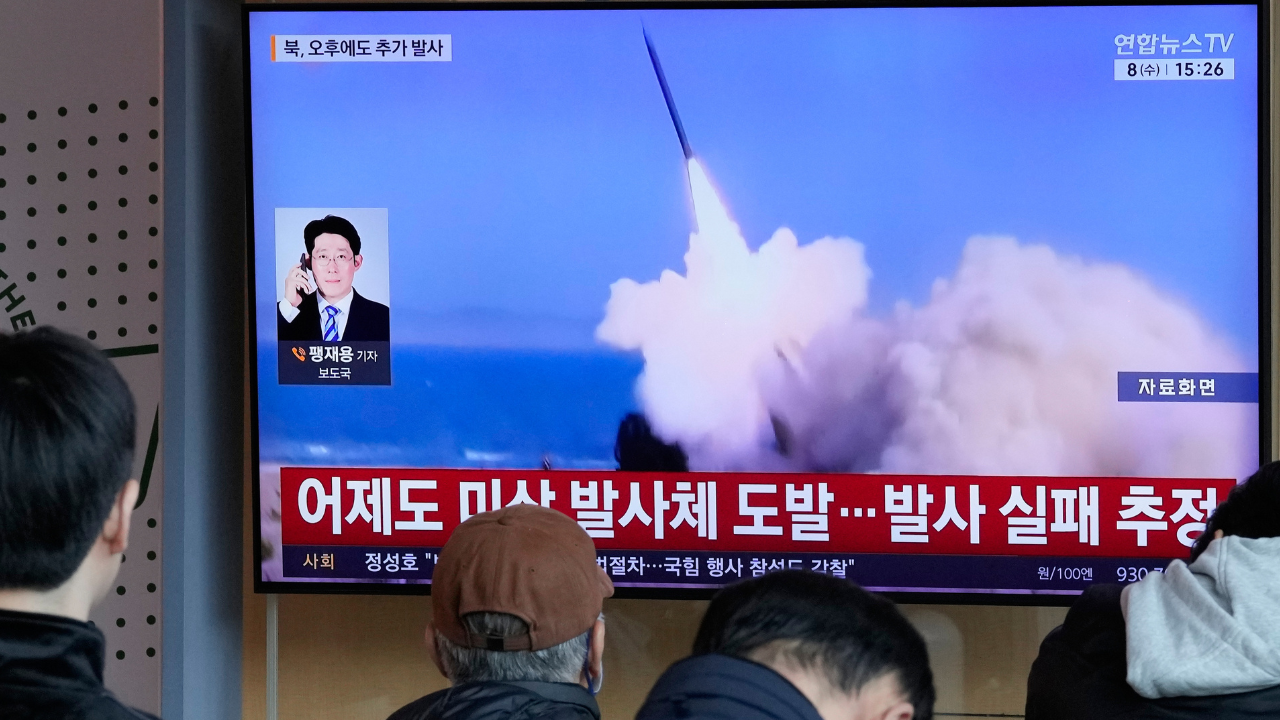
The Western media has a comfort blanket. It is the narrative of the "unpredictable" Kim Jong Un. Every time a missile splashes into the East Sea, the pundits trot out the same tired script: North Korea is "saber-rattling" to get attention, or they are "reacting" to joint military drills. They frame Pyongyang as a moody teenager throwing a tantrum for a seat at the big kids' table.
This view is not just wrong. It is dangerous. It masks a calculated, multi-decade military industrial strategy with a layer of psychological projection. Recently making news in this space: The Legal Fiction of Terminated Hostilities with Iran.
If you think North Korea fires missiles because they are "angry" or "desperate," you have fundamentally misunderstood the most disciplined weapons development program on the planet. They aren't looking for a hug or a handout. They are running a hardware startup with a sovereign budget and zero regulatory oversight.
The Myth of the "Mixed Signal"
The recent cycle of rare praise for internal achievements followed by a barrage of short-range ballistic missiles (SRBMs) is not a contradiction. It is a synchronization of domestic propaganda and kinetic testing. More insights into this topic are explored by The Washington Post.
Mainstream analysts see "mixed signals." They wonder why Kim would offer words of conciliation or focus on rural development one day, only to authorize a launch the next. They treat these events as if they belong to different universes. In reality, they are two sides of the same coin: Sovereign Legitimacy.
Kim’s praise for the "20x10" regional development policy is the internal carrot. The missiles are the external stick. You cannot have one without the other. Without the perceived security provided by a nuclear-capable delivery system, the domestic economic promises carry no weight. They are testing hardware, not feelings.
Missile Launches are R&D, Not Rhetoric
Stop calling every launch a "provocation." When SpaceX tests a Starship and it explodes or deviates, we call it "iterative development." When North Korea launches a Hwasong-11, we call it a "threat to global peace."
From a purely engineering standpoint, North Korea is currently in a high-intensity optimization phase. They are moving away from liquid-fueled clunkers that take hours to prep—and are thus easy to hit on the pad—to solid-fuel canisters that can be fired in minutes from a hidden tunnel or a mobile launcher.
Consider the technical requirements of a solid-fuel engine. You need high-grade chemicals, sophisticated casting techniques to ensure the fuel grain doesn't have cracks (which cause explosions), and advanced nozzles. You don't "saber-rattle" with solid fuel. You iterate. Every "barrage" of missiles is a data-gathering exercise for their telemetry teams. They are testing:
- Cold-launch reliability: Can the missile pop out of the tube before the engine ignites?
- Pull-up maneuvers: Can the warhead skip off the atmosphere to evade THAAD or Patriot batteries?
- Salvo timing: Can they coordinate multiple launches to saturate an Aegis destroyer’s tracking capability?
If you treat this as a cry for attention, you miss the fact that they are solving specific math problems. They are debugging their code in real-time.
The Fallacy of the "Attention Seeker"
The "People Also Ask" sections of the internet are littered with questions like "Why does North Korea want attention?"
They don't.
North Korea has spent the last four years actively ignoring the United States. The Biden administration’s "calibrated, practical approach" was met with a dial tone. Pyongyang has realized that bilateral talks are a dead end that only lead to temporary freezes while their tech stagnates.
Instead, they have pivoted to a "New Cold War" architecture. By aligning with Russia—specifically by providing munitions for the war in Ukraine—they have secured something far more valuable than a photo op in Singapore: Real-world combat data.
There is a high probability that the missiles being fired into the sea near Japan are the exact same models being shipped to the front lines in Eastern Europe. Russia provides the "live fire" laboratory; North Korea provides the inventory. In exchange, Pyongyang gets Russian telemetry data, aircraft technology, and potentially satellite assistance.
This isn't a cry for help. It’s a B2B transaction.
The Lee Apology Distraction
When a high-ranking official like Lee (or any subordinate) issues an apology or is purged, Western analysts salivate over "signs of instability."
This is amateur hour.
In the North Korean political theater, apologies are a mechanism for devolving blame. By allowing a subordinate to take the hit for economic failures or technical delays, Kim Jong Un maintains the "infallibility" of the supreme leadership. It is a standard corporate restructuring move rebranded for a total dictatorship. It isn't a sign of a crumbling regime; it's a sign of a regime that is effectively managing its internal PR to ensure the core leadership remains untouched by the friction of governance.
The Tech Gap is Closing Faster Than You Think
We used to laugh at North Korean missiles. We called them "bottle rockets." We aren't laughing anymore.
The move toward tactical nuclear weapons—smaller warheads designed for battlefield use—is a tactical shift that makes the "denuclearization" conversation obsolete. The U.S. and South Korea are still playing a game of "How do we get them to give up the nukes?" while North Korea has already moved on to "How do we win a limited nuclear exchange on the peninsula?"
They are developing the KN-24 and KN-25, which fly on "depressed trajectories."
$h_{peak} < 50km$
By staying low, these missiles stay under the optimal radar horizon of many long-range interceptors. They are designed to hit Busan and Pyeongtaek before the operators even finish their coffee. This isn't a political statement. It is a hardware solution to a geographic problem.
Stop Asking the Wrong Questions
The media asks: "When will they return to the negotiating table?"
The real question is: "Why would they ever return to a table where the only allowed outcome is their unilateral disarmament?"
The industry consensus is that sanctions will eventually force a change. I have watched this "maximum pressure" strategy fail for two decades. Sanctions only encourage the development of a shadow financial network and a robust cyber-warfare division that steals more crypto in a weekend than most mid-sized banks hold in reserve.
North Korea’s "barrage" is a demonstration of strategic autonomy. They are proving that they can build, scale, and deploy advanced ballistics while under the most restrictive sanctions regime in human history.
The Brutal Reality
If you are looking for a "solution" to the North Korea problem, you are looking for a ghost. There is no solution that involves Kim Jong Un waking up and deciding to become a Jeffersonian Democrat.
The strategy is clear:
- Normalize the launches. Make them so frequent that they stop being front-page news.
- Achieve technical parity. Make their second-strike capability so undeniable that the U.S. has to accept them as a nuclear power, like Pakistan or India.
- Decouple the alliance. Prove to Seoul that the U.S. "nuclear umbrella" is a myth because Washington won't trade San Francisco for Seoul.
The missiles fired this week weren't a "message" to the White House. They were a performance review for the North Korean Academy of National Defense Science. They were an advertisement for Russian buyers. They were a stress test for South Korean radar operators.
The "lazy consensus" wants you to think this is a cycle of madness. It isn't. It is a linear, logical, and highly successful military procurement roadmap.
If you want to understand what North Korea will do next, stop reading the State Department briefings and start reading the technical specifications of solid-fuel propellant. The truth isn't in the rhetoric; it's in the flight path.
Accept the reality: North Korea is a nuclear weapons state that has successfully bypassed the global order. No amount of "concern" or "monitoring" changes the physics of the warheads already sitting in their silos.
The era of "denuclearization" is dead. We are now in the era of containment and high-tech deterrence. Anything else is just fairy tales for the foreign policy establishment.



