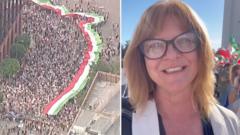
The air in Tehrangeles doesn’t smell like California. Not tonight. On this stretch of Westwood Boulevard, the usual scent of exhaust and expensive sea salt is buried under a thick, aromatic haze of saffron, charred meat, and something far more volatile: hope. It is a scent that travels across decades and oceans. It clings to the hair of grandmothers and the leather jackets of teenagers who have never stepped foot in Isfahan but can sing every word of a revolutionary anthem.
Hassan stands on the corner near a shop selling Persian rugs that cost more than a mid-sized sedan. He is seventy-two. His hands, weathered by years of engineering and, later, the quiet indignity of driving a taxi in a city that didn't know his name, are shaking. He isn't cold. It’s eighty degrees at midnight. He is shaking because he is watching the street turn into a river of green, white, and red. Recently making waves lately: The Kinetic Deficit Dynamics of Pakistan Afghanistan Cross Border Conflict.
This isn't a protest. Not in the way the nightly news defines it. It is a reclamation. For forty-five years, the story of the Iranian diaspora in Los Angeles has been one of quiet mourning, masked by the frantic pursuit of the American Dream. They built businesses. They became doctors. They bought homes with views of the canyon. But under the polished surface of the "model minority" was a persistent, aching silence.
Tonight, that silence is dead. More details on this are detailed by The Washington Post.
The Geography of a Heartbreak
To understand why thousands of people are currently jumping on the hoods of cars and dancing to the rhythmic honking of horns, you have to understand the geography of exile. Los Angeles is home to the largest population of Iranians outside of Iran. Some estimates put the number at over half a million. It is a city within a city, a shadow nation that exists in the strip malls of the San Fernando Valley and the high-rises of Wilshire.
For these people, a headline from Tehran isn't just news. It’s a seismic event that rattles the dishes in their kitchens three thousand miles away. When the internet goes dark in Shiraz, the dinner tables in Beverly Hills go silent. The "Competitor" articles will tell you that "tensions are rising" or "demonstrators gathered to express support."
Those words are empty vessels. They don't capture the weight of a daughter in Santa Monica who hasn't seen her father in twenty years because a visa is a political weapon. They don't account for the way a single video clip smuggled out of a basement in Mashhad can make a grown man weep in the middle of a Ralphs grocery store.
Hassan watches a young woman climb onto a bus stop bench. She isn't wearing a headscarf. She is wearing a tank top and jeans, her hair a wild, dark halo under the streetlights. She leads a chant that starts as a low rumble and builds into a roar that vibrates in the marrow of your bones.
Zan, Zendegi, Azadi. Woman, Life, Freedom.
The syllables are percussive. They are a heartbeat.
The Ghost in the Machine
Consider the mechanics of a revolution from a distance. In the past, if you wanted to change the world, you needed a printing press or a radio station. Now, you need a VPN and a smartphone. The irony of the crowd in Los Angeles is that they are the digital echo of a physical struggle. Every photo taken on Westwood Boulevard is uploaded, beamed into space, and bounced back down into the phones of kids hiding in alleys in Tehran.
It is a feedback loop of courage. The diaspora provides the megaphone; the people on the ground provide the blood.
There is a specific kind of guilt that comes with being a spectator to your own country's liberation. It’s a heavy, greasy feeling. You eat a kale salad while someone your age is facing down a paramilitary unit. You go to the gym while your cousin is being hauled into a van. The celebrations in the streets of Los Angeles are, in part, an attempt to burn that guilt off.
"We are their voice," a girl named Sara tells me. She’s twenty-four, a law student. She’s been here for six hours. Her voice is a jagged rasp. "They try to cut the cables. They try to kill the Wi-Fi. We make so much noise that the satellites have to pick it up. We make it impossible for the world to look away and say they didn't know."
The statistics of the Iranian diaspora are impressive—highest levels of education, significant economic impact, a cultural footprint that spans from high fashion to NASA. But statistics are cold. They don't tell you about the "Persian party" paradox: the way these gatherings are always a chaotic mix of profound grief and ecstatic joy.
On one corner, a man holds a picture of a son he lost to a firing squad in 1988. Ten feet away, a group of boys are blasting rhythmic dance music from a portable speaker, their bodies moving in a synchronized, fluid grace that looks like a defiance of gravity itself.
The Cost of Looking Back
There is a danger in nostalgia. It’s a trap that many exiles fall into, a loop of "how it used to be" that freezes them in time. For years, the Iranian community in L.A. was split. The older generation looked back at the 1970s through a lens of sepia-toned perfection. The younger generation, born in the States, looked forward, often distancing themselves from a heritage that the evening news associated only with hostage crises and nuclear deals.
But the current movement has dissolved the generational divide. The grandmother in the floral hijab is standing next to the queer activist with the nose ring. The monarchist is sharing a water bottle with the secular socialist.
Why? Because the stakes have become singular.
It is the realization that the "invisible stakes" aren't about who holds the throne or the office, but about the right to exist without permission. It’s the right to sing. The right to feel the wind in your hair. The right to return to a land that has been a ghost in your dreams for half a century.
"I just want to see the mountains," Hassan says. He isn't looking at the crowd anymore. He’s looking north, toward the Santa Monica mountains that loom over the city. To him, they look enough like the Alborz mountains north of Tehran that if he squints, if the light hits them just right, he can pretend he’s home.
"I want to take my grandson to the Caspian Sea. I want him to know what the soil feels like when it isn't under concrete."
A Symphony of Displacement
The traffic on Wilshire is a nightmare. Ferraris are bumper-to-bumper with battered Toyotas. No one is angry. Drivers lean out of their windows to high-five pedestrians. This is the one night where the brutal, ego-driven hierarchy of Los Angeles melts away.
In this moment, the city is no longer a collection of zip codes. It is a sounding board.
The "Competitor" narrative might focus on the logistics—how many people showed up, what the police said, which local politician made a cameo. But the real story is the tectonic shift in the soul of a community. For the first time in forty years, the diaspora isn't just reacting to tragedy. They are participating in a birth.
Births are messy. They are loud. They involve a terrifying amount of uncertainty.
The people in the streets know that tomorrow, the news cycles will move on. They know that the regime they are shouting against has survived decades of shouting. They aren't naive. They understand the brutal math of power. But they also understand the physics of a breaking point.
When you compress a spring for forty-five years, the energy stored within it becomes a physical force. What we are seeing in Westwood is the release of that spring. It is the sound of half a million people finally exhaling.
As the clock crawls toward 2:00 AM, the energy should be flagging. It isn't. If anything, the air feels more electric. A car goes by with a giant flag draped over its roof, the lion and sun shimmering under the amber glow of the streetlights. A group of teenagers starts a new chant, their voices high and clear, cutting through the bass of the music.
Hassan pulls a small, crumpled photograph from his wallet. It’s black and white, the edges frayed into lace. It shows a young man in a university courtyard, laughing, a book tucked under his arm.
"That was the last day I was a person in my own country," he says. He doesn't look sad. He looks focused. He looks like a man who has been waiting for a bus for forty years and finally sees the headlights turning the corner.
He puts the photo back. He straightens his jacket. He steps off the curb and into the river of people. He doesn't know if he will ever see the Alborz mountains again. He doesn't know if the slogans being shouted tonight will be the ones written in the history books of the future.
But as he joins the chant, his voice—thin and cracked but steady—merges with the lawyer, the student, the grandmother, and the ghost of the boy in the university courtyard.
The street is a chaos of light and sound. The cars are trapped in a gridlock of celebration. The world is watching, or maybe it isn't, but for the first time in a very long time, that doesn't seem to matter. They are shouting for themselves. They are shouting because the silence was a slow death, and tonight, they have chosen to live.
The moon hangs low over the Pacific, indifferent to the borders and the blood. Down on the asphalt, a young girl sits on her father’s shoulders, waving a flag that is too heavy for her small arms. She is tired, her eyes drooping, but she refuses to go home. She knows, with the intuitive clarity of a child, that she is standing in the middle of a crack in history.
She watches the sparks from a stray firework dance against the black sky. They flicker and fade, but for one brilliant second, they provide enough light to see exactly where we are.
Would you like me to explore the specific cultural history of "Tehrangeles" or perhaps draft a companion piece on the role of digital activism in modern diaspora movements?