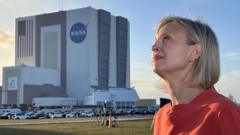
The air in coastal Florida at three in the morning does not feel like the future. It feels like old wool, heavy with salt and the thick, stagnant scent of inland swamps. For three weeks, I slept in the back of a rented midsize sedan, my spine molded into the awkward contour of the driver’s seat, waiting for a mechanical beast to wake up. My skin was permanently tacky with bug spray. My laptop battery was a constant source of anxiety. Around me, scattered across the dark grass of the press site, hundreds of other journalists, engineers, and space enthusiasts hovered over glowing screens, looking less like the vanguard of a new space age and more like refugees from a shipwreck.
We were all waiting for Artemis I.
The public sees space travel as a series of polished, hyper-edited highlights. They see the pristine white suits, the slow-motion walks, and the triumphant thumbs-up from astronauts. They do not see the plumbing. They do not see the liquid hydrogen leaks that freeze valves shut, or the frantic, whispered arguments between technicians at two o'clock on a Tuesday morning over a sensor that refuses to read correctly.
When the Space Launch System finally ignited, it did not look like technology. It looked like an eviction notice served to the night sky.
The flash comes first, silent and blinding, turning the midnight marsh into noon for a terrifyingly long sequence of seconds. Then comes the sound. It is not a roar. A roar is something an animal makes. This was a physical tearing, a violent ripping of the atmosphere that vibrated the fillings in my teeth and rattled the camera lenses inside my bag. The pressure wave hit my chest like a heavy, flat hand, forcing a sudden, involuntary exhale.
In that moment, the cold data points of NASA’s press releases—the 8.8 million pounds of thrust, the four RS-25 engines, the twin solid rocket boosters—ceased to be statistics. They became an existential statement. We were putting our foot down on the pedal of gravity, and we were breaking through.
The Anatomy of an Empty Seat
For the twenty-five days that followed, the story of Artemis I shifted from the deafening theater of Florida to a quiet, clinical room in Houston. The rocket was gone, dissolved into the blackness of the cis-lunar void. What remained was a ghost ship.
The Orion spacecraft was empty of human life, but it was far from unoccupied. In the commander's seat sat Commander Campos, a mannequin named after Arturo Campos, the legendary electrical engineer who helped bring Apollo 13 home safely. Strapped into the other seats were Helga and Zohar, two phantom torsos made of materials that mimic human bone and soft tissue, riddled with thousands of passive and active radiation sensors.
To look at the live telemetry feeds from inside the cabin during those three weeks was an exercise in profound loneliness. You could see the empty controls, bathed in the soft blue light of the displays, while the moon loomed larger and larger in the small window ports.
It was easy to question the sanity of it all. Why spend billions of dollars to send plastic dummies on a 1.4-million-mile loop around a dead rock? The doubt creeps in when you are staring at a spreadsheet of expenditures at midnight. You think about the problems on the ground, the broken roads, the strained grids, the immediate, bleeding needs of a fragile planet.
But the real problem lies elsewhere. If we do not test the threshold of our survival in the deep radiation belts of space, we remain trapped on a single island with a finite expiration date. Helga and Zohar were taking the cosmic punches so that a flesh-and-blood woman wouldn't have to suffer them a few years from now. They were measuring the invisible storm—the solar particles and galactic cosmic rays that wait for us past the protective shield of Earth’s magnetosphere.
Consider what happens next when you push past that shield. Orion traveled 40,000 miles beyond the far side of the moon, farther than any spacecraft built for humans had ever flown. At that distance, Earth is no longer a dominant blue marble. It is a marble, period. A small, turquoise bead that you can block out entirely by raising your thumb against the window.
The engineers I talked to during those long transit days spoke in a language of terrifying precision. They didn't talk about the grandeur of exploration; they talked about thermal protection systems and orbital insertion burns. Yet, their voices shifted when they looked at the pictures sent back by Orion’s solar array cameras. It was a shared vulnerability. We are a very small species, trying very hard to do a very big thing.
The Loneliness of the Far Side
There is a specific kind of silence that occurs when a spacecraft slips behind the moon. Radio contact ceases. The telemetry drops to a flat line of static. For roughly half an hour during its closest flyby, Orion was utterly, completely alone in the dark, cut off from the collective knowledge and comfort of humanity.
During Apollo, that silence belonged to men like Michael Collins or Al Worden. This time, the silence belonged to the machines we built to mimic us.
I watched the tracking screens in the press center go dark during that first lunar pass. The room, usually buzzing with the clatter of mechanical keyboards and the murmurs of television anchors, fell completely silent. We were all staring at a digital clock counting down the seconds until reacquisition of signal.
[LOS] LOSS OF SIGNAL — BEHIND LUNAR HORIZON
COUNTDOWN TO AOS: 28:14
That half-hour felt longer than the three weeks in the back of my rental car. It was a stark reminder of the stakes. If the service module's main engine failed to ignite while hidden behind that massive wall of gray dust and craters, Orion would be trapped in a permanent, erratic orbit around the moon, a sleek, expensive tomb for our ambitions.
When the signal chirped back to life, and the first grainy images of the lunar surface flickered onto the monitors, the collective intake of breath in the room was audible. The spacecraft had passed just 80 miles above the jagged, battered crust of the moon. The craters looked close enough to touch, cast in stark, unforgiving shadows by a sun that has no atmosphere to soften its light.
We weren't just looking at a rock. We were looking at a mirror. The moon tells the history of our neighborhood in the solar system, a scarred record of every collision and cataclysm that Earth has managed to heal over with oceans and shifting tectonic plates. To go back there is to read the diary of our own origin.
The Sixty-Second Furnace
The final act of the mission was not a slow deceleration, but a violent collision with our own sky.
On December 11, Orion approached Earth at twenty-five thousand miles per hour. That is roughly thirty-two times the speed of sound. At that velocity, the air in front of the spacecraft cannot move out of the way fast enough. It compresses instantly, transforming into a superheated plasma that burns at 5,000 degrees Fahrenheit. That is half the temperature of the surface of the sun.
To survive this, the spacecraft utilized a technique never before attempted with a human-rated vehicle: a skip entry.
Think of a flat stone skipped across the surface of a still pond. Orion hit the upper atmosphere, bounced back up into the vacuum of space to shed velocity and heat, and then plunged back down for its final descent. It was a high-stakes gamble with orbital mechanics. Come in too steep, and the spacecraft incinerates under g-forces that would crush human lungs. Come in too shallow, and it skips off the atmosphere entirely, lost to the deep void like a stone thrown into a dark well.
From the deck of the USS Portland, waiting in the Pacific Ocean off the coast of Baja California, the sky looked clear and deceptively peaceful.
Then, a sonic boom split the afternoon.
Two small dots appeared high in the clouds, followed rapidly by the deployment of three massive, red-and-white striped parachutes. The canopy blossomed against the blue sky like giant, synthetic flowers.
The capsule hit the water with a distant, muted thud, kicking up a white wall of spray. It bobbed in the gentle swells of the Pacific, charred, blackened, and peeling from its furnace ride through the heavens, but intact.
I looked at the live feed of the capsule floating in the water, and then looked down at my own hands, still gritty with the salt of a Florida swamp from weeks prior. The loop was closed. The machine had gone into the dark, took the hits, ran the gauntlet, and come back to our shore.
We have built a habit of treating these triumphs as routine, as if the conquest of physics is merely an administrative task to be checked off a corporate ledger. We forget that every successful splashdown is a miracle of human coordination, a testament to thousands of people who refused to let a million variables go unmonitored.
Commander Campos, Helga, and Zohar were hoisted from the water by Navy divers, silent and uncomplaining in their plastic suits. Their job was done. The next time that capsule opens after a journey to the moon, the faces looking out at the Pacific will not be made of synthetic resin. They will be creased with exhaustion, wet with sweat, and looking back at us with human eyes.