The metal pole stands unassuming on the corner of Main Street, looking like any other utility upgrade. Atop the shaft sits a small solar panel and a dark, unblinking lens. It does not blink when you walk past with your grocery bags. It does not look away when you walk your children to the bus stop, or when you argue quietly with your partner in the car, or when you return home late after a long shift at the hospital.
It simply records. Every color, every make, every license plate, every second of movement, cataloged and beamed to a private cloud.
Across the United States, more than 130,000 automated license plate recognition cameras built by a company called Flock Safety have quietly colonized thousands of municipalities. They line intersections, shopping center parking lots, and quiet residential streets under the banner of public safety. Proponents argue they are electronic shields against carjackings and burglaries. But as these black-box sentinels multiply, a different kind of public reaction is taking root in the dark.
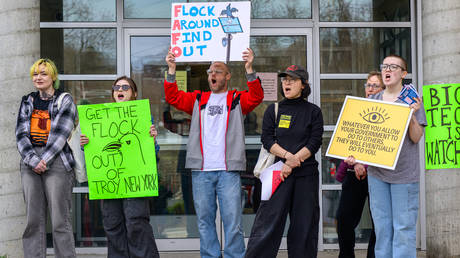
Resistance is no longer confined to heated city council meetings. It looks like a retired resident sitting in a folding chair, using a twelve-foot pool skimmer to tape a protest sign over a lens. It looks like activists throwing black trash bags over uncollected hardware in towns that voted to cancel their surveillance contracts. And, increasingly, it looks like shattered glass, spray-painted housings, and cut-down metal shafts. According to grassroots tracking groups, more than 160 of these devices have been disabled or destroyed nationwide.
Consider what happens next: the state installs a machine to watch the public, and the public responds by turning the machine into a target.
This friction is born of a fundamental broken promise. Citizens were told these digital eyes would only look for stolen vehicles and wanted fugitives. They were not told about the breadth of the dragnet. Investigative reports have revealed that law enforcement officers across multiple states have used the network to stalk romantic partners, track ex-spouses, and dig into private lives without a warrant or a crumb of probable cause. Studies from municipal police audits have shown error rates where a staggering majority of automated alerts misread plates, casting an indiscriminate net over innocent drivers going about their lawful days.
Privacy is not something you notice while you have it. You only feel its absence when it is gone.
Think of a small business owner driving through their neighborhood, unaware that every routine errand is being cross-referenced, stored, and potentially exposed through software vulnerabilities or shared with federal agencies without judicial oversight. Think of a community waking up to find that the quiet rural crossroad or suburban block now functions like a permanent checkpoint, where movement itself is treated as a pre-crime.
The corporate response has been swift damage control. Executives have stepped forward to promise shorter data retention windows and tighter internal audits. Yet critics point out that trimming a storage window from thirty days to seven does not cure the underlying disease. A shorter dragnet is still a dragnet.
The physical pushback playing out on city streets—from spray paint to sledgehammers—is messy, illegal, and loud. It has drawn police responses, arrests, and escalating tension between local governments and the citizens they represent. Yet it speaks to a deep, visceral panic. People feel like strangers in their own hometowns, monitored by private entities profiting off the systematic erosion of anonymity.
When the streets are owned by algorithms, privacy becomes an act of defiance.
As the poles continue to rise and the spray paint continues to fly, the core question remains entirely unresolved. We are drawing a sharp line across the pavement. On one side sits the promise of frictionless, automated security, where every car is tracked and every movement is logged. On the other stands an older, harder idea: that human beings have a right to exist in public spaces without being permanently filed away in a database.
The lens stares down from its pole, waiting for the next car to pass. The lens is watching. But down below, the street is starting to look back.