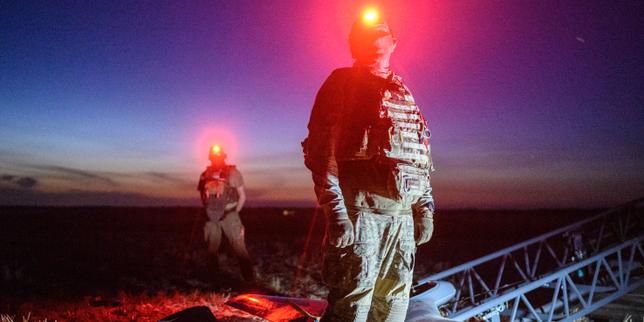
The air smells of burnt copper and damp earth. If you have ever stood in a garden while the horizon turns the color of a fresh bruise, you know the particular silence that precedes a storm. In modern Europe, that silence belongs to the radar operators.
It was Tuesday turning into Wednesday. Across the sprawling plains and jagged river valleys of Ukraine, millions of people pulled their blankets a little tighter. They listened. They waited. They checked their phones for the familiar, grim notification of an air raid alert. Out in the dark, five hundred and two mechanical hornets were humming toward their destination.
Let us be entirely clear about the scale of what happened. Five hundred and two. This is not a skirmish. This is an industrial orchestration of terror, a migration of winged metal carrying high explosives, dispatched under the cover of night to break the infrastructure of a nation that refuses to vanish.
According to official military reports from Moscow, every single one of those five hundred and two drones was intercepted.
Pause for a moment and consider that number. Five hundred and two.
Human brains are poorly equipped to process statistics of this magnitude. We understand three. We can visualize twelve. But five hundred and two buzzing through the stratosphere, tracking coordinates, programmed to detonate upon impact, represents an abstract cloud of destruction. Yet behind that dry military statistic lie two competing realities. On one side, an aggressive campaign designed to exhaust air defense stockpiles, forcing a nation to burn through millions of dollars in interceptor missiles night after night. On the other side, an invisible shield of human vigilance, radar screens glowing in subterranean bunkers, and anti-aircraft crews squinting into thermal scopes while the rest of the world sleeps.
Consider a hypothetical watchtower commander—let us call him Mykola—sitting in a cramped, cinder-block command post somewhere near the Dnipro. Mykola has not slept properly in six months. His coffee is cold, held in a chipped mug decorated with a faded cartoon character his daughter gave him before she left for Poland. He does not think about geopolitics when the sirens wail. He thinks about vectors. He thinks about speed. He thinks about the fragile electrical substation three kilometers down the road that keeps the maternity ward warm.
When the first wave appeared on his monochrome display, Mykola did not panic. Panic is a luxury for the uninvolved. He adjusted his headset, his knuckles white against the plastic console, and began calling out coordinates with the mechanical calm of a man reading a grocery list.
"Target bearing twenty-four. Speed moderate. Altitude low."
The war in the air has become a mathematics contest played with human lives. Every drone launched by Russia is a calculated gamble. Can they saturate the defenses? Can they find the blind spots in the radar network? Can they overwhelm the mobile fire groups—those brave teams driving modified pickup trucks mounted with heavy machine lamps and searchlights, racing across muddy fields to shoot down flying bombs with sheer kinetic grit?
When we read headlines about hundreds of intercepted drones, it is easy to view it as a video game scoreboard. Numbers go up. Zero impacts reported. Clean sweep.
That view is a profound mistake.
Every interception is an explosion in the dark. It is shrapnel raining down on quiet orchards. It is windows shattering in rural homes, waking children with a concussive shock that leaves them stuttering for days. Even when an air defense system performs with terrifying perfection, the collateral thunder of the blast wave rattles the psychological foundations of millions of civilians.
The strategy of mass saturation is designed precisely for this psychological attrition. The goal is not just military destruction. The goal is exhaustion. It is the wearing down of national morale, the slow erosion of a population's will to rebuild what was broken yesterday. If you drop five hundred drones into the night sky, you are forcing an entire country to hold its breath for eight hours. You are keeping surgeons from operating, bakers from kneading dough, and students from learning.
Yet, the morning after the skies cleared over Kyiv, Kharkiv, and Odesa, people stepped outside.
This is the part of the story that algorithms and dry press briefings fail to capture. The stubborn, almost defiant banality of survival. Street sweepers clearing glass from the pavement. Bakeries opening their metal shutters at six in the morning, the scent of fresh yeast cutting through the chemical reek of burnt composites. Old women selling spring onions from wooden crates at the corner market, arguing over the price of potatoes as if the night before had been nothing more than a bad thunderstorm.
There is a profound psychological defense mechanism in human routine. It is not denial. It is a quiet rebellion.
When Russian state media broadcasts claims of five hundred and two intercepted drones, it attempts to frame the event through a lens of total control. But what does a hundred percent interception rate actually signify? It signifies an unprecedented, staggering volume of incoming ordnance. It means the scale of violence has reached a pitch where half a thousand flying bombs can be deployed in a single night as routine operational background noise.
Think about that. Five hundred and two drones in a single night. A year ago, such a number would have marked a historical escalation, an anomaly discussed in emergency sessions of the United Nations Security Council. Today, it is cataloged as a Tuesday.
We are living through a normalization of the unimaginable.
The technology driving this conflict has evolved into a grim symbiosis of cheap consumer parts and lethal military engineering. Many of these long-range loitering munitions are built using commercial drone components, off-the-shelf microprocessors, and simple fiberglass hulls. They are relatively inexpensive to manufacture, yet they require expensive, sophisticated missile batteries or coordinated gunfire to bring down. This economic asymmetry is the silent crisis of modern warfare. It is a contest of attrition where the defender is forced to spend a fortune to destroy a bargain-bin weapon of mass harassment.
And still, the defenders hold.
Why? Because defending your home has a different emotional weight than attacking someone else's. It simplifies the universe. Complex philosophical questions dissolve into a single, blindingly clear imperative: protect what is behind you.
As the sun rose higher over the Ukrainian landscape, the radar screens in Mykola’s bunker finally quieted down. The green blips faded. The air filter hummed a low, monotonous tune in the corner of the room. He took a sip of his bitter, lukewarm coffee, rubbed his bloodshot eyes, and stared at the empty map.
He knew tomorrow would bring another migration. The hornets would return. The math would start over.
Out on the street, a stray dog trotted past a shattered lamppost, its tail wagging at a passing cyclist. Somewhere in the distance, a church bell began to ring, marking the hour with a steady, bronze chime that cut right through the lingering ghosts of the night.