The sound hits you before the flash does. It is a high-pitched, weed-whacker whine that tears through the freezing night air, a mechanical buzz that has become the terrifying soundtrack of the 21st century. In the dark, you cannot see the plastic wings or the taped-on lithium batteries. You only hear the approach.
For the people of Kyiv and Moscow, this sound is no longer a distant headline. It is the immediate, breath-catching reality of a modern conflict that has fundamentally rewritten the rules of warfare. What we are witnessing is not just an escalation of numbers; it is the dawn of the automated siege.
The headlines call it a "massive exchange of drone strikes." They list the tallies like sports scores—dozens launched, most intercepted, a few slipping through. But statistics are a terrible way to understand a war. They flatten the terror. They erase the cold sweat of a mother hiding in a tiled bathroom, praying the shrapnel misses the window. To understand what is actually happening right now in the skies over Eastern Europe, we have to look past the military briefings and look at the sky itself.
The Disruption of the Safe Distance
War used to have a front line. There was a place where the fighting happened, and there was a place where life, however fractured, tried to continue. Drones have permanently shattered that geography.
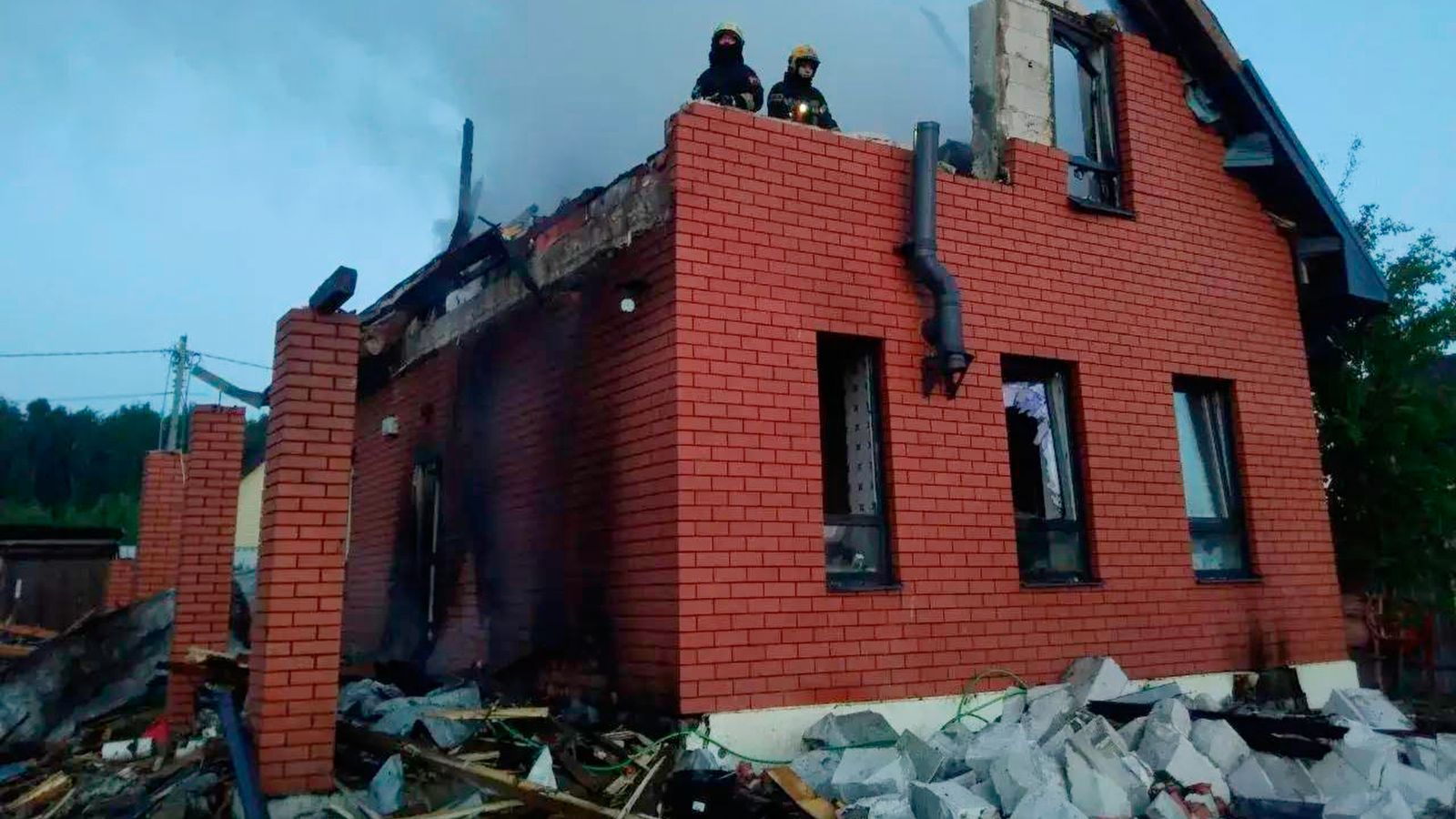
Consider a hypothetical resident we will call Elena, sitting in an apartment building in Kyiv. She is not a soldier. She works in logistics. Yet, her Tuesday night is spent staring at a Telegram channel, tracking the flight paths of incoming Shahed-type loitering munitions. Hundreds of miles away, an analogous figure—let us call him Mikhail in the suburbs of Moscow—wakes up to the rattling of his windowpanes as a Ukrainian-made long-range drone is brought down by air defense systems just blocks from his home.
The front line is now everywhere.
This is the psychological core of the current drone escalation. The weaponization of cheap consumer electronics has allowed both nations to bypass traditional air defenses by sheer volume. If you fire three multimillion-dollar cruise missiles, a sophisticated air defense system will likely knock them out. But what happens when you launch seventy converted commercial drones, each costing less than a used sedan?
The math breaks down. The economic asymmetry is staggering. A missile designed to protect a city can cost $1 million per launch. The drone it is shooting down might cost $20,000. It is a war of attrition where the defender can bleed out financially just by winning the tactical engagements.
The Anatomy of the Swarm
To truly grasp how we reached this point, we have to pull apart the technology. These are not the sleek, sci-fi predators of the early 2000s. The current escalation relies heavily on two distinct categories of automated weapons.
First, there are the long-range strike drones. These are essentially slow-moving, propeller-driven cruise missiles. They are loud, they are relatively slow, but they are incredibly persistent. They fly low, hugging the terrain to avoid radar detection, navigating via pre-programmed GPS coordinates or inertial guidance systems that do not rely on satellite signals at all. When Russia launches a wave of these toward Ukrainian energy infrastructure, or when Ukraine retaliates against oil refineries deep inside Russian territory, the goal is the same: economic paralysis and psychological exhaustion.
Second, there is the terrifying evolution of the FPV (First-Person View) drone. These are the agile quadcopters you might see hobbyists racing in a park, but modified to carry RPG warheads or plastic explosives.
Through cheap video transmitters, a pilot sitting in a trench three miles away sees exactly what the drone sees through a pair of virtual reality goggles. They can fly these devices directly through an open doorway, under a armored vehicle's chassis, or into a specific window of a building.
The sheer scale of the recent exchanges shows that both sides have moved from experimental usage to industrial production. We are no longer looking at improvised garage workshops. We are looking at massive state-sponsored factories pumping out thousands of these automated killers every single week.
The Shared Illusion of Control
There is a profound, unsettling irony in how we talk about this technology. We call them "unmanned" aerial vehicles, as if the human element has been removed from the equation. In reality, the human cost is merely displaced.
The pilots operating these drones describe a unique kind of trauma. They are miles away from the explosion, safe from immediate physical harm, yet they watch their targets die in high-definition color. They see the frantic, last-second scramble of a soldier who realizes a drone is hovering directly above him. There is no distance in the lens.
For the civilian populations on both sides, the trauma is different—it is the agonizing helplessness of the lottery. When an air defense missile intercepts a drone directly over a residential neighborhood, the drone does not simply vanish. Its fuel tank, its warhead, and the heavy metal fragments of the interceptor missile all come raining down onto whatever, or whoever, happens to be below. A successful defense can still mean a burning apartment complex.
We often look at these massive drone exchanges and wonder where the red line is. The truth is, we crossed it months ago. The escalation we are seeing now is the logical conclusion of a war that has become a laboratory for autonomous conflict.
The Long Shadow Over the Horizon
The implications of this month's massive strikes extend far beyond the borders of Ukraine and Russia. Every military strategist on earth is watching this play out, rewriting their doctrines in real time. The era of the massive, expensive, concentrated military asset—the grand battleship, the dense troop column, the sprawling forward operating base—is under severe threat. If a swarm of five hundred cheap, autonomous drones can overwhelm any modern air defense matrix, then the way nations project power must change completely.
The sky over Eastern Europe is thick with the smoke of intercepted metal, but the real residue of these strikes is the permanent shift in human anxiety.
The hum in the night is no longer just a nuisance. It is a reminder that the distance between peace and the battlefield has shrunk to the width of a plastic propeller. Elena turns off her lights in Kyiv, staring at the ceiling, listening. Mikhail does the same in Moscow. The machines keep flying, indifferent to the borders below, governed only by the cold, unyielding logic of their code.