The air in Tehran usually tastes of lead and exhaust. It is a heavy, utilitarian air that matches the concrete sprawl and the watchful eyes of the morality police. But on the night the news finally broke—the confirmation that the Supreme Leader was dead—the air changed. It didn't become lighter. It became electric, charged with a static that made the hair on your arms stand up.
Imagine a woman named Elham. She is thirty-two, a graphic designer who has spent her entire life under the shadow of a single, unyielding portrait. For Elham, the Supreme Leader was not just a politician; he was the architecture of her reality. He was the reason she checked her headscarf in the rearview mirror three times before stepping out of her car. He was the reason her favorite cafes were raided and why her internet connection stuttered whenever the streets grew restless.
When the state media finally moved from "hard landing" reports to the solemn, Quranic recitations that signal a death in the high command, Elham did something she hadn't done in years. She opened her window.
Across the alley, she saw a neighbor’s light flick on. Then another. There was no shouting yet. Just the sound of a thousand windows sliding open, a collective intake of breath. The giant was dead.
The Fireworks in the Dark
In the West, we often view Iranian politics through the lens of geopolitics—nuclear enrichment levels, regional proxies, and oil prices. We forget the kitchen table. We forget the secret bottles of homemade wine and the coded Telegram messages.
That night, in the corners of Tehran and Isfahan, people began to set off fireworks.
These weren't the organized displays of a national holiday. They were frantic, jagged bursts of color against a black sky. To an outsider, it looked like a celebration. To those setting them off, it was a scream. It was the sound of a generation realizing that the man who had claimed divine authority over their bodies was, in the end, made of nothing more than aging cells and fragile breath.
But the celebration was brittle. Even as some danced in the privacy of their living rooms, others sat in total darkness, paralyzed. This is the paradox of life under an autocracy: the death of a tyrant feels like the end of a long, suffocating winter, but it also feels like the floor has dropped out from under the house.
Consider the grocery store owner in Shiraz. He doesn't care about the ideological purity of the next leader. He cares about the fact that his shelves are half-empty because of sanctions and mismanagement. For him, the Supreme Leader’s death is a terrifying variable. Will the Revolutionary Guard take over? Will there be a civil war? Will the price of bread double by Tuesday?
The Invisible Architecture of Control
The Supreme Leader was the keystone of a very specific arch. In engineering, if you remove the keystone, the entire structure doesn't just sit there. It seeks a new equilibrium, often through a violent collapse.
The Iranian state is not a monolith. It is a vibrating web of competing interests: the traditional clergy, the ultra-hardline military commanders, and the pragmatic technocrats who just want the machinery of state to keep grinding. For decades, the Leader was the ultimate arbiter. He was the one who decided whose head stayed on and whose was offered up to appease the crowds.
With him gone, the silence from the government was more deafening than the fireworks.
For the youth—the "Zan, Zendegi, Azadi" (Woman, Life, Freedom) generation—the stakes are existential. They have seen their friends dragged into vans. They have seen the gallows erected in public squares. For them, this death is a biological inevitability that the regime tried to ignore. You can't arrest time. You can't execute the future.
But the future is a jagged thing.
The Shadow of the Guard
The most dangerous moment for any country is not the height of a revolution; it is the morning after a transition.
In the hours following the announcement, the Islamic Revolutionary Guard Corps (IRGC) didn't just stand by. They moved. They are the true spine of the country now—a military-industrial complex that owns the ports, the telecommunications, and the heavy industry. They don't need a charismatic holy man to lead them. They need order.
This is where the fear enters the room. Many Iranians worry that the "theocracy" will simply be replaced by a naked military dictatorship. The black turban replaced by the green fatigue. In that scenario, the fireworks are short-lived. The crackdown that follows a power vacuum is often more brutal than the steady-state repression that preceded it.
Elham, watching from her window, knew this. She felt the urge to cheer, but she also felt the urge to pack a "go-bag." She looked at her passport on the shelf. It is a document that feels increasingly like a lottery ticket—a chance to escape to a world where the death of a leader is a headline, not a life-altering earthquake.
The Weight of the Next Day
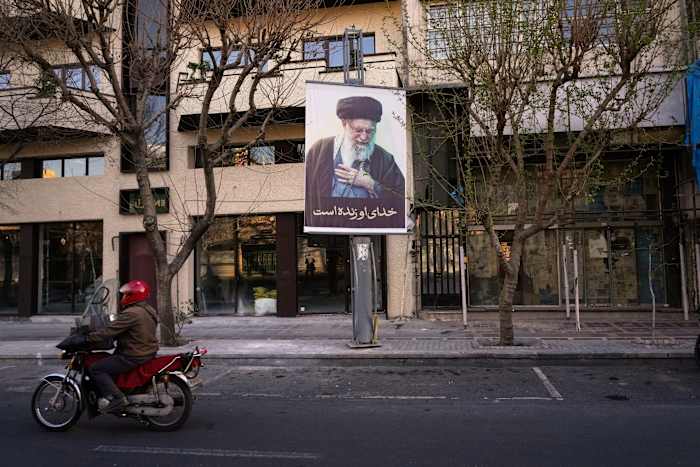
As the sun began to rise over the Alborz mountains, the fireworks stopped. The state-mandated mourning period began. The banners went up—massive, somber portraits of the fallen Leader, draped in black.
The streets were eerily quiet. The shops stayed closed, not out of grief, but out of caution. In Iran, you don't go out when the wind is changing. You wait to see which way the trees lean.
There is a specific kind of exhaustion that comes from living through "historic moments." It is a bone-deep weariness. The people of Iran have been told for forty years that they are at a crossroads. They are tired of the crossroads. They want the road.
The world watches the succession. They look at the names—the sons, the protégés, the aging clerics. They analyze the bloodlines and the loyalties. But they miss the most important detail.
The real story isn't in the assembly that will choose the next Leader. It is in the millions of people who, for the first time in their lives, looked at a blank space where a god-like figure used to be and realized that the space could be filled by something else.
Elham closed her window. The smell of exhaust was returning, but the electricity remained. She went to her desk and opened her laptop. She didn't work on her client’s project. Instead, she opened a blank canvas and drew a single, small green leaf growing out of a crack in a concrete wall. It was a cliché, perhaps. But in a city built on secrets and shadows, the simplest truths are the most radical.
The regime will try to name a successor. They will try to project strength. They will march the soldiers and chant the slogans. But you cannot un-ring the bell of that first night. You cannot erase the memory of the neighbor’s light flicking on.
The giant is dead, and for a few hours, everyone saw that the sky didn't fall. It just stayed there, vast and indifferent, waiting for someone new to claim it.
Elham reached for her phone. Her thumb hovered over the delete button for her encrypted messaging apps—the habit of a lifetime of fear. Then, she stopped. She didn't delete them. She put the phone down, walked to her kitchen, and made a cup of tea. The water boiled, the steam rose, and for the first time in thirty-two years, she didn't look at the portrait on the wall to see if it was watching her.
It was just a piece of paper. It was just ink. It was just a man. Over the mountains, the sun continued its ascent, indifferent to the mourning and the secret joy alike, casting long, sharp shadows over a country that was, for one brief, terrifying moment, holding its breath together.
The silence of the morning wasn't the silence of the grave. It was the silence of a theater right before the curtain rises, when the audience knows the play has changed, but the actors haven't yet found their marks.
The fireworks were gone, but the ash was still on the ground. And in the morning light, even the ash looked like a beginning.