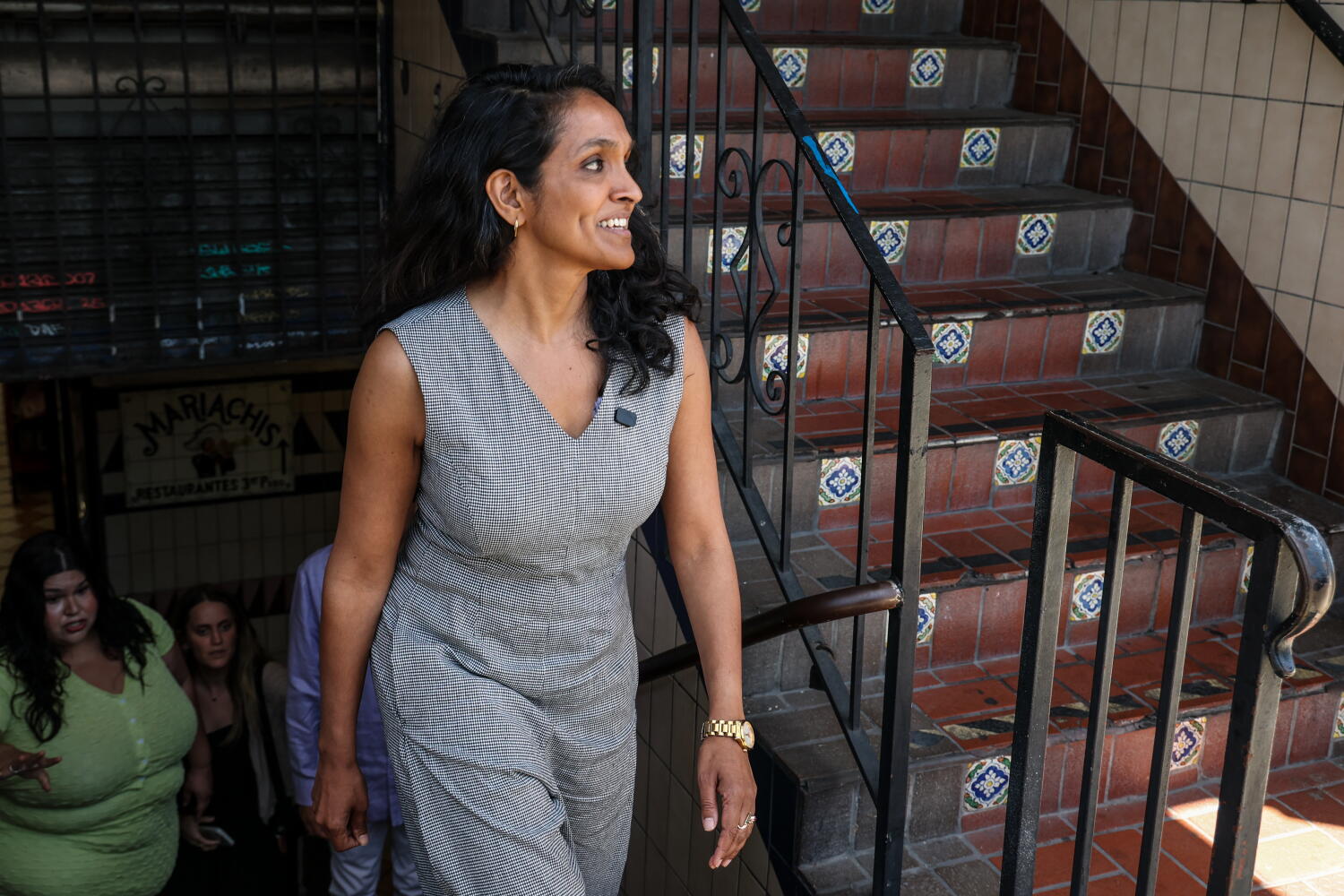
The tacos at midnight taste different when an empire falls.
Picture a crowded living room in Silver Lake, or perhaps a cramped campaign headquarters off Sunset Boulevard, where the air smells like stale coffee, warm corn tortillas, and the particular, electric sweat of twenty-something canvassers who haven’t slept since Tuesday morning. Outside, the neon hum of Los Angeles stretches toward the San Gabriel Mountains, indifferent as always. Inside, someone refreshes a browser tab on a laptop balanced precariously on a stack of voter registration clipboards.
Silence. Then, a scream that rattles the windowpanes.
Nithya Raman had done it. In 2020, a former urban planner and grassroots organizer had unseated David Ryu, an entrenched incumbent in Los Angeles City Council District 4. And four years later, in March 2024, facing an even steeper uphill climb after redistricting carved away much of her progressive base and handed her a sprawling, wealthier, more conservative slice of the San Fernando Valley, she did it again. She beat back a ferocious, well-funded challenge from Ethan Weaver, a deputy city attorney backed by police unions, real estate developers, and—most tellingly—the heavy artillery of Los Angeles’s established Latino political machine.
To understand why that laptop screen caused a tremor that shook City Hall to its foundations, you have to look past the ballot totals. You have to look at the ghost in the machine.
For decades, the political math in Los Angeles seemed carved into granite. Demographics were destiny. As the city’s Latino population grew into a decisive plurality, a tight-knit network of labor leaders, state lawmakers, and Eastside power brokers built a formidable, disciplined apparatus. They operated on a simple, unspoken covenant: loyalty was rewarded with access, endorsements were traded like currency in smoke-free backrooms, and no outsider—especially not an academic-turned-activist from India with a background in tenants’ rights—was supposed to waltz into City Hall and rewrite the rules.
Columnist Gustavo Arellano, writing in the Los Angeles Times, captured the seismic shock of Raman’s triumph in plain, unsparing terms. Her victory wasn't just a local win for democratic socialism or progressive housing policy. It was a resounding rebuke to L.A.’s Latino political establishment.
Wait. Let that sink in.
Why would a South Asian woman winning a district stretching from Koreatown to Sherman Oaks represent a crisis of legitimacy for Latino political bosses?
The Illusion of the Monolith
To see the cracks in the foundation, we need to leave the press conferences and walk down a residential street in Reseda or Van Nuys on a blistering July afternoon. Let us invent a composite character—we will call her Elena—to stand in for thousands of real voters whose frustration rarely makes the evening news.
Elena is thirty-four. Her parents immigrated from Jalisco in the late eighties, worked double shifts in garment factories and restaurant kitchens, and scraped together enough money to buy a modest stucco duplex in the Valley. Elena went to Cal State Northridge. She works in healthcare administration. She pays two thousand four hundred dollars a month for a one-bedroom apartment three miles from her parents' house because she cannot afford to buy in the neighborhood where she grew up.
When mailers arrive in Elena’s mailbox bearing the smiling faces of veteran Latino politicians endorsing candidates who promise "law and order" and oppose tenant protections, Elena does not feel represented. She feels managed.
Think of the old political machine like a vintage jukebox in a corner diner. For forty years, the owners kept the same records spinning inside—anthems of ethnic solidarity, union pride, and incremental progress. Those songs meant something profound in the 1980s and 1990s, when figures like Gloria Molina and Antonio Villaraigosa shattered glass ceilings and forced an indifferent Anglo power structure to share the table.
The music was revolutionary once.
Today, however, the needle is stuck in the groove, scratching out the same tired melody while the diner catches fire.
When the 2022 City Hall leaked audio scandal erupted—exposing three powerful Latino councilmembers and a top labor leader trading racist remarks and scheming to manipulate redistricting maps to hoard power—the jukebox didn't just skip. It exploded. The tapes stripped away the moral veneer of the establishment, revealing a cartel obsessed with protecting its turf at the expense of Black, Indigenous, and progressive constituents—and even working-class Latinos who dared to step out of line.
Nithya Raman was one of the targets on those tapes. The insiders mocked her, plotted to weaken her district, and treated her brand of movement politics as an existential threat to their fiefdom.
They drew the lines to defeat her. They poured millions of dollars into independent expenditure committees to bury her in attack ads. Prominent Latino officials lined up behind Ethan Weaver, betting that institutional muscle and fear-mongering about homelessness would carry the day.
Instead, they handed Raman the very weapon she needed to prove her point.
Why Voters Stopped Obeying the Endorsement Slate
Ask any political consultant in Sacramento or downtown L.A. how to win a municipal race, and they will recite the same catechism: raise early money, lock down the Los Angeles County Federation of Labor, secure the blessings of the county supervisors and state assemblymembers, and flood mailboxes with glossy slate cards.
It is a formula built on top-down obedience. It assumes voters are passive consumers waiting for trusted elders to tell them which box to check.
Consider what happens next when a candidate refuses to play by that script.
Raman didn't win because she outspent the establishment; she was heavily outgunned by outside PAC money. She won because she built an army of volunteers who knocked on doors in triple-digit heat, had twenty-minute conversations on front porches about rent stabilization and mental health crisis response, and treated voters like adults capable of weighing complex trade-offs.
Let us be brutally honest about the stakes here. Homelessness in Los Angeles is not an abstract policy debate. It is visceral, heartbreaking, and infuriating. If you live in District 4, you step over tents on your way to buy groceries. You see human misery rotting under freeway overpasses while billions of dollars in bond measures seem to evaporate into bureaucratic ether.
Voters were angry, scared, and desperate for change. The establishment bet that anger would drive residents into the arms of a prosecutor promising sweeps and handcuffs. They assumed that framing Raman as soft on crime and overly sympathetic to unhoused neighbors would be fatal.
They misread the room entirely.
Many residents looked at the sweep-and-arrest playbook that City Hall had used for decades and asked a devastatingly simple question: If criminalizing poverty actually worked, wouldn't the sidewalks be clear by now?
By championing non-police crisis response teams, permanent supportive housing, and strict tenant protections to stop families from falling into homelessness in the first place, Raman offered something the establishment had forgotten how to sell: coherence. Even voters who disagreed with her on specific tactics recognized that she was actually showing up, listening, and attempting to fix the root cause rather than sweeping human beings three blocks over into someone else’s district.
The Generation Gap Nobody Wants to Measure
There is a quiet civil war unfolding inside Latino politics across California, and Raman’s re-election dragged it into the fluorescent light of day.
On one side sits an older guard forged in the battles of the Chicano movement and traditional machine politics. Having fought tooth and nail to capture institutional power, they guard it with fierce, sometimes paranoid intensity. To them, unity means falling in line behind the anointed successor. Critique from the left feels like ingratitude; coalition-building outside traditional channels looks like treason.
On the other side is a multiracial, younger coalition of renters, service workers, teachers, and disillusioned professionals who see class and housing affordability—not ethnic loyalty—as the defining fault lines of their lives.
Let us return to our hypothetical voter, Elena, standing at her kitchen counter with a stack of campaign flyers. One flyer features a state senator whose last name sounds like her grandfather’s, urging her to vote against Raman. Another flyer, handed to her by a twenty-two-year-old organizer who spoke Spanish with a slight Valley accent and stayed to talk about the Ellis Act, outlines Raman’s fight to keep corporate landlords from evicting seniors.
Elena did not vote against her heritage. She voted for her survival.
When Gustavo Arellano pointed out that Raman’s victory was a rebuke to the Latino establishment, he was naming a truth that terrified career politicians from Boyle Heights to Pacoima. The old slate cards have lost their magic. Endorsements from officials who take developer checks while voting against renter protections no longer carry moral authority with a generation drowning in debt and priced out of its own hometown.
I remember standing outside a polling place in East Hollywood a few election cycles back, watching an older precinct captain hand out sample ballots pre-marked with the establishment’s chosen candidates. A young Latina woman took the paper, glanced at the names, smiled politely, and dropped it straight into the blue recycling bin by the curb before walking inside to vote. No argument. No speech. Just a quiet, unmistakable dismissal.
That single gesture contains the entire political trajectory of modern Los Angeles.
The Anatomy of a Misreading
How could smart, seasoned political operatives get it so wrong?
Hubris. Pure, unfiltered hubris.
When you spend twenty years inside the bubble of City Hall—attending the same fundraising galas at the Biltmore, trading favors with the same lobbyists, reading the same insider newsletters—you begin to confuse your network with the electorate. You start believing that because five power brokers agree on a candidate over lunch, five hundred thousand voters will automatically ratify their choice in March.
Redistricting was supposed to be the ultimate insurance policy. By shifting District 4’s boundaries to drop progressive strongholds like Silver Lake and Los Feliz while absorbing more conservative neighborhoods in the Valley, the architects of the map thought they had engineered Raman’s political obituary.
They forgot two critical variables.
First, political geography is not static. The San Fernando Valley is no longer the sleepy, homogenous suburb of the 1970s. It is denser, younger, more diverse, and increasingly squeezed by the same housing crisis that radicalized voters in the urban core. A homeowner in Sherman Oaks might worry about street encampments, sure—but their twenty-eight-year-old kid is sleeping in the guest bedroom because studio apartments cost two thousand dollars a month.
Second, authenticity cannot be manufactured by a direct-mail firm. Voters have developed an almost supernatural radar for political theater. When establishment politicians wrapped themselves in the language of working-class solidarity while siding with police unions and real estate interests to crush a progressive woman of color, the hypocrisy was blinding.
Raman didn't hide her ideology. She didn't triangulate or soften her edges to appease the editorial boards. She leaned into her record, admitted how painfully slow municipal government can be, and asked voters for the time to finish what she started.
Vulnerability, it turned out, was stronger than bravado.
What Breaks When the Dam Gives Way
Make no mistake: the old guard is not going to pack its bags and leave City Hall tomorrow. Institutional machines have deep pockets, long memories, and tremendous staying power. They still control vast swaths of state legislative seats, labor councils, and county boards.
Yet something irreversible happened when the final votes were tallied in District 4.
The spell broke.
For years, aspiring progressive candidates—especially young Latino, Black, and Asian organizers—were told to wait their turn. Pay your dues, the elders whispered. Carry water for the incumbents, don't rock the boat, and maybe in fifteen years, we’ll let you run for an open seat.
Raman’s back-to-back victories proved that waiting your turn is a sucker’s game. You do not need permission from the gatekeepers if you can build a direct relationship with the people living behind the gate. You can survive a redistricting ambush. You can withstand millions of dollars in smear campaigns. You can beat the machine on its own turf without becoming a cog inside it.
Across Los Angeles, from council districts in the Northeast to neighborhoods in South L.A., young organizers watched Raman’s campaign headquarters erupt in celebration and took notes. They saw a blueprint for multiracial, working-class solidarity that refuses to be divided by cynical appeals to tribalism.
Think back to that living room in Silver Lake at midnight, the laptop glowing in the dim light, the cold tortillas on paper plates, the exhausted canvassers hugging each other with tears streaking down their faces.
Outside, the city was sleeping, unaware that the tectonic plates beneath its politics had just shifted another inch. Inside the marble corridors of City Hall, though, the lights stayed on late—and for the first time in a generation, the people holding the keys could hear footsteps coming up the stairs.


