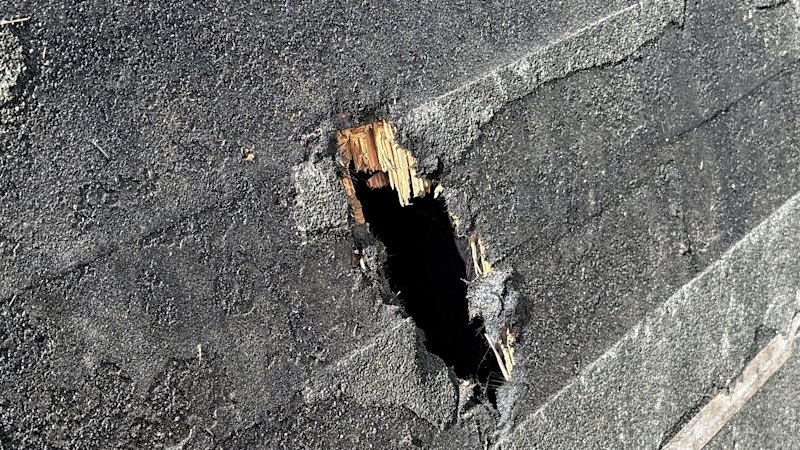
The ceiling did not fall because of a leaky pipe or a rotted beam. It exploded.
One afternoon in Hopewell Township, New Jersey, a quiet suburban home became the bullseye for a projectile that had been traveling through the freezing, silent void of space for 4.5 billion years. Imagine sitting in your living room, perhaps thinking about dinner or bills, when a thud vibrates through your floorboards—a sound too heavy to be a bird, too violent to be a stray baseball.
When the homeowners walked into the room, they found a shattered ceiling, a gouged floor, and a strange, metallic rock resting in the debris. It was roughly the size of a coffee mug, weighing a little over a pound. It was still warm.
Most people would call a contractor. Some might call the police. But the swift actions taken in that room during the subsequent twenty minutes inadvertently saved a pristine record of the dawn of our solar system.
The Fragility of Deep Time
Space is an exceptional preserver, but Earth is an aggressive destroyer. The moment a piece of the cosmos breaches our atmosphere, our planet begins to erase its history. Oxygen corrodes it. Rainwater dissolves its ancient salts. Even the invisible oils on a human palm can seep into the porous stone, contaminating a multi-billion-year-old chemical diary with modern biological noise.
The rock that tore through the Hopewell Township home belongs to a vanishingly rare class of space debris known as a CM1/2 carbonaceous chondrite. To understand what that means without getting bogged down in geological jargon, think of it as a time capsule from the era before Earth even existed. It is a clump of the original dust cloud that collapsed to form our sun and planets.
But these specific rocks are essentially cosmic sponges. They are packed with ancient carbon compounds and clay minerals forged by liquid water long before the Earth had oceans.
Because they are so absorbent, finding one on the ground weeks or months after it falls is usually a heartbreak for scientists. By then, the rock has drank in the local weather. It has become a hybrid of outer space and New Jersey topsoil.
The homeowners, guided by sheer intuition or perhaps a subconscious respect for the bizarre object, did something extraordinary: they kept it clean. They avoided handling it carelessly, ensuring it was isolated quickly. When Peter Jenniskens, a meteor astronomer from the SETI Institute and NASA’s Ames Research Center, arrived on the scene, he realized they were looking at one of the cleanest, most unpolluted samples of primordial space matter ever recovered on Earth.
Brine from an Alien World
Consider what happens next when such a pristine specimen is brought into a clean room. Scientists at institutions across the country began slicing into the rock, peer into its molecular structure for a study published in Science Advances.
What they found inside was not just dry stone. Locked within the matrix of the meteorite were chemical signatures of a chaotic, watery past. The data revealed the presence of ancient, brine-like fluids—salty water trapped inside the rock from when it was part of a larger, parent asteroid billions of years ago.
This is not a metaphor. The rock contained the actual, physical remnants of water that flowed in the darkness of the early solar system, preserved through the cataclysmic impact of its descent.
For decades, humanity has wrestled with a profound, quiet question: Where did we come from? How did a barren, molten rock spinning around a young star transform into a living planet covered in blue oceans and thinking creatures?
The Hopewell Township meteorite does not contain alien microbes. It does not prove that life originated in the stars. But it does something arguably more grounded and terrifyingly beautiful. It proves that the raw ingredients—the liquid water, the complex carbon molecules, the prebiotic chemistry required to spark the very first biological reactions—were already floating around in the dark, waiting to be delivered.
The cosmic ledger shows that these ingredients were distributed across the solar system, ready to seed any planet fortunate enough to provide a hospitable cradle.
The Human Cost of Discovery
It is easy to look at scientific breakthroughs through the lens of immaculate laboratories and pristine data charts. We forget that these revelations often require a collision with the messy reality of human lives.
A family had their home violated by a cosmic bullet. They experienced the sudden, jarring realization that the boundary between our fragile terrestrial lives and the violent infinity of the universe is much thinner than we like to admit. We build roofs to keep out the rain, never expecting them to be pierced by rocks moving at miles per second.
Yet, because that specific roof broke, our collective understanding of deep time shifted.
The study of this rock allows us to feel, however briefly, the texture of the primitive solar system. It bridges the gap between the abstract math of astrophysics and the tactile reality of a warm stone sitting on a ruined floorboards.
The hole in the ceiling has likely been patched by now. The drywall has been replaced, the dust swept away, and the quiet rhythm of suburban life restored. But the stone that caused the chaos remains preserved in a vault, its trapped droplets of ancient brine finally telling the story of how our world began.