Listen.
Before the air-defense sirens begin their familiar, nauseating wail over the Sea of Azov, there is a sound that does not belong to nature. It is not the rhythmic slap of dark water against concrete pilings, nor the low diesel rumble of a supply train creeping westward under cover of darkness. It is a thin, high-pitched, mechanical buzz, multiplied until the sky itself seems to vibrate like a plucked wire.
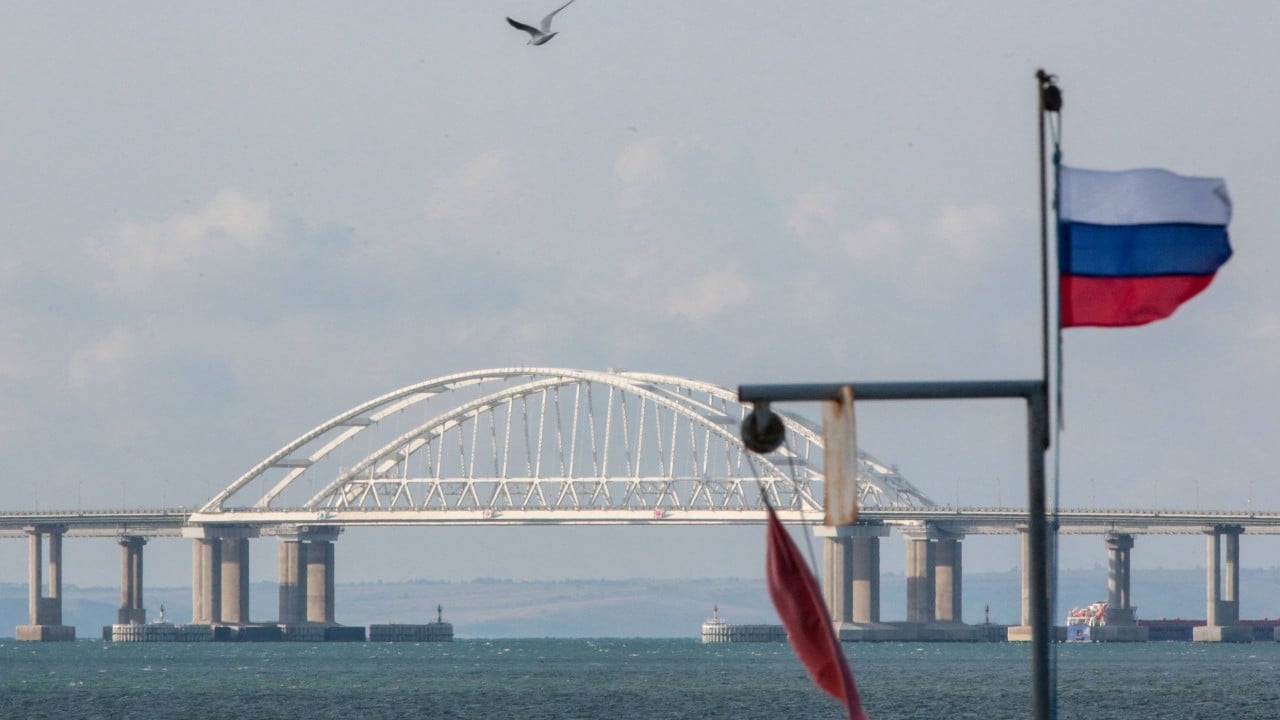
To understand what happened over the Kerch Strait when 1,336 drones converged on the twelve-mile span of steel and concrete linking mainland Russia to occupied Crimea, you have to stop looking at maps. Maps make war look tidy. On a screen, the Crimean Bridge is just a thin gray line bridging two bodies of water, a logistical artery marked with neat directional arrows.
On the ground, in the salt-heavy dark of 3:00 AM, it is something else entirely.
Consider a hypothetical Russian radar operator—let’s call him Aleksei, stationed in a cramped, fluorescent-lit van near Taman on the eastern shore. Aleksei has spent the last two years staring at phosphor-green sweeps, trained to spot the clean, fast signatures of ballistic missiles or the heavy, unmistakable profiles of fighter jets. His job is built on an old, comforting assumption about warfare: that expensive things are destroyed by even more expensive things, and that you can always count the incoming threats on two hands.
Then the screen blooms.
Not with ten dots. Not with fifty. One thousand three hundred and thirty-six.
The Arithmetic of Exhaustion
Modern air defense is fundamentally a math problem disguised as engineering. Every interceptor missile sitting in a launcher tube along the Crimean coast carries a price tag measured in hundreds of thousands—sometimes millions—of dollars, alongside months of precision manufacturing. A long-range unmanned aerial vehicle, assembled from carbon fiber, commercial electronics, and a warhead packed into a fuselage no larger than a dining table, costs a fraction of that.
When 1,336 drones enter a single operational corridor in a sustained wave, they are not merely flying toward a target; they are executing an economic and psychological ambush.
Think of it like trying to stop a swarm of hornets with a sniper rifle. You might have the finest optics, the steadiest hand, and the most lethal ammunition ever forged, and you might even hit the first twenty hornets out of the air. You will still get stung.
For Aleksei in that radar van, the crisis is not a single explosion. It is cognitive overload. Which blip on his screen is a cheap foam decoy carrying nothing more than a radar reflector to trick his battery into firing? Which blip is a surveillance node streaming live telemetry back to an operator hundreds of miles away? And which blip, flying twenty feet above the whitecaps to hide beneath the radar horizon, carries the heavy shaped charge aimed directly at a bridge pier?
Every second he hesitates, the swarm closes another five hundred meters. Every time he fires, he depletes a magazine that cannot be reloaded before dawn.
Concrete, Steel, and Symbolism
To grasp why Ukraine would commit over thirteen hundred unmanned aircraft to a single coordinated strike against this specific structure, you have to look beyond the rebar and asphalt.
Built at a staggering cost of roughly $3.7 billion and opened with theatrical fanfare in 2018, the Kerch Strait Bridge was never just a highway and a railway. In Moscow, it was cast in concrete as a permanent monument to the 2014 annexation of Crimea—a physical declaration that the peninsula had been welded onto the Russian mainland forever. For years, its twin arches stood as the ultimate symbol of political permanence.
Yet in war, symbols double as bottlenecks.
Geography is stubborn. Crimea is connected to the southern Ukrainian mainland by narrow, exposed land corridors that sit well within range of precision artillery and short-range strike systems. That leaves the Kerch Bridge as the primary heavy-lift umbilical cord feeding fuel, ammunition, armored vehicles, and engineering equipment into the peninsula. Every tank shell fired on the southern front, every liter of diesel burned by a logistics truck in Sevastopol, likely crossed those twelve miles of open water.
I have stood on coastal causeways in winter when the wind comes off the water hard enough to sting your eyes, and the first thing you notice is how exposed everything feels. There is no cover on a sea bridge. There is no hillside to duck behind, no forest canopy to break up a silhouette. A twelve-mile span over open water is an engineering triumph in peacetime and a shooting gallery in war.
Previous strikes on the bridge—the devastating truck bomb in October 2022 that collapsed sections of the roadway, and the surface-drone attack in July 2023 that buckled the deck—proved the structure could be hurt. Each time, repair crews worked around the clock under floodlights, patching spans, erecting submerged barriers, and ringing the approaches with barges, smoke generators, and layers of surface-to-air missile batteries. Moscow turned the strait into one of the most heavily defended patches of airspace on earth.
The 1,336-drone barrage was the answer to that fortress.
Inside the Swarm
We tend to imagine drone warfare as a solitary pilot wearing goggles in a darkened bunker, steering a single aircraft onto a target like a video game. At the scale of a thousand-plus platforms, that image collapses. Human thumbs cannot fly a thousand planes at once.
Instead, what crossed the Black Sea and the Sea of Azov was a symphony of autonomy, pre-programmed waypoints, and distributed coordination. Imagine a flock of starlings wheeling over a marsh at dusk—thousands of individual birds moving without a central leader, each reacting to its neighbors while following an overarching seasonal pull. Now replace the birds with delta-wing airframes guided by inertial navigation systems immune to GPS jamming, optical terrain-matching sensors that recognize coastlines in the dark, and algorithms trained to probe gaps in radar coverage.
Let’s trace the timeline of a saturation attack like this, separating the verified mechanics of modern drone warfare from the fog of combat.
First come the pathfinders and decoys. Launched hours earlier from scattered, mobile positions deep inside Ukrainian territory—fields, abandoned industrial yards, stretches of rural highway—the initial wave approaches from multiple compass bearings. Their job is not necessarily to hit the bridge. Their job is to force the defenders to turn on their radars, revealing the exact coordinates of every Pantsir, Tor, and S-400 battery guarding the strait.
The moment those radar emitters light up, the battlefield changes.
Anti-radiation seekers and secondary strike waves immediately have a map of the defense network. Meanwhile, tracer fire begins stitching orange lines into the black sky. Heavy machine guns chatter from patrol boats anchored near the pilings. Surface-to-air missiles streak upward in blinding arcs of white smoke, detonating miles out over the water with dull, chest-thumping booms that rattle windows in Kerch and Taman alike.
For the civilians living along both shores, the night dissolves into an endless strobe light. Imagine waking up at three in the morning to your bedroom curtains flashing bright orange every few seconds, the floorboards humming from the concussion of interceptors launching a mile away, your phone lighting up with frantic messages from relatives asking if the bridge is still standing. You don't know whether to shelter in the hallway or pack a bag by the front door. Uncertainty, in a war zone, is heavier than fear.
The Invisible Stakes
What happens when even five percent of a 1,336-drone wave slips through a saturated defense shield?
Do the math. Five percent of 1,336 is roughly sixty-seven drones.
Even if half of those are decoys or miss in the blinding chemical smoke deployed by Russian defense vessels to obscure the bridge's arches, dozens of high-explosive warheads still reach the concrete deck, the railway tracks, the power substations, and the critical support piers.
Railway bridges are notoriously unforgiving structures. While an asphalt highway can sometimes be patched with steel plates in a matter of days, a rail line carries immense, concentrated axle loads. Heat from burning fuel tankers warps steel girders, stripping them of their structural temper. Shrapnel severs signaling cables and overhead catenary lines. A single damaged expansion joint or shifted pier cap can force engineers to halt heavy freight traffic for weeks while divers inspect underwater pilings and metallurgists test the concrete for micro-fractures.
And when the trains stop rolling across the Kerch Strait, the ripple effects travel hundreds of miles inland.
Fuel reserves at military airfields in Crimea begin ticking downward without replenishment. Artillery units along the southern front have to ration shells, firing five rounds where they used to fire twenty. Logistics planners in Moscow are forced to reroute thousands of tons of supplies onto longer, slower overland rail lines running through occupied southern Ukraine—routes that sit far closer to Ukrainian rocket artillery and partisan sabotage.
That is the invisible genius of strategic infrastructure strikes. You do not need to drop an entire twelve-mile bridge into the sea to break its back. You only need to turn a reliable artery into a flickering, unpredictable hazard that drains time, money, and air-defense missiles every single week.
A New Grammar of War
Step back from the smoke over the strait for a moment, because the implications of a 1,336-drone barrage reach far beyond Eastern Europe. Every military planner in Washington, Beijing, Taipei, and Brussels is studying the telemetry of that night with quiet unease.
For eighty years, since the aircraft carriers of the Pacific War replaced the battleship, military dominance belonged to the nation that could build the biggest, most sophisticated platforms. A single destroyer, a single stealth bomber, a single hardened airbase represented decades of industrial might.
Massed, low-cost unmanned systems have turned that hierarchy upside down.
When an attacker can launch over a thousand precision-guided aircraft in a single night from trucks parked in barns and clearings, no fixed piece of infrastructure is truly invulnerable. Not a bridge. Not a power grid. Not an oil refinery. Not a naval port. Defense becomes an asymmetrical trap: the defender must be right 1,336 times in a row, while the attacker only needs to be right twenty times.
There is something deeply unsettling about watching warfare automate at this scale. When I look at the trajectory of these strikes—from dozens of drones in 2022, to hundreds in 2024, to over thirteen hundred in a single coordinated wave—I am struck not by the science-fiction sheen of it all, but by its relentless, industrial hum. There is no cavalry charge here. There is no heroic dogfight in the clouds. There are only workshops assembling carbon-fiber wings in shifts, software engineers refining guidance code on laptops, and dark skies filling with machines programmed to fly until they run out of fuel or find concrete.
Dawn Over the Water
By the time the first gray light leaks over the Sea of Azov, the acoustic storm finally subsides. The air smells sharply of cordite, burned diesel, and the thick, oily chemical fog pumped out by harbor defense boats.
Down on the water, patrol craft weave slowly between floating fragments of shattered composite wings and blackened life jackets. Up on the bridge deck, emergency crews in high-visibility vests step carefully around scorched craters, twisted guardrails, and tangled knots of melted fiber-optic cable, measuring gaps with steel tapes while helicopters thump overhead.
Traffic is halted. Columns of idling trucks stretch back for miles along the highway approaches on both shores, their drivers leaning against warm fenders, smoking cigarettes and squinting toward the hazy silhouette of the central arches.
The bridge is still there, rising out of the slate-gray water just as it did the evening before. Yet nothing about it feels permanent anymore. Out beyond the horizon, in workshops lit by bare bulbs, the next thousand wings are already curing in their molds.


