For decades, investigators and journalists treated satellite imagery as the final anchor of truth. If a photo showed a bombed-out hospital or a military convoy in a remote desert, you could cross-reference it with mapping tools to verify if it actually happened. That baseline reference layer just cracked wide open.
When Google introduced generative image editing capabilities into Google Earth, allowing users to type a single sentence and alter real-world maps with photorealistic synthetic renderings, the company likely hoped for gasps of creative wonder. Instead, they handed bad actors an elite weapon for mass deception. Researchers wasted no time proving how fragile our digital reality has become.
How the Google Earth AI Feature Broke Verification Standards
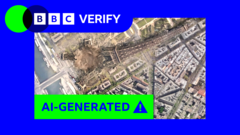
Within hours of the rollout, online researchers took to platforms like X to test the limits of the new mapping tool. The results weren't just concerning; they were alarming. By simply typing text prompts into the system, testers successfully embedded fabricated nuclear facilities onto real terrain in Iran, staged refugee encampments along the Mexico border, and generated hyper-realistic crash scenes on ordinary streets in Amsterdam.
The core danger stems from context anchoring. Traditional stand-alone image generators often leave subtle artifacts, such as warped lighting, floating objects, or unnatural textures that give away their synthetic origins.
When you inject an AI-generated object directly into a native Google Earth coordinate, those visual warnings disappear. The fake element inherits the authentic shadows, lighting physics, and surrounding topography of the actual satellite data. It looks real because the foundation underneath it is real.
Open-source intelligence investigators who rely on these maps to monitor active war zones and human rights abuses are sounding the alarm. Sam Stockwell, a senior research associate at the Alan Turing Institute, noted that building a generative tool directly into the industry's primary verification benchmark corrupts the very instrument used to expose fakes.
Why Watermarks Won't Stop the Misinformation Wave
Google has defended the release by emphasizing built-in safety parameters. Every image generated using the tool includes SynthID, an invisible digital watermarking system designed to tag synthetic media. The tech giant points out that users can run suspicious images through Google Lens or Gemini to check their origin.
That defense relies on a flawed assumption. Casual social media users scrolling through a crisis feed don't pause to run forensic checks on every piece of visual media they encounter. Panic and outrage travel faster than verification workflows. By the time a digital watermark is flagged or a fact-checker issues a correction, the altered image has already shaped public opinion, influenced market trades, or inflamed geopolitical tensions.
Furthermore, researchers demonstrated that safety filters intended to block harmful prompts failed multiple baseline tests. Prompts regarding sensitive geopolitical flashpoints slipped past restrictions without triggering safety blocks or warning labels.
What This Means Moving Forward
We are entering an era where seeing is no longer believing, and trusted geographic infrastructure can no longer serve as an objective witness. If you consume news online, you must adopt a higher level of skepticism toward localized imagery. Check multiple independent reporting streams, look for institutional confirmation, and assume that any dramatic photo pulled from a mapping platform can be fabricated in seconds.
Protecting digital truth requires moving away from single-source validation. Journalists, researchers, and everyday internet users must demand stricter cryptographic verification standards for geospatial data before convenience completely destroys our shared reality.