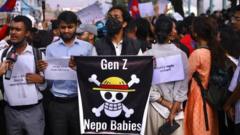
The lazy consensus currently suffocating the Nepali press is that the "Nepo Baby" is a dying breed. The narrative is as seductive as it is naive: a Gen Z uprising on Discord toppled a government, the 2025 protests burned down the old guard’s houses, and now, magically, the era of dynastic entitlement has evaporated into the Himalayan mist.
It is a comforting fairy tale. It is also a total delusion.
What the amateur pundits miss is that political capital in Nepal isn't just about a last name; it is about the machinery of the "revolving door" that has governed this country for thirty years. You don't dismantle a three-decade-old oligarchy with a hashtag or a viral video of a politician’s son at a Hilton. To believe that the "Nepo Kids" have vanished just because they’ve scrubbed their Instagram feeds is to fundamentally misunderstand how power actually regenerates.
The Professionalization of the Progeny
Critics point to the 2022 elections and the 2025 uprising as the "end" of the dynasty. They cite the rise of the Rastriya Swatantra Party (RSP) and the fall of K.P. Sharma Oli as proof that the public has rejected the silver-spoon brigade.
But look closer at the mechanics. The "Nepo Kids" haven't left; they’ve pivoted. They’ve moved from the "flaunting wealth" phase to the "technocratic infiltration" phase. I’ve seen this play out in corporate boardrooms across South Asia—when the brand becomes toxic, you don't close the shop; you rebrand the CEO.
The new strategy for the political elite isn't to run their children on a platform of "My Dad was PM." It’s to position them as "Policy Experts" and "Independent Consultants" who just happen to have the keys to the state treasury. They are the invisible bridge between the old-guard corruption and the new-age "transparency" rhetoric.
The RSP Illusion: Trading One Cult for Another
The "Anti-Nepo" movement’s champion, the RSP, is marketed as the antidote to dynastic rot. But let’s be brutally honest: replacing a dynasty of blood with a dynasty of personality is a lateral move, not an upgrade.
While the youth were voting on Discord channels, the RSP was already showing signs of the same structural defects it claimed to hate. The party's internal power struggle between Rabi Lamichhane and Balendra Shah is not a debate over policy; it’s a fight for the crown. When a party becomes a "one-man show," as insiders have already labeled it, it creates a new type of nepotism—one based on loyalty to the Leader rather than the Party.
- The Dependency Trap: The traditional parties (NC, UML, Maoist) have deep-rooted patronage networks that reach every village.
- The Funding Gap: While Gen Z is great at organizing protests, they are terrible at funding them. The old dynasties still control the bank accounts of the business class.
- The Skillset Myth: Being a "rapper-mayor" or a "social media influencer" is a great way to win an election. It is a terrible way to manage a $40 billion economy facing a massive trade deficit.
The Cost of the "Clean" Candidate
We are obsessed with the "purity" of the candidate. We want them to have zero ties to the past. But in a country where every state institution—from the Nepal Oil Corporation to the Land Revenue Office—is built on a foundation of rent-seeking, a "clean" candidate is often an "ineffective" candidate.
Imagine a scenario where a perfectly independent, non-nepo youth leader takes the PM's office tomorrow. Within forty-eight hours, they would realize that the civil service is staffed by appointees from the Deuba, Oli, and Dahal eras. The "Deep State" of Nepal is not a conspiracy; it is a human resources reality.
The "Nepo Kids" aren't the problem; they are a symptom of a system where the "cost of entry" into politics is so high that only those with inherited capital can play. By focusing on the faces of the children, we are ignoring the architecture of the house.
The Brutal Reality of the 2026 Ballot
The upcoming elections are being framed as a "generational showdown." This is a mistake. It is an audition.
The traditional parties are not stupid. They are currently absorbing the energy of the 2025 protests. They are expelling "rebel" candidates not because they want reform, but because they need to consolidate power under a unified banner to survive the RSP surge.
The "Nepo Kids" are currently watching from the sidelines, waiting for the "Independent" fervor to burn itself out. They know that when the high of the revolution fades and the reality of garbage collection, inflation, and power outages sets in, the public will look for "experience." And who has the most experience in the halls of power? The people who grew up in them.
Stop Looking for Heroes
The obsession with finding a "saviour" who isn't a "Nepo Baby" is just another form of the same mental trap. It assumes that the individual matters more than the institution.
If you want to disrupt Nepal’s political landscape, stop focusing on who the candidates' fathers are and start looking at how the parties select their candidates behind closed doors. The 2025 uprising showed that the youth can burn down a building, but it didn't show they can build a party that doesn't eventually look exactly like the ones they torched.
The dynasties haven't gone anywhere. They’ve just gone quiet. They are waiting for you to get bored of the "new" faces so they can walk back through the front door, carrying the same old keys.
Would you like me to analyze the specific funding structures of the "New" parties to see if they are actually being backed by the same old-guard business interests?


