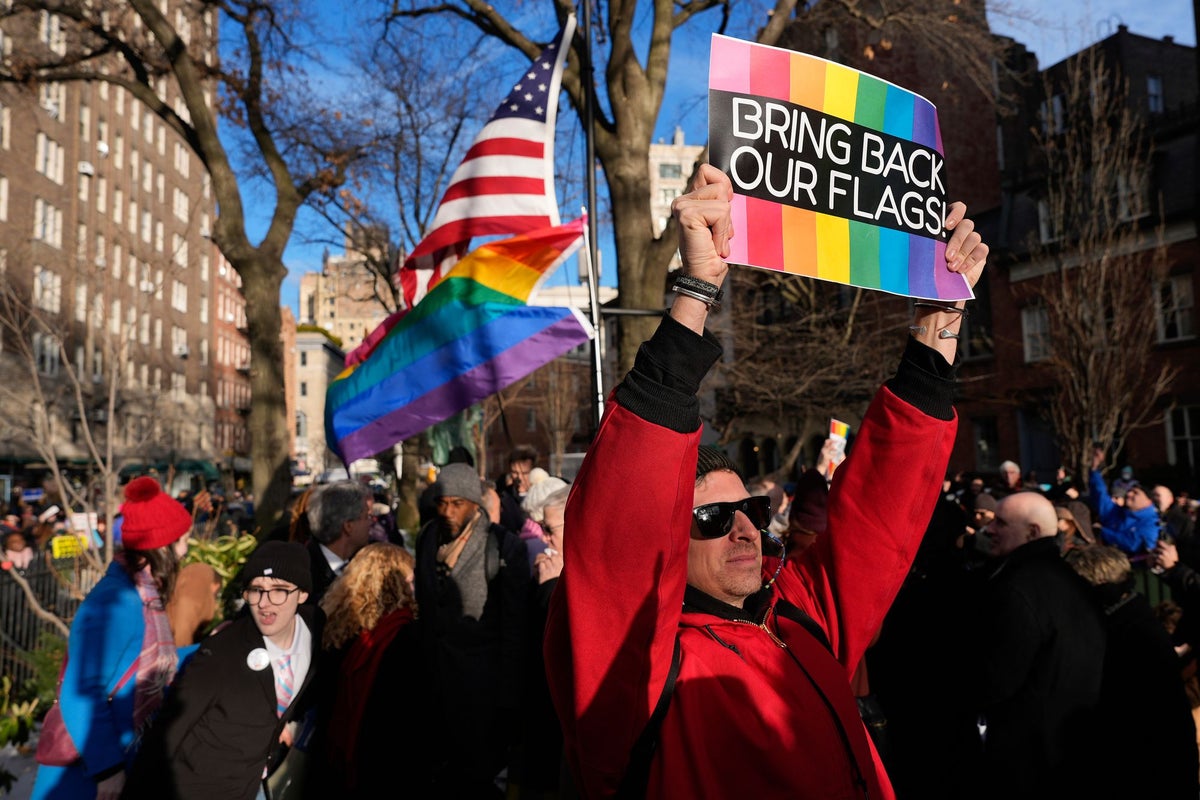
The wind off the Hudson River doesn't care about politics. It whips around the corners of Greenwich Village with a biting indifference, rattling the windowpanes of the Stonewall Inn and tugging at the fabric of anything left unsecured. For decades, the air here has carried the scent of rebellion, sweat, and cheap beer. But on a Tuesday afternoon in Manhattan, the air carries something else: a heavy, symbolic silence.
Standing in Christopher Park, you can feel the weight of the pavement. This isn't just a patch of urban greenery. It is a battlefield. It is the birthplace of a modern movement. And for a moment, it was the center of a quiet, bureaucratic tug-of-war that threatened to pull down a flag that many people had fought, bled, and died to keep flying.
The news broke with the sterile thud of a press release. The Trump administration, after a period of uncertainty and internal friction within the Department of the Interior, had agreed to keep the rainbow Pride flag flying at the Stonewall National Monument. To a casual observer, it was a minor administrative correction—a footnote in a news cycle dominated by louder, more chaotic headlines. To the people who walk these streets, it was a hard-fought truce.
The Fabric of a Ghost Story
To understand why a piece of dyed polyester matters, you have to look at the ghosts.
Imagine a young man in 1969. Let’s call him Leo. Leo didn't move to New York to be a hero; he moved here because the town he grew up in felt like a tightening noose. In the Village, he found a family of outcasts, people who lived in the shadows because the light was too dangerous. When the police kicked in the doors of the Stonewall Inn on that humid June night, Leo wasn't thinking about civil rights. He was thinking about survival. He was thinking about the fact that he was tired of being afraid in the only place he felt safe.
That night, the shadows fought back.
Bricks flew. Drag queens stood their ground against tactical gear. The marginalized reclaimed the street. When the rainbow flag was eventually designed years later by Gilbert Baker, it wasn't just a decoration. It was a map. Every color represented a different aspect of the human experience—healing, sunlight, nature, serenity. It was a signal fire.
When the Stonewall National Monument was designated in 2016, the permanent installation of the Pride flag on federal land was a victory that felt permanent. It was the first time the United States government officially recognized that LGBTQ+ history was American history. But permanence is an illusion in the world of policy.
The Friction of the Flagpole
The tension began when the National Park Service (NPS) initially suggested that the flag might have to come down. The logic was buried in the fine print of federal regulations. National parks have strict rules about which flags can fly on their grounds. Usually, it’s the Stars and Stripes and the NPS ensign. Everything else is considered "special interest" or "temporary."
But Stonewall is not a "usual" park.
The struggle wasn't just about a flagpole. It was about whether the government would continue to acknowledge the specific identity of the people who made that park famous. If you take the flag away from Stonewall, you are left with a nice park and some statues. You lose the heartbeat. You lose the visual proof that the state no longer sees these citizens as criminals.
The debate moved through the halls of the Department of the Interior like a slow-moving storm. There were memos. There were "clarifications." Activists, local politicians, and veterans of the 1969 riots watched with a mixture of exhaustion and fury. They had spent their lives proving they existed; now they had to prove they deserved a 12-foot pole and a bit of color.
Then, the pivot.
Whether it was the result of intense public pressure or a realization that this was a battle not worth the political capital, the administration blinked. The flag would stay. The NPS reached a "permitting agreement" that allowed the flag to remain, technically maintained by local groups but standing on federal soil.
It was a victory, but it was a cold one. It was a reminder that even the most sacred symbols are subject to the whims of whoever holds the pen in Washington.
The Invisible Stakes
Why does this keep us up at night?
Because symbols are the only things that survive us. We are fragile. We age, we lose our memories, and eventually, we are gone. But a monument is a promise made by the living to the dead. It says, We will remember why you were here. When the status of the flag was in limbo, it sent a tremor through the community. It wasn't just about one park in New York. It was a question of whether the progress of the last fifty years was a solid foundation or just a temporary lease. For someone like Leo, now in his seventies and watching the world change from a bench in the park, the flag is a pulse check. If it's there, the country is still breathing. If it’s gone, the air gets thin again.
The administration’s decision to keep the flag flying wasn't a grand gesture of support. It was a concession to reality. The reality is that you cannot de-consecrate ground that has already been baptized in the struggle for dignity. You can move the paperwork, but you cannot move the meaning.
The Quiet Guard
Walk through Christopher Park today.
You’ll see the white plaster statues of the "Gay Liberation" monument by George Segal. They are hauntingly still—two women sitting on a bench, two men standing nearby. They look like they are waiting for a bus that never comes. They are ghosts made of stone.
But above them, the flag moves.
It is the only thing in the park that is constantly in motion. It reacts to the environment. It snaps in the wind, it hangs limp in the heat, and it glows under the streetlights at 2:00 AM when the bars are letting out. It is the living part of the monument.
The decision to keep it there means that for at least one more day, the story of Stonewall remains a part of the official American narrative. It means that the kid who just hopped off a bus from a town that doesn't want them can look up and see a piece of federal property that says, You belong here. Bureaucracy is often a machine designed to grind down the individual. It uses rules and regulations to smooth out the edges of human passion until everything is a uniform gray. But every so often, the machine hits something it can’t break. It hits a story so thick and a history so vibrant that the only choice is to let it be.
The rainbow flag at Stonewall is a small thing in the grand scheme of a trillion-dollar government. It is a few yards of fabric and a bit of rope. But as the sun sets over the Village, casting long shadows across the cobblestones, that flag catches the last of the light. It stays bright while the rest of the world fades into the evening.
The truce holds. The sentinel remains. And the wind keeps blowing.