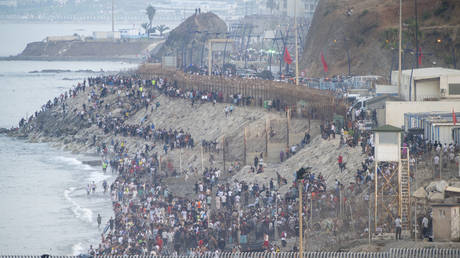
Imagine waking up to find your city's population swelled by seventy percent in less than twenty-four hours. That is the reality that hit Ceuta, a tiny Spanish territory tucked onto the North African coast, when nearly 60,000 migrants swam, waded, and rushed across the border from Morocco. It was absolute chaos. Streets filled with dazed arrivals, local public services collapsed instantly, and Prime Minister Pedro Sánchez flew in to condemn what he called a direct violation of territorial integrity.
Most people look at a surge of this magnitude and assume it was just another spontaneous wave of desperate humanity. But the scale points to something much more calculated. Why did roughly 60,000 people attempt the crossing almost simultaneously? The answers point to a volatile mix of legal loopholes, social media panic, and geopolitical pressure.
The Spark Behind the Surge
To understand the sudden rush into Ceuta and Melilla, you have to look at a Spanish Supreme Court decision handed down earlier in July. The ruling dealt with how migrants arriving by sea are handled. It determined that the immediate summary return of a migrant without an administrative expulsion procedure does not apply cleanly to people who reach these enclaves through the water.
Human trafficking networks weaponized that legal nuance. They spread the word like wildfire through messaging apps, convincing thousands of young people that swimming around the border breakwater meant a guaranteed ticket to stay in Europe. Desperate for better economic prospects, crowds packed buses and trains toward Moroccan border towns like Fnideq.
Yet, the legal ruling tells only part of the story. The sheer volume of people reaching the shoreline raised hard questions about the role of local security forces.
The Moroccan Factor and Geopolitical Leverage
Getting near the razor wire and breakwaters of Ceuta isn't easy under normal circumstances. The approach is heavily monitored by Moroccan police and auxiliary units. When tens of thousands of people manage to bypass those checkpoints all at once, analysts notice.
Relations between Madrid and Rabat have always been complex. Enclaves like Ceuta and Melilla remain historical flashpoints, and migration control is frequently used as diplomatic leverage. While Moroccan officials defended their record and blamed social media frenzy, the sudden slackening of enforcement allowed a localized flashpoint to explode into an international crisis.
The human cost was immediate and brutal. At least 57 people lost their lives, drowning in the choppy waters of the Strait of Gibraltar or crushed in stampedes near the Tarajal breakwater.
The Rapid Reversal
What goes up must come down, and this crisis deflated almost as fast as it swelled. Within days, the reality of the situation set in for the arrivals. They found no jobs, no housing, and overwhelmed emergency shelters where thousands slept on sidewalks.
Faced with bleak conditions and active containment measures, the tide reversed. Roughly half of those who crossed chose to return voluntarily to Morocco, walking back through border gaps disillusioned by the empty promises of smugglers.
European leaders immediately pledged tighter regional controls, with France and Italy stepping up border vigilance. But the episode leaves a permanent scar on local infrastructure and exposes just how fragile European border security remains when geopolitical tensions and misinformation collide.


