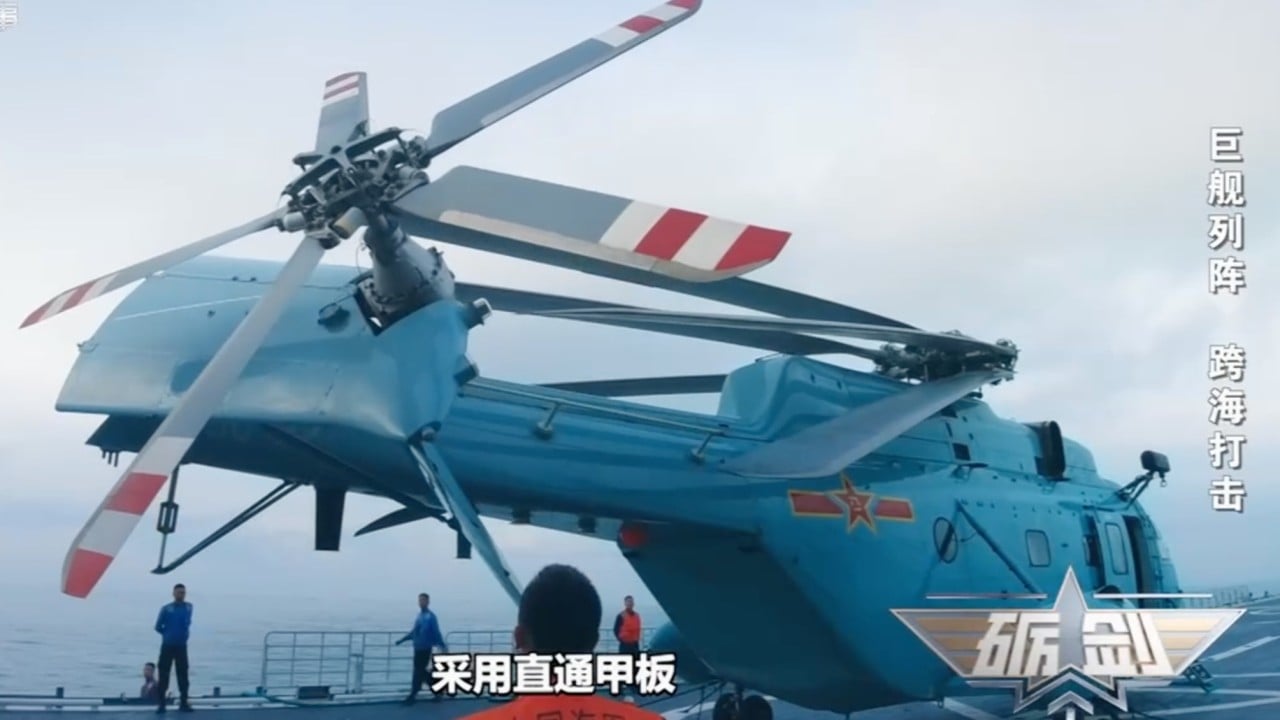
The People’s Liberation Army Navy (PLAN) is transitioning from a platform-centric force to a network-centric entity, a shift anchored by the deployment of sophisticated shipborne Unmanned Aerial Vehicles (UAVs). While traditional analysis focuses on the airframes themselves, the actual strategic weight lies in the reduction of the "Kill Chain" latency—the time elapsed between target detection and kinetic effect. By embedding vertical take-off and landing (VTOL) and fixed-wing UAVs into the organic structure of its surface fleet, the PLAN is attempting to solve the geographic constraints of the South China Sea through persistent, low-cost sensor density.
The operational utility of these systems is governed by three specific structural shifts: the extension of the radar horizon, the decentralization of electronic warfare (EW) nodes, and the economic inversion of maritime attrition.
The Radar Horizon Constraint and Height of Eye Advantage
Surface combatants are physically limited by the curvature of the Earth. A standard radar array mounted 20 meters above sea level has a theoretical horizon against a surface target of approximately 18 kilometers. Even with advanced over-the-horizon (OTH) backscatter radar, the resolution is often insufficient for precise fire control of long-range anti-ship cruise missiles (ASCMs) like the YJ-18.
By deploying UAVs such as the AR-500C or specialized variants of the Wing Loong from the decks of Type 052D destroyers and Type 075 amphibious assault ships, the PLAN achieves a "height of eye" of several thousand meters. At an altitude of 3,000 meters, the visual and electronic horizon extends beyond 200 kilometers.
This creates a definitive causal link:
- Sensor Elevation: The UAV acts as a remote sensor node, pushing the fleet's detection envelope forward by an order of magnitude.
- Data Tethering: High-bandwidth datalinks transmit raw sensor telemetry back to the "Combat Information Center" (CIC) of the host ship.
- Fire Control Calculation: The host ship calculates a firing solution based on remote data, allowing the vessel to remain electronically silent (EMCON) while its "eyes" are active 150 kilometers away.
This "Passive-Active Split" protects high-value surface assets from being localized by enemy Electronic Support Measures (ESM) while maintaining offensive readiness.
The Cost Function of Maritime Attrition
Modern naval warfare is defined by an extreme cost asymmetry. A single SM-6 interceptor or an Aster 30 missile costs millions of dollars. Conversely, a medium-altitude long-endurance (MALE) UAV or a swarm of smaller loitering munitions costs a fraction of that.
When the PLAN integrates these drones into its South China Sea operations, it forces an unfavorable economic calculus on opposing forces. If an adversary uses a multi-million dollar interceptor to down a $50,000 drone, the PLAN wins the engagement through economic exhaustion. If the adversary ignores the drone, the PLAN gains persistent targeting data that facilitates a saturation strike with heavy missiles.
Determinants of Attrition Value
- Production Velocity: The ability of China's industrial base to replace lost airframes faster than an adversary can replace interceptor stocks.
- Mission Payload Versatility: Modular bays that allow a single airframe to switch between signals intelligence (SIGINT), synthetic aperture radar (SAR) mapping, and laser designation.
- Autonomous Swarm Recovery: The technical hurdle of recovering multiple VTOL units simultaneously during high-state seas (Sea State 5 or higher), which determines the tempo of sustained operations.
Decentralized Electronic Warfare Nodes
The most overlooked application of the PLA’s new shipborne drones is the distribution of Electronic Warfare capabilities. Traditionally, EW is concentrated on the hull of the ship. This makes the ship the primary target for anti-radiation missiles (ARMs).
The new operational doctrine utilizes UAVs as "Electronic Decoys" and "Stand-forward Jammers." By positioning UAVs between the PLAN fleet and an enemy carrier strike group, the drones can emit signatures that mimic much larger vessels. This creates a "Ghost Fleet" on enemy radar screens, forcing the opponent to commit reconnaissance assets to investigate false positives.
Furthermore, these drones serve as localized jammers. By flying close to enemy aircraft or sensor buoys, a UAV can saturate specific frequencies with noise using much lower power than a ship-based jammer would require. This localized interference disrupts the enemy's "Common Operational Picture" (COP) without revealing the location of the PLAN surface group.
Structural Limitations and the "Link" Bottleneck
The effectiveness of this drone integration is not absolute; it is constrained by the physics of communication and the environment of the South China Sea.
The Latency Barrier
In a high-intensity conflict, satellite communication (SATCOM) is the first capability likely to be degraded through kinetic or cyber means. Without SATCOM, shipborne UAVs must rely on Line-of-Sight (LoS) datalinks. This restricts the drone’s operational radius to the horizon of the ship’s communication masts, effectively tethering the "long-range" asset to a relatively short leash.
The Maintenance Tail
Naval environments are corrosive. High salinity and humidity levels cause rapid degradation of composite materials and sensitive avionics. A carrier air wing has a dedicated crew of hundreds for maintenance; a Type 054A frigate does not. The integration of drones creates a "Maintenance Bottleneck" where the frequency of sorties is limited not by fuel, but by the mechanical failure rate of folding wing mechanisms and sensor gimbals in salt-heavy air.
Acoustic Signatures in Sub-Surface Warfare
While drones are primarily aerial assets, their interaction with Anti-Submarine Warfare (ASW) is critical. Drones equipped with magnetic anomaly detectors (MAD) or those capable of dropping sonobuoys extend the ship's ability to hunt submarines. However, the data processing required for ASW is immense. If the ship cannot process the drone's acoustic data in real-time, the "Time-to-Contact" for a submarine increases, rendering the drone a mere observer rather than a hunter.
The Intelligence, Surveillance, and Reconnaissance (ISR) Grid
In the South China Sea, geography provides the PLAN with a "Home Field Advantage" through "Unsinkable Aircraft Carriers"—the fortified features in the Paracel and Spratly Islands. Shipborne drones act as the connective tissue between these stationary bases and the mobile fleet.
The logic follows a "Grid-and-Pulse" model:
- The Grid: Land-based sensors on islands provide a permanent, low-resolution baseline of maritime traffic.
- The Pulse: When an anomaly is detected, shipborne drones are launched to provide a high-resolution "pulse" of data, identifying the specific hull type, cargo, and armament of the target.
This prevents "Sensor Overload," where commanders are buried in too much data. The drones provide "Information on Demand," ensuring that the kinetic assets (missiles) are only deployed against verified high-priority targets.
Quantitative Comparison: Manned vs. Unmanned Naval Aviation
The transition to shipborne drones is driven by the comparison of "Loss Tolerance." The loss of a J-15 pilot and airframe is a strategic setback with political ramifications. The loss of an ASN-209 or similar UAV is a line item in an operational budget.
| Metric | Manned Aviation (J-15) | Unmanned Aviation (VTOL UAV) |
|---|---|---|
| Launch Footprint | Full Flight Deck | 5m x 5m Pad |
| On-Station Time | 2–4 Hours | 12–20 Hours |
| Risk Tolerance | Low (Pilot Safety) | High (Expendable) |
| Data Processing | In-Cockpit | Cloud-Distributed |
| Turnaround Time | High (Pilot Fatigue) | Low (Battery/Fuel Swap) |
The second-order effect of this shift is the "Saturation of the Battlespace." A fleet can realistically only manage a few manned sorties simultaneously due to the cognitive load on Air Traffic Control and the physical space of the deck. However, automated recovery systems allow for a "Continuous Stream" of UAVs, ensuring there is never a gap in the ISR coverage.
Strategic Trajectory
The integration of shipborne drones by the PLAN signals a move away from the "Big Ship" philosophy toward a "Distributed Lethality" model. The goal is not to build a fleet that can survive every hit, but to build a network that remains functional even as its individual nodes are destroyed.
For adversaries, the challenge is no longer just finding the ship; it is penetrating a multi-layered "Bubble" of unmanned sensors that extend hundreds of miles from the hull. To counter this, the focus of maritime competition will shift toward:
- Non-Kinetic Neutralization: Using high-power microwaves (HPM) to fry drone electronics without wasting expensive missiles.
- Data Poisoning: Injecting false data into the UAV-to-Ship datalink to deceive the host vessel's AI-driven targeting systems.
- Acoustic Masking: Developing sub-surface technologies that can bypass the increased sensor density provided by the "Height of Eye" advantage.
The PLAN’s naval drone strategy is effectively an attempt to turn the South China Sea into a "Transparent Sea," where the fog of war is lifted for the defender and thickened for the intruder. The success of this strategy depends entirely on the resilience of the datalinks and the autonomy of the software governing the "Kill Chain" in the absence of human intervention.
Future force structures will likely prioritize "Drone-Carrier" frigates over traditional multi-role hulls, emphasizing a shift toward a maritime environment where the primary weapon is not the gun or the missile, but the uninterrupted flow of targeting data.


:quality(85)/x8/fh/7HXvnnMcdomscTiif7/Blonde-porn-star-Shayla-LaVeaux-bends-over-to-get-her-pussy-smashed_015.jpg)