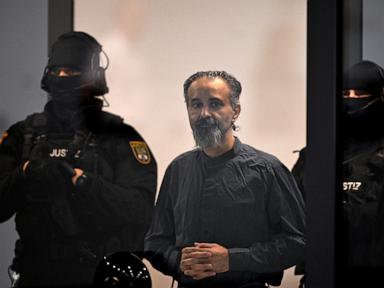
The German judiciary just handed down a lifetime of isolation to Taleb al-Abdulmohsen, the 51-year-old psychiatrist who turned a rented BMW X3 into a weapon of mass devastation at the Magdeburg Christmas market. The standard media script is already running on autopilot: a tragic anomaly, a disgruntled ex-Muslim doctor twisted by narcissistic personality disorder, an idiosyncratic actor who "didn't fit the profile" of conventional extremism.
This narrative is a comforting lie. It is an intellectual sedative designed to shield state bureaucracies from their own systemic obsolescence.
By framing the Magdeburg tragedy as an unpredictable explosion of personal grievance, mainstream reporting misses the critical failure of modern intelligence. I have spent years analyzing how security architecture scales—or fails to scale—against decentralized threats. The cold, data-driven reality is that the German state did not lack the information to prevent this massacre. They lacked the framework to understand it.
We are treating a network-era phenomenon with cold-war analytical tools, and six people paid for that administrative inertia with their lives.
The Mirage of the Outlier
Every post-verdict analysis leans heavily on how the defendant defied standard extremist classification. He was an educated medical professional, a psychiatrist who evaluated criminals inside the prison system. He was a self-proclaimed atheist running web forums dedicated to helping people flee the Gulf. On paper, he was an integrated immigrant; on social media, he was a radical far-right agitator posting unhinged manifestos about the "Islamisation of Europe" while simultaneously accusing local police of orchestrating a conspiracy against him over a civil legal dispute.
The security establishment looks at this chaotic mixture of traits and calls it an unclassifiable outlier. That is a fundamental error in threat modeling.
Abdulmohsen is not an anomaly; he is the new archetype. The modern threat vector is no longer a top-down, command-and-control cell operating with a shared, coherent theology. It is an algorithmic composite. When an individual is marinating in digital subcultures, personal narcissism fuses with geopolitical grievance, accelerated by localized institutional friction—like a failed criminal complaint or a lost lawsuit.
To call him "unaffiliated" because he lacked an explicit handler is like saying a day-trader isn't part of the market because they don't work for Goldman Sachs. The network is the handler. The algorithm is the recruiter.
The Intelligence Inflation Problem
Let us look at the data that the standard coverage glosses over to protect the reputation of federal intelligence offices. The public is told that investigators faced a sudden, unexpected rampage that lasted just sixty-four seconds. But the digital and bureaucratic trail stretched back for years.
- 2013: The defendant is convicted and fined by a Rostock court for threatening criminal offenses.
- November 2023: The Federal Intelligence Service receives a explicit report from Saudi Arabian intelligence stating that Abdulmohsen is plotting something "big" in Germany.
- 2023–2024: The Saudi government issues a total of three distinct warnings regarding his radicalization and human trafficking activities.
- May 2024: The defendant posts publicly online: "I seriously expect to die this year. The reason: I will ensure justice at any cost."
The issue here was not a lack of data. It was data intoxication. Modern security agencies are drowning in signals but completely bankrupt when it comes to synthesis.
Imagine a system where a high-risk individual can be flagged three times by foreign intelligence, possess a prior domestic conviction for violent threats, openly publish a timeline for his own violent intent on public servers, and yet still walk into a car rental agency to secure a 340-horsepower SUV without a single red flag being tripped. That isn't a failure of collection; it's a catastrophic structural breakdown of predictive analysis.
The Failure of Institutional Profiling
Why did the state machinery fail to act on these clear markers? Because bureaucratic systems require clean, pre-defined boxes to justify defensive action.
If a suspect does not explicitly match a known checklist—waving a specific flag or communicating with a tracked foreign cell—the administrative mechanism defaults to inaction to avoid liability. They classified his escalating behavior as a localized, civil dispute rather than a matter of state security. They looked at his background as a state-employed psychiatrist and assumed institutional compliance, ignoring the reality that proximity to institutional systems often provides the perfect cover for radicalization.
This institutional blindness is exactly what we observe in corporate risk management when legacy firms ignore asymmetric digital threats because they do not fit the traditional competitive matrices. The state looked for a formal organization, while the threat was operating as a fluid, atomized entity driven by online feedback loops.
The True Cost of Defensive Architecture
The state’s response to its own systemic predictive failure is always the same: building massive physical fortresses after the damage is done. The Magdeburg trial required the construction of an entire temporary courtroom complex on the outskirts of the city just to process the sheer volume of plaintiffs, lawyers, and witnesses.
We are exceptionally skilled at building bureaucratic monuments to handle the aftermath of a disaster. We are completely incapable of updating the analytical logic required to intercept them.
The life sentence with "exceptional gravity" passed down by Judge Dirk Sternberg ensures the driver will likely never see freedom. It provides a clean judicial ending to a messy, terrifying systemic failure. The media will archive the story under the folder of "lone wolf madness," the public will move on, and the security apparatus will continue to scan the horizon for 20th-century threat profiles while the next algorithmic actor rents a vehicle.
Punishing the perpetrator after sixty-four seconds of horror is a baseline requirement of justice. But pretending that this verdict represents a victory for public safety is an act of collective delusion. Until threat assessment models abandon the pursuit of rigid ideological categories and begin tracking the intersection of personal volatility, digital acceleration, and prior warning thresholds, our most vital public spaces remain soft targets. The verdict didn't fix the hole in the wall; it just locked the door after the house was cleared out.