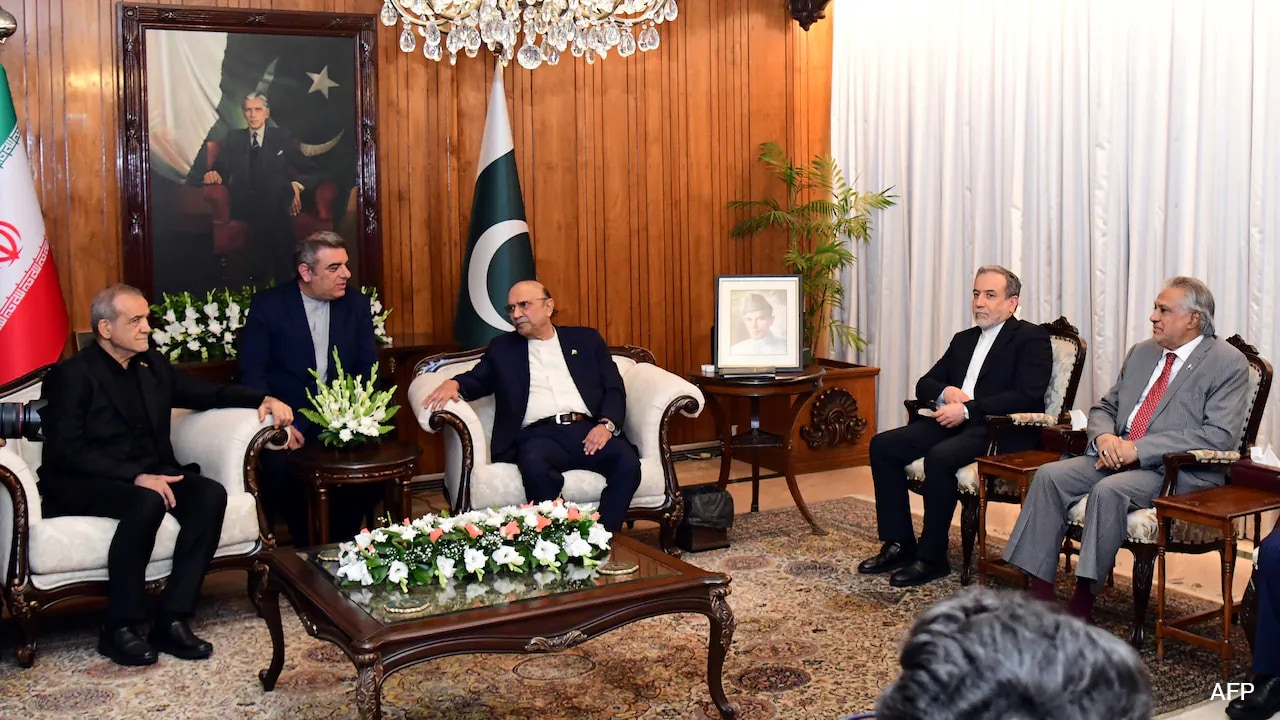
Mainstream media outlets love a good photo opportunity. When the Iranian President rolls into Islamabad to meet with Pakistan's top leadership, the standard press releases write themselves. The headlines inevitably blare with words like "peace initiatives," "regional connectivity," and "bilateral cooperation." Editors spin a comforting yarn about two neighboring Islamic republics joining hands to stabilize a fractured region.
It is a comforting narrative. It is also completely wrong.
The lazy consensus surrounding these high-level summits presumes that diplomatic engagement equals stability. The reality on the ground dictates the exact opposite. These meetings are not a sign of growing strength or alignment; they are a desperate, reactionary exercise in damage control by two deeply vulnerable regimes. When Tehran and Islamabad start talking about peace, it means the threat of cross-border conflict has reached a boiling point that neither side can afford to ignore.
Let us dismantle the optics and look at the hard mechanics of this geopolitical friction point.
The Mirage of Border Security
The core premise of the recent diplomatic theater is that Iran and Pakistan are working together to secure their shared 900-kilometer border. For decades, security analysts have treated the Balochistan border region as a localized policing issue. They frame it as a space troubled by fringe militant groups like Jaish al-Adl operating on the Pakistani side, or Baloch separatists taking refuge on the Iranian side.
This view completely misunderstands the structural nature of the borderland. The frontier between Iran and Pakistan is not failing because of a lack of joint committees. It is structurally un-policeable under the current political frameworks of both nations.
Consider the data. In January 2024, the world watched in mock surprise as Iran launched missile strikes inside Pakistan, followed immediately by retaliatory Pakistani strikes inside Iran. It was the most explicit military escalation between the two countries in decades. The mainstream analysis treated this as a sudden, anomalous flare-up.
It wasn't. It was the logical conclusion of a long-term trend.
I have spent years tracking regional security dynamics across Southwest Asia, observing how states manage peripheral spaces. Regimes in Kabul, Islamabad, and Tehran treat their borderlands not as sovereign spaces to develop, but as buffer zones to exploit or suppress. The cross-border violence is a permanent structural feature, not a bug.
When a state loses economic control over its periphery, security cannot be maintained via a signed memorandum of understanding. The informal economy of the Iran-Pakistan border—dominated by the smuggling of cheap Iranian fuel, narcotics, and weapons—is the only thing keeping the local population alive.
When the Iranian President and Pakistani Prime Minister stand at a podium promising to eradicate "terrorist elements," they are proposing to destroy the informal economic networks that prevent a total regional uprising. They cannot execute this promise. If they actually sealed the border, the economic collapse of Pakistani Balochistan and Iranian Sistan-Baluchestan would trigger a massive humanitarian crisis that would destabilize both capitals within months.
The Economic Pipe Dream
Every single time Iranian and Pakistani officials meet, the ghost of the Iran-Pakistan (IP) gas pipeline is dragged out of the closet. The media breathlessly reports on the potential for energy cooperation, framing it as a vital project that could solve Pakistan’s chronic energy shortages.
This is pure fiction. The IP pipeline is a geopolitical corpse that no amount of diplomatic CPR can revive.
The mechanics of international finance make the project impossible. Pakistan is structurally dependent on the International Monetary Fund (IMF) and western financial institutions to avoid sovereign default. Iran remains under a comprehensive blanket of US unilateral sanctions. Pakistan cannot import Iranian gas without triggering secondary US sanctions that would instantly collapse its fragile financial system.
Pakistan’s energy ministry knows this. Iran’s oil ministry knows this. Yet, they continue to sign progress reports and extend deadlines. Why? Because it serves as a useful tool for leverage.
- For Islamabad: The threat of continuing the pipeline is used as a bargaining chip to extract economic concessions or security assistance from Washington and Riyadh.
- For Tehran: The project allows Iran to project an aura of regional integration, signaling to its domestic audience that western isolation strategies are failing.
To believe this pipeline will ever deliver gas to Karachi is to ignore the foundational rules of global trade architecture. It is an economic impossibility disguised as an alternative energy strategy.
The Sectarian Undercurrent Nobody Wants to Mention
The third fatal flaw in the mainstream narrative is the absolute erasure of the ideological and sectarian divergence between the two states. The official communiqués maintain a strict focus on secular state-to-state relations. But geopolitics in this part of the world does not operate in a secular vacuum.
Pakistan is a majority Sunni state with deep, existential financial ties to Saudi Arabia and the Gulf monarchies. Iran is the global vanguard of Shia geopolitical power. For forty years, Pakistan has served as a battlefield for proxy competition between Riyadh and Tehran.
When Pakistan’s leadership embraces Iran, a nervous clock begins ticking in Riyadh. Pakistan cannot tilt toward Tehran without risking its financial life support from the Gulf. This dynamic creates a hard ceiling on how far any diplomatic thaw can go.
Any substantial intelligence sharing or military cooperation between Islamabad and Tehran is dead on arrival because the Pakistani security apparatus is structurally integrated with Gulf security frameworks. The handshakes in Islamabad are carefully calibrated to be warm enough to prevent a shooting war, but cold enough to keep Riyadh’s checkbook open. It is a cynical, high-wire balancing act that leaves no room for actual, sustainable peace initiatives.
Dismantling the Frequently Asked Questions
When you challenge the established narrative on Iran-Pakistan relations, establishment analysts rely on a predictable set of defensive questions to preserve the status quo. Let us answer them directly, without the diplomatic gloss.
Can joint border markets replace the informal economy?
The short answer is no. The premise that a few government-regulated border bazaars can replace a multibillion-dollar illicit trade network is laughable. The informal trade survives precisely because it bypasses state tariffs, corruption, and bureaucratic bottlenecks. A truck driver smuggling Iranian diesel into Pakistan does so because the price differential makes it highly profitable. The moment the state regulates that trade, the profit margin vanishes, and the local economy starves. These markets are cosmetic fixes designed for press releases, not structural economic reforms.
Won’t China force both countries to cooperate for the sake of CPEC?
This is a massive overestimation of Beijing's leverage. While China has invested heavily in the China-Pakistan Economic Corridor (CPEC) and wants stability near the Gwadar port, Beijing is not a magical regional peacemaker. China’s primary interest is risk mitigation. Beijing does not want an open war between Iran and Pakistan that threatens its infrastructure investments, but it has zero interest in arbitrating deep-seated ethnic and sectarian grievances that have persisted for centuries. China can build roads; it cannot build trust between two paranoid national security states.
Is a formal defense pact between Iran and Pakistan possible?
Absolutely not. To suggest a defense pact is to ignore the fundamental alignment of Pakistan’s military elite. The Pakistani armed forces are deeply intertwined with Western military hardware, training, and doctrines, alongside their strategic alliance with China. Iran’s military doctrine is built entirely on asymmetric warfare, proxy networks, and anti-Western revisionism. A military alliance would require Pakistan to completely rupture its relationships with the West and the Gulf Arab states. The costs of such a move outweigh any marginal benefits Iran could provide.
The Brutal Reality for Regional Policy
The hard truth is that the Iran-Pakistan relationship is characterized by managed hostility, not developing partnership.
If you are a corporate strategist, an energy investor, or a policy maker, betting on a meaningful alliance between these two countries is a fast track to losing money and credibility. The region will remain highly volatile. The border will remain a zone of violence and smuggling. The pipeline will remain a trench in the sand.
Stop analyzing the statements issued by foreign ministries. Look at the balance sheets, the structural reliance on foreign patrons, and the unalterable geography of the Balochistan frontier.
The meetings in Islamabad do not herald a new dawn of regional peace. They are the frantic, superficial maneuvers of two neighboring states that are too weak to fight each other, too broken to trust each other, and completely incapable of fixing the underlying rot that divides them.