Headlines across the international press love a tidy narrative. When Moscow rolls out the red carpet for a Taliban delegation, the lazy consensus writes itself. Analysts in Washington and London scramble to publish quick takes about diplomatic recognition, shifting geopolitical axes, and a united authoritarian front carving up Central Asia. It is a neat story. It is also entirely wrong.
I have spent years watching diplomats misread the Kremlin through the lens of ideological alignment. Moscow does not care about the Taliban's domestic governance, their medieval social edicts, or their ideological purity. They care about borders, drug flows, and the very real possibility of a failed state bleeding millions of refugees and thousands of radicalized militants straight into the soft underbelly of the Commonwealth of Independent States.
What the Western media frames as an embrace is actually a containment strategy wrapped in pragmatism. Russia is not partnering with the Taliban out of strength. They are managing a threat because nobody else in the neighborhood is willing to touch the mess with a ten-foot pole.
The Myth of Regional Alignment
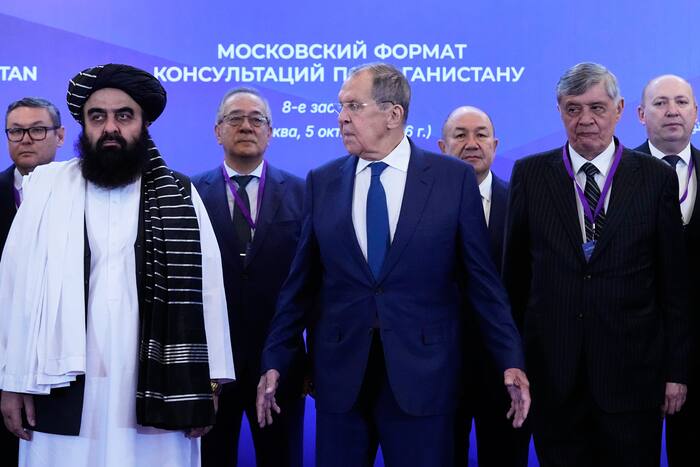
Every time a delegation lands at Vnukovo Airport, think tanks trot out the tired trope of an emerging anti-Western axis. Beijing, Moscow, and Kabul forming a triangle of defiance.
Look at the mechanics of the relationship. True partnership requires shared strategic goals and mutual trust. Russia and the Taliban share neither. What they share is a shared terror of the Islamic State Khorasan Province, known widely as ISIS-K. That group views Moscow as an infidel target and the Afghan regime as apostates failing to implement a pure enough version of extremism.
When Russian Special Presidential Envoy for Afghanistan Zamir Kabulov sits across the table from Taliban officials, he is not negotiating an alliance. He is issuing demands disguised as diplomatic protocol. The message is simple: secure your northern border, or we will find reasons to make your governance impossible.
To call this cooperation is to misunderstand how great powers handle failed states on their doorstep. It is police work at a geopolitical scale. Moscow is paying protection money in the currency of diplomatic legitimacy to keep a hostile actor from exporting chaos northward into Tajikistan, Uzbekistan, and Turkmenistan.
Security Paranoia Dictates Kremlin Policy
To understand why the Kremlin engages with a regime nobody else will touch, you have to look at a map through the eyes of a Russian security planner.
The security architecture of Central Asia is fragile. The porous borders separating Afghanistan from its northern neighbors are highways for heroin, synthetic precursors, and militant recruiters. If the Taliban regime collapses under the weight of economic isolation and internal factionalism, what fills the vacuum? Not a democratic transition. Not a moderate coalition. Total fragmentation.
A fractured Afghanistan means dozens of warlords and transnational terrorist cells operating without central control. That is a nightmare scenario for Moscow. A unified, even if brutal and internationally isolated, Taliban administration provides a single address for accountability. If a cell launches an attack across the Amu Darya river, Moscow wants one phone number to call, and they want the person on the other end to have the monopoly on local violence required to fix it.
This is realpolitik stripped of moralizing. Western capitals can afford the luxury of non-recognition because the oceans and secure borders buffer them from the immediate fallout of Afghan destitution. Russia does not have that luxury. Their southern border is thousands of miles of flat steppe and porous mountain passes.
The Economic Mirage
Do not mistake diplomatic engagement for investment. Read the trade reports coming out of Moscow and Kabul, and you will see grand announcements of bilateral commerce, grain deals, and energy corridors.
Look closer at the actual capital flows. They are minuscule. Russian banks are hyper-vigilant about international sanctions and secondary penalties from Western regulators. Major Russian corporations are not pouring capital into Afghan infrastructure projects or mineral extraction. The risks catastrophic security failures, rampant corruption, lack of reliable legal frameworks, and global banking blacklists entirely outweigh the speculative rewards.
When minor trade agreements happen, they are almost entirely transactional, low-value, and routed through complex workarounds to avoid financial tracking. The Taliban needs fuel and food. Russia has surplus grain and petroleum products. It is a bazaar economy transaction, not a strategic economic integration. The grand visions of regional integration pushed by Kabul's spokesmen are domestic propaganda meant to project normalcy to a starving population. Moscow plays along because letting the regime starve faster serves no Russian security interest.
The Diplomatic Sleight of Hand
Why does Moscow bother hosting them in official capacities, granting them platforms, and removing them from domestic terrorist lists on paper while maintaining operational caution?
Because formal recognition is a cheap chip to play. By dangling the carrot of eventual official recognition, Moscow keeps the Taliban engaged, cooperative on security metrics, and reliant on Russia for diplomatic cover at the United Nations Security Council. It is leverage. The moment Russia grants full, unconditional recognition, that leverage vanishes.
Washington watches these summits and hyperventilates about Moscow undercutting international isolation norms. But watch what Russia actually does at the UN. They are not pushing for sweeping international aid packages with no strings attached. They are managing the stagnation, keeping the pressure low, and ensuring that no other external power—whether it is Washington trying to retain covert intelligence footprints or regional rivals—can use Afghan territory to project power against Russian interests.
The Contrarian Reality
The common narrative tells you that Russia is winning influence in South Asia by cozying up to the Taliban while the West retreats.
The truth is much darker. Russia is stuck babysitting a geopolitical radioactive zone because abandoning it is too dangerous. They are managing a worst-case scenario with limited tools, biting their nails over every intelligence report about cross-border infiltration, and offering just enough diplomatic oxygen to keep the current regime from suffocating and collapsing into total anarchy.
Stop looking at these delegations as a sign of a new geopolitical dawn. They are a desperate exercise in border defense. Moscow is not building an empire in the Hindu Kush. They are building a firewall. And every day the firewall holds is a good day in the Kremlin.