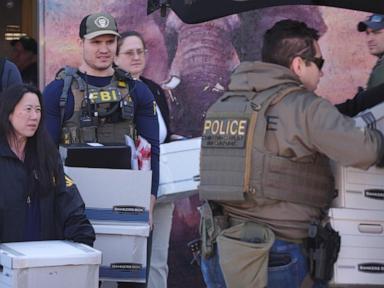
The coffee was still hot in the mug when the flashing lights arrived. In a suburban neighborhood where the loudest sound is usually a lawnmower or a school bus brakes, the sudden rhythm of heavy boots on pavement feels like a heartbeat skipping. This wasn't a routine traffic stop. This was the clinical, coordinated arrival of the federal government.
Federal agents do not knock like neighbors. They knock with the weight of an investigation that has been quietly coiling for months, sometimes years. On this particular morning in Minnesota, the silence of a fraud probe ended. The paperwork became a physical presence.
When we read a headline about "agents serving search warrants," our minds often drift to cinematic images of gold-lettered jackets and yellow tape. But the reality is far more grounded in the mundane details of a life being dismantled. It is the sound of filing cabinets sliding open. It is the blue light of a computer screen as gigabytes of private data are mirrored onto government drives. It is the realization that a business, built on the promise of service or innovation, is now being viewed through the narrow, cold lens of a ledger.
The Paper Trail that Leads to the Door
Fraud is rarely a crime of passion. It is a crime of math. It starts with a decimal point moved slightly to the right, or a reimbursement claim for a service that existed only on a digital spreadsheet. In the federal fraud probe currently unfolding in Minnesota, the stakes aren't just about missing dollars. They are about the breach of a social contract.
Every dollar diverted from a legitimate program is a dollar stolen from a person who actually needed it. Think of a hypothetical small business owner—let’s call her Sarah. Sarah spends late nights ensuring her payroll is exact, her taxes are filed, and her compliance is airtight. When she hears about a massive fraud investigation, it isn't just news. It’s a gut punch. It’s the feeling that the rules she follows so diligently are being treated as suggestions by those with enough audacity to bypass them.
The warrants served this week represent the tipping point. In the world of federal investigations, a search warrant is not the beginning; it is the climax of the first act. To get a judge to sign that paper, agents had to present a "probable cause" so thick and undeniable that it justified breaking the sanctity of a private home or office. They had to show that the trail of breadcrumbs led not just to a mistake, but to a motive.
The Anatomy of an Invisible Crime
Why do we care about a fraud probe in a state far from the financial capitals of the world? Because the ripples are universal. Minnesota has often been a bellflower for how federal oversight operates in the Midwest. When the FBI and the IRS Criminal Investigation division show up together, they aren't looking for a single missing check. They are looking for a system.
Fraud often hides in the complexity of the "middle." It’s in the gap between a government grant being issued and the end-user receiving the benefit. In that middle ground, ghosts can be created. Ghost employees. Ghost patients. Ghost storefronts. It is a world of mirrors where everything looks functional until you try to touch it and find your hand passing through empty air.
The agents involved in these raids are trained to see through the mirrors. They look for the discrepancies that the human eye wants to ignore. They look for the luxury car bought with "consulting fees" that don't match any known work product. They look for the pattern of wire transfers that move in a frantic, circular motion, trying to outrun their own origin.
The Weight of the Badge at the Entryway
Imagine being the agent standing on that doorstep. You are not there to be a villain, but you are also not there to be a friend. You are the embodiment of a consequence.
The air in the room changes when a warrant is read. There is a specific kind of stillness that settles over a workplace when the computers are unplugged. Employees look at each other, wondering how much they knew, or how much they chose not to know. This is where the human element of fraud becomes most painful. It isn't just the "bad actors" who suffer. It’s the receptionist who thought she worked for a reputable firm. It’s the junior accountant who raised a question and was told to "just keep typing."
The collateral damage of a federal probe is measured in lost trust. It’s the way the neighbors look at the house for the next six months. It’s the way the bank freezes the accounts, turning a lifestyle of perceived success into a frantic scramble for basic liquidity.
Why the Silence Matters
For months leading up to this morning, there were likely no headlines. Federal investigators are ghosts until they are giants. They move through bank records and emails with a silence that can be mistaken for inactivity. This is the part that people often get backward. They think if nothing is happening in the news, nothing is happening at all.
But the silence is where the case is built. The "dry" facts of a warrant—the case numbers, the specific statutes cited, the list of seized items—are the bones of a story that is finally being told out loud.
In Minnesota, this probe is a reminder that the reach of the law is long and its memory is longer. We live in an era where digital transactions feel ephemeral, like they disappear the moment we hit "send." The federal government, however, operates on the principle that nothing ever truly disappears. It only waits to be found.
The items carried out in cardboard boxes today will be cataloged. They will be cross-referenced with testimonies. They will be laid out in a courtroom where the "compelling narrative" will meet the "cold facts," and one will be forced to account for the other.
The sun will set on those Minnesota streets, and the flashing lights will eventually fade. But the neighborhood is different now. The people living there have been reminded that the walls between a quiet life and a federal investigation are thinner than they appear. It only takes one moved decimal point, one ghost in the machine, for the boots to find your pavement.
The real story isn't the raid itself. It’s the slow, steady erosion of a life that led to the moment the door had to be opened. It’s the cost of thinking that the rules are for someone else, until the person with the badge proves they are for you.