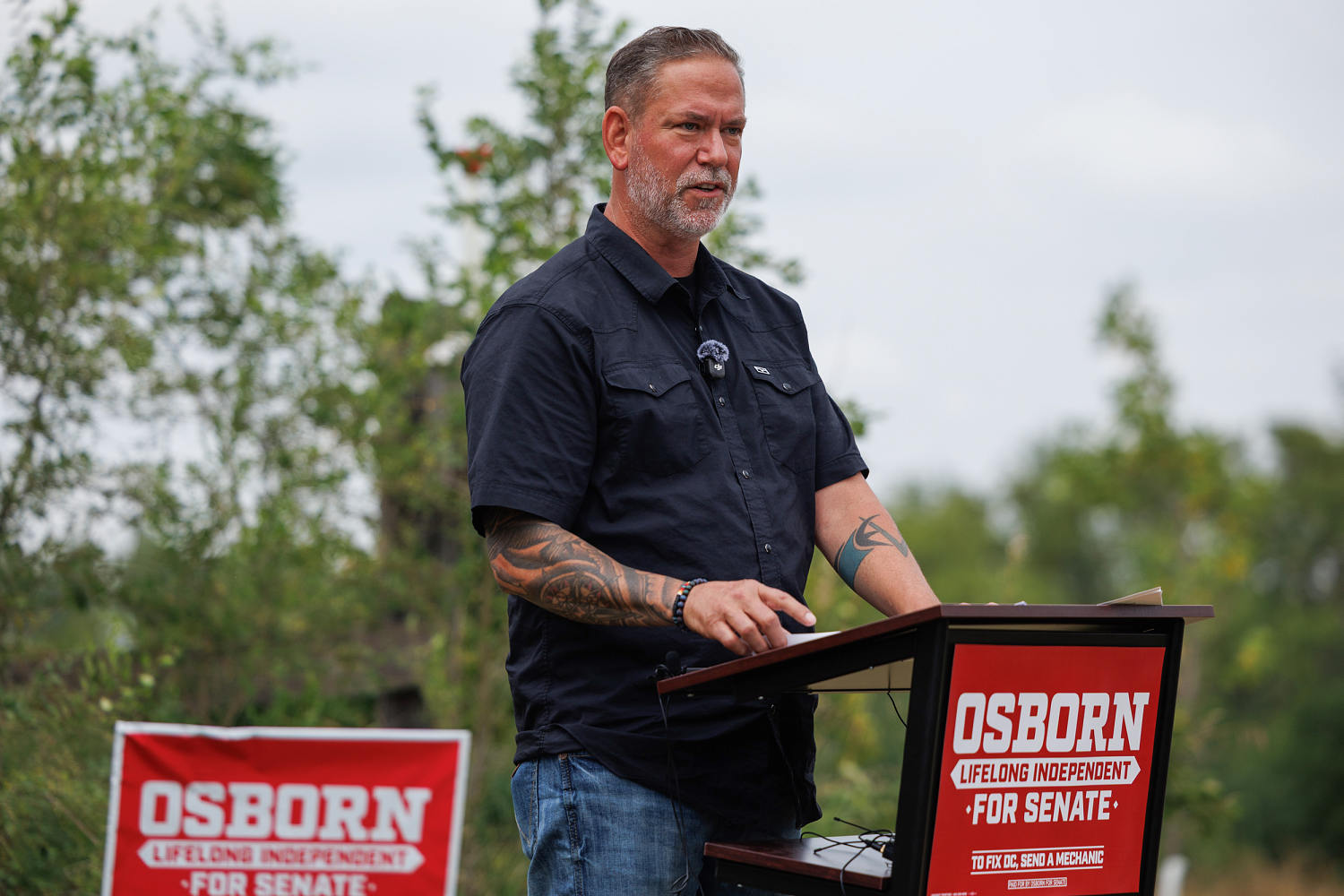
The air inside the BigIron Events Center at the Nebraska State Fair was heavy with more than just late-summer humidity as incumbent Republican Senator Pete Ricketts and independent challenger Dan Osborn squared off in their first major debate. For an hour, two vastly different political universes collided under the glare of television lights. Millions of dollars in inherited wealth met blue-collar union grit head-on.
The primary query driving voter interest across the plains is simple. Can an independent populist unseat entrenched party power in a deep-red stronghold? The State Fair stage provided the clearest blueprint yet of how that battle will be fought. Ricketts relied heavily on framing his opponent as an agent of coastal Democrats, repeatedly deploying the moniker "Democrat Dan". Osborn countered by painting the incumbent as a billionaire elite out of touch with the financial realities facing working families.
Nebraska politics rarely witnesses friction of this magnitude. Ricketts, a former two-term governor appointed to his Senate seat and possessing vast personal resources derived from his family's financial empire, represents the traditional establishment. Osborn, an industrial mechanic and union leader who engineered a high-profile strike at an Omaha cereal plant, has built his political identity on shop-floor pragmatism. Their clash exposes the deep fault lines fracturing contemporary American electoral strategy.
The Battle Lines of Wealth and Class
Money dominated the opening salvos. Ricketts pointed to out-of-state political action committees and national donors contributing to left-leaning networks, arguing that Osborn's independent facade hides national partisan backing. Federal election data underscores the financial disparity, showing millions flowing into the incumbent's campaign war chest.
Osborn dismissed the attack by turning the spotlight onto economic policy. He pointed to federal tax and spending legislation, arguing that policy choices in Washington consistently favor the wealthiest fraction of society while squeezing middle-class households.
"Their party bosses cater to their donors, and now we've seen bad policy, and we've seen the biggest transition of wealth in human history," Osborn told the packed room of roughly two hundred spectators.
Ricketts defended his legislative record, emphasizing his votes to secure the border, curb government spending, and protect local industries. He argued that his policies defend Nebraskans from tax increases and foster a stable economic environment for agricultural producers.
Agriculture and Trade Realities
Substance occasionally broke through the partisan crossfire when the debate turned to agriculture and local resources. Both candidates agreed on specific regional vulnerabilities, finding rare common ground regarding executive actions on foreign beef imports. When asked about temporary federal decisions to allow wider foreign ground beef entry, both Ricketts and Osborn condemned the move as detrimental to local cattle ranchers.
"This is a colossal mistake for our cattle ranchers," Osborn stated, aligning with the incumbent's position.
Yet divisions quickly resurfaced over industrial expansion and resource management. The rapid influx of massive data centers across the state brought water rights and energy consumption into sharp focus. Osborn argued for strict community guardrails to protect the Ogallala Aquifer from over-extraction, insisting that local residents must have binding agreements before major tech infrastructure breaks ground.
Tariffs and international trade policy also drew starkly different interpretations. While Ricketts advocated for strategic tariffs to level the playing field against unfair foreign competition, Osborn emphasized that congressional oversight must strictly control trade policies to prevent unintended harm to American agricultural exports.
The Independent Experiment
The underlying tension of the 2026 cycle is whether Osborn's performance in his previous statewide race was an anomaly or the vanguard of a broader populist shift. Losing his initial bid by a single-digit margin established him as a credible threat to the Republican monopoly in the state. By refusing to caucus with either major national party, Osborn is attempting to chart a narrow, difficult path through a highly polarized electorate.
Observers note that independent bids require near-flawless execution to overcome the institutional advantages of party machinery. Ricketts commands a formidable network of precinct organizations, deep donor lists, and decades of political branding across the state. Osborn relies on retail politics, visiting small towns, and capitalizing on populist anger directed at both national parties.
As the debate drew to a close, the candidates offered contrasting emotional appeals. Ricketts focused on economic security and traditional conservative values. Osborn warned against the toxic polarization tearing families and communities apart over partisan loyalty.
The race now enters its final stretch, defined by intense media spending and grassroots mobilization across every county. The State Fair confrontation proved that neither side can afford complacency as voters weigh the cost of power in the heartland
A closer look at the race dynamics
This video provides additional context on independent challenger Dan Osborn's strategy and his previous electoral runs in deep-red Nebraska.
http://googleusercontent.com/youtube_content/1