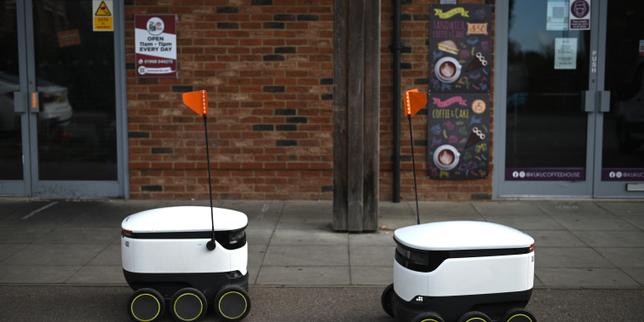
If you walk down a residential sidewalk in Milton Keynes long enough, a white, six-wheeled cooler on tracks is going to roll right past you. It isn't a glitch in the matrix. It's just a routine grocery drop-off.
While major tech hubs spent years arguing about drone delivery legislation and testing aerial concepts that routinely crashed into trees, this planned English town quietly embraced a fleet of sidewalk rovers. Starship Technologies launched its commercial service here back in 2018, partnering with local supermarkets like Co-op and Tesco.
Why did a town fifty miles north of London become the epicenter for autonomous sidewalk delivery? The answer lies in urban design, grid systems, and a local council willing to say yes while other municipalities got bogged down in bureaucratic hesitation.
Built for Cars, Weirdly Perfect for Robots
Milton Keynes is famous for two things: concrete cows and grid roads. Developed in the late 1960s as a master-planned New Town, it features a distinct network of grid-patterned H-roads and V-roads designed to keep vehicular traffic moving at high speeds without traditional traffic lights.
More importantly for our mechanical friends, the residential areas were designed with an extensive, interconnected web of wide pedestrian redways and sidewalks that bypass cars entirely.
Traditional cities hate delivery robots because sidewalk congestion creates immediate friction with pedestrians, street vendors, and cyclists. Milton Keynes didn't have that problem. Its sprawling layout, wide footpaths, and modern infrastructure created an environment where a slow-moving, pedestrian-speed machine could navigate safely without blocking traffic.
When Starship started rolling out its units, the town's unique architectural blueprint acted as a pre-made testing ground. Planners didn't have to retrofit ancient, narrow medieval alleys. They dropped the bots into a town built for modern transit expansion.
How the Tech Actually Works on the Ground
You might wonder if these units are remote-controlled by someone sitting behind a screen halfway across the world. They aren't.
The machines operate at Level 4 autonomy. That means they drive themselves using an onboard suite of cameras, ultrasonic sensors, and radars. They map their surroundings in real-time, calculate pedestrian trajectories, and stop automatically if a dog or a toddler darts across their path.
- Autonomy Level: 99% self-driving
- Speed: Roughly 4 miles per hour, matching a fast pedestrian pace
- Security: Cargo bays lock tight and only open via a digital key on the recipient's smartphone
Human operators only step in during edge cases. If a robot encounters an unexpected obstacle or a confusing construction zone, a remote supervisor can take over the controls for a few seconds to guide it back onto a clear path.
Once the machine arrives at your doorstep, you tap your phone screen, the lid pops open, and you grab your milk or fresh sandwiches. It's mundane, which is precisely why it works.
The Real Environmental Math
Municipalities love talking about green transitions, but Milton Keynes backed it up with hard data. Early joint studies between the local council and Starship revealed that hundreds of thousands of short car journeys for minor grocery runs were avoided.
Instead of firing up a petrol-powered hatchback to drive down to the local shop for a single bag of items, residents tapped an app. The electric motors inside the rovers pull roughly as much electricity to complete a trip as it takes to boil a household kettle for a single cup of tea.
The carbon savings add up quickly when scaled across millions of deliveries. Towns across Europe and North America started paying attention because Milton Keynes proved that low-emission last-mile logistics could scale without destroying local budgets or tearing up asphalt.
Growing Pains and Public Pushback
It hasn't been entirely smooth sailing. Whenever you introduce autonomous hardware into public spaces, friction follows.
Pedestrian advocacy groups, including national organizations like Living Streets, have raised valid concerns about pavement clutter. When fleets scale up and dozens of units share narrow walking spaces during peak hours, crowding happens. People pushing strollers or using wheelchairs occasionally find their paths obstructed by a machine waiting patiently at a curb cut.
Vandalism also happened early on, though at a much lower rate than skeptics predicted. The units are heavy, equipped with loud anti-tamper alarms, and tracked via GPS down to the inch. Stealing one gets you a heavy metal box full of someone else's groceries that you cannot open without triggering local alerts.
The real challenge moving forward isn't technological. It's regulatory harmonization. As other UK cities attempt to follow the Milton Keynes blueprint, patchy local laws create speed bumps for expansion. National transit authorities are dragging their feet on unified frameworks, leaving local councils to figure out sidewalk rights-of-way on a case-by-case basis.
What Other Cities Can Learn From This Pilot
Most smart city initiatives fail because they try to invent sci-fi solutions for problems people don't actually care about. Milton Keynes succeeded because it addressed a boring, expensive bottleneck: the last mile of local retail logistics.
If you want to introduce autonomous delivery into an urban center, stop trying to fly packages through the air. Look down at the pavement. Design for low speeds, wide walkways, and short distances.
The future of urban logistics isn't a high-speed flying drone dropping packages onto balconies. It's a humble, battery-powered box rolling down the sidewalk at walking speed, quietly handling the chores you didn't have time to do yourself.