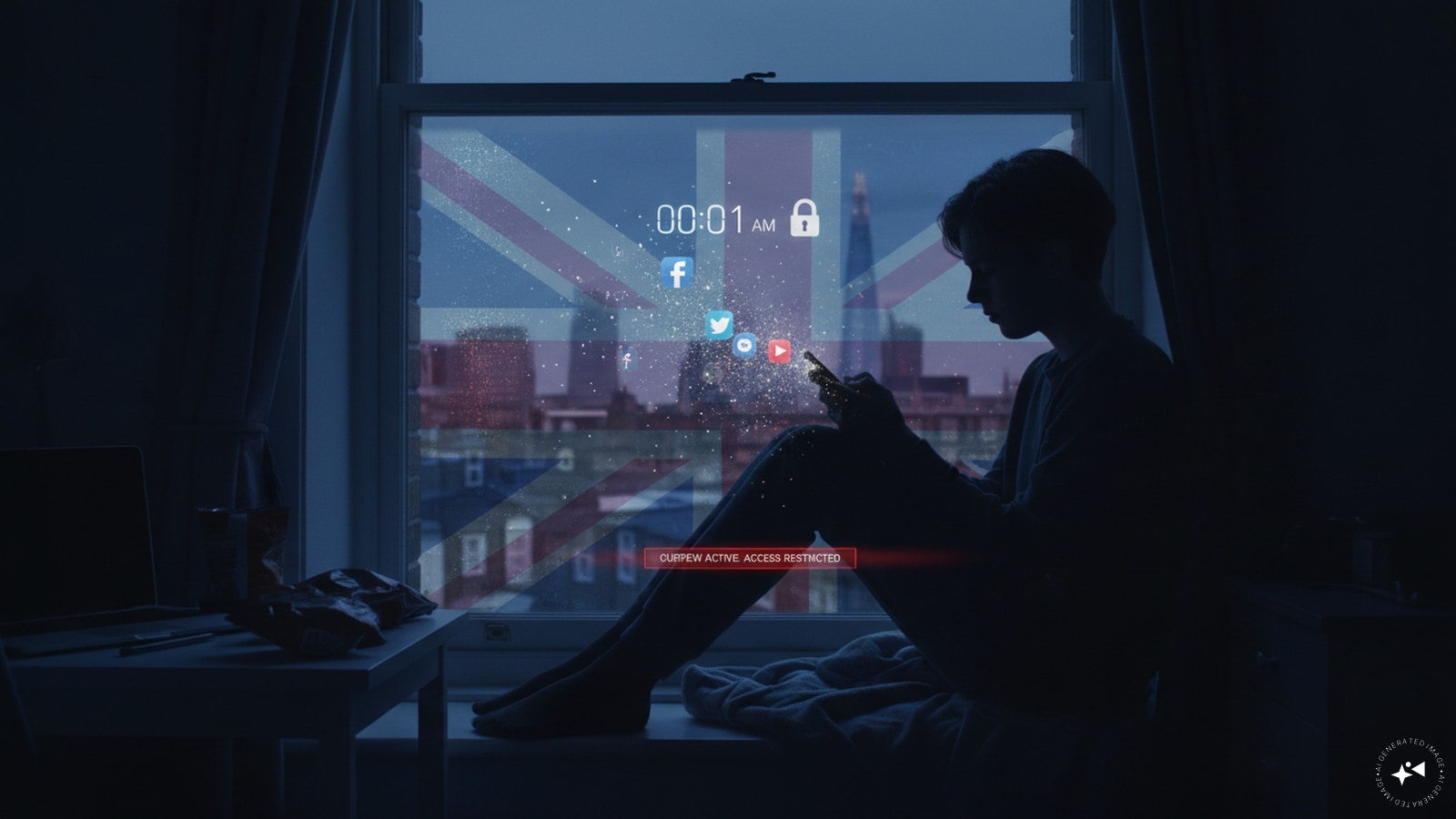
The house is asleep, but the bedroom next door is alive.
Under the crack of the door, a thin, cold blade of blue light cuts across the hallway carpet. It is 2:14 AM. If you walk in, you will find a teenager. Let us call him Leo, a hypothetical but entirely accurate composite of every sixteen-year-old in Britain today. Leo is not reading. He is not studying. He is suspended in a state of waking paralysis, his thumb performing a rhythmic, hypnotic flick. Up. Up. Up.
His eyes are bloodshot, reflecting a rapid-fire sequence of thirty-second videos. He is exhausted, yet his brain is flooded with dopamine, convinced that the very next swipe will bring something vital. It never does. But the machine is designed to ensure he keeps looking.
This silent, midnight battle is fought in millions of homes every single night. It is a war of attrition between human biology and the most sophisticated attention-harvesting software ever engineered. And now, the British government has decided to intervene with a digital curfew.
But in trying to save teenagers from the machine, policymakers have built a barrier made of tissue paper.
The Default State of Being
The UK government’s newly announced policy sounds decisive on paper. Starting next spring, sixteen- and seventeen-year-olds across the country will face a default social media curfew. From midnight until 6:00 AM, apps like Instagram, TikTok, and Snapchat are supposed to go dark.
At the same time, the features that keep Leo awake—the autoplaying videos that slide into view without consent, the infinite scroll that removes any natural stopping point—will be switched off by default. Under-18s using artificial intelligence chatbots will also find themselves forced to take regular breaks.
It is an extension of the outright ban for under-sixteens slated for early 2027. The state is stepping into the bedroom, attempting to act as the ultimate parent, turning off the lights when the household cannot.
But there is a catch. A massive one.
The curfew is not a hard lock. It is a suggestion. With two taps of his thumb, Leo can opt out. He can dismiss the warning, re-enable the infinite scroll, and dive straight back into the glowing digital current.
Critics have quickly dismissed this as political theatre. They call it a "dog’s dinner" of a policy, arguing that a restriction you can simply turn off is no restriction at all. After all, if you give a sixteen-year-old the agency to vote, how can you tell them they are too young to decide when to lock their phone?
Yet, this criticism misses a fundamental truth about human behavior: the extraordinary power of friction.
The Magic of the Speed Bump
To understand why a voluntary curfew might actually change things, we have to look at how our brains interact with technology.
Imagine driving down a clear, open highway. You press the accelerator, and the car moves effortlessly. If there are no stop signs, you keep driving. This is the modern social media feed. It is a friction-free superhighway designed to keep you moving forward forever.
Now, imagine the road suddenly introduces a speed bump. It does not block the road. It does not force you to turn around. But it forces you to tap the brakes. It breaks your momentum.
In psychology, this is known as "choice architecture." When a system has a default setting, the vast majority of people stick with it, simply because changing it requires conscious effort. When we are exhausted at 1:00 AM, our conscious, decision-making brain is effectively offline. We scroll not because we want to, but because we lack the cognitive energy to stop.
By turning off the infinite scroll and locking the app at midnight by default, the government is introducing a digital speed bump.
When Leo’s feed suddenly freezes at midnight, he is forced to make an active decision. He has to think: Do I really want to click through three menus just to keep watching strangers dance?
Sometimes, the answer will be yes. But often, that brief moment of friction—that sudden pause in the dopamine loop—is just enough to let reality creep back in. It is a moment to feel the weight of his eyelids, to hear the silence of the house, and to finally put the phone on the nightstand.
The Cost of the Quiet
During the government’s pilot test of this curfew, which tracked more than 300 families, the physical benefits were clear. Teenagers slept longer. They concentrated better during school hours. Their baseline anxiety began to cool.
But the study also revealed a darker, more fragile reality.
When the screens went black, some teenagers experienced acute anxiety. Parents described the initial days of the trial as a period of withdrawal, marked by irritability, mood swings, and a profound sense of isolation.
This is the uncomfortable truth we rarely want to face. For many teenagers, social media is not just entertainment; it is their social infrastructure. It is where their friends are. When the app shuts down at midnight, the digital playground empties out. For a generation raised on hyper-connectivity, the sudden silence of a disconnected night does not feel like peace. It feels like exile.
If we force the screens to go dark without addressing the underlying loneliness that drives kids to them in the first place, we are only treating the symptom. We are taking away the pacifier without offering any real comfort.
The Illusion of a Safe Harbor
There is a deeper hypocrisy at play here.
While the state debates whether a teenager should scroll at 1:00 AM, the larger digital ecosystem remains fundamentally hostile. Tech companies have spent billions of dollars perfecting algorithms designed to exploit human vulnerability, and no default curfew will change the core business model of attention extraction.
We are asking teenagers to exercise self-control against systems designed to dismantle it.
Moreover, the focus on social media curfews ignores the shifting patterns of teenage life online. If Leo cannot scroll TikTok, he might spend his night talking to an AI companion that mimics human empathy. The government's plan to mandate "breaks" for chatbot users suggests they see this coming, but a mandatory break is a weak defense against a machine designed to feel like your best friend.
We are attempting to police the clock because we have failed to police the platforms themselves.
The Choice in the Dark
Back in the bedroom, the clock ticks to midnight.
Under the new rules, Leo’s screen will dim. A prompt will appear, offering him a choice: close the app, or override the barrier and keep going.
The policy is fragile, easily bypassed, and highly flawed. It will not solve the teenage mental health crisis, nor will it magically restore the offline world of decades past.
But for a few teenagers, on a few nights, that simple pop-up window will be the first time they are asked to look at their own reflection in the dark glass and decide if they are ready to sleep. In a world that profits from our sleeplessness, even a temporary pause in the dark is a victory.
To understand the political debate and the mechanics behind this new initiative, you can watch this BBC News report on the proposed midnight curfew which outlines how the government expects the defaults to function.