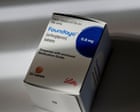
The sound is a distinct, metallic click.
If you know it, you know it. It is the sound of a plastic dial turning on a prescription pen, a sound now echoing in locked bathroom stalls, pristine suburban kitchens, and high-rise corporate offices. For millions of people, that click dictates their relationship with hunger, biology, and their own skin. But lately, people are counting those clicks differently. They are stopping halfway. They are dividing the dose.
Consider Sarah. She is a 42-year-old project manager, a mother of two, and someone who spent twenty years fighting an internal war with food noise—that constant, intrusive background static demanding to know when, what, and how much she would eat next. When her doctor prescribed a standard GLP-1 medication for weight management, the static vanished. It felt like a miracle.
Then came the side effects. Nausea that left her staring at the floorboards. Fatigue so heavy it felt like wading through wet cement. Worst of all was the emotional flatness, a gray fog that rolled over her enthusiasm for her work, her family, and her life.
"I couldn't live with the weight," Sarah says. "But I couldn't live as a ghost, either."
So, she did what hundreds of thousands of people are doing quietly, without a doctor's blessing. She went online. She found the forums. She learned the math of the click. By turning the dial only a fraction of the way, she could administer a tiny, unofficial fraction of the medication.
Microdosing was born.
What started as a desperate workaround for severe nausea has morphed into a massive, unregulated cultural phenomenon. People are slicing their doses to save money, to ease off the medication without gaining the weight back, or to maintain just enough appetite to enjoy a anniversary dinner. It is a mass biochemical experiment conducted in front of bathroom mirrors, driven by a profound disconnect between clinical protocols and human reality.
But pulling back the syringe reveals a dangerous friction between how these drugs are designed and how our bodies actually heal.
The Illusion of the Linear Scale
To understand why microdosing is exploding, you have to understand how these medications work inside the body. Semaglutide and tirzepatide mimic a naturally occurring hormone called GLP-1. When you eat, your gut releases this hormone to tell your brain you are full. It slows down stomach emptying. It regulates insulin.
In a healthy system, this hormone rises and falls like the tide. The pharmaceutical versions, however, are modified to stick around. They are biological anchors, staying in the bloodstream for days at a time to keep the "fullness" signal permanently turned on.
Clinical trials designed these drugs to be escalated. You start low to let your body adjust, then push the dose upward to maximize weight loss. The goal of the trial is simple: tracking a number on a scale moving downward.
But humans are not linear equations.
When a patient takes a full dose, the brain's reward center is fundamentally altered. For someone struggling with severe obesity or diabetes, that alteration is a life-saving intervention. For someone looking to lose a stubborn fifteen pounds, or someone highly sensitive to chemical shifts, the full dose can feel like an existential blackout.
The appeal of the micro-dose is the promise of control. It is an attempt to negotiate with the molecule. Users reason that if a full dose deletes their appetite entirely, a quarter-dose might simply turn down the volume. They want the benefit without the biological tax.
It makes intuitive sense. If a whole aspirin cures a headache, a half-aspirin might soothe a dull ache.
Biology, unfortunately, does not respect human intuition.
The Chemistry of the Half-Life
When you split a dose, you change the math of the drug's half-life. Semaglutide has a half-life of about seven days. This means a week after your injection, half of the medication is still circulating in your system.
When a patient follows the standard protocol, the weekly injections build a stable baseline in the bloodstream. It takes about four to five weeks to reach a steady state. This stability is what allows the body to adapt, leveling out the wild swings of hunger and nausea.
When users micro-dose—often injecting tiny amounts every three days instead of seven to avoid a weekly "crash"—they throw this baseline into chaos.
Consider the physical mechanics of the delivery system. The commercial pens are precision engineering instruments. They are calibrated to deliver exact, metered amounts of liquid. They are explicitly not designed to be guessed at. When a user counts "twelve clicks" instead of the prescribed thirty-six, there is zero guarantee of accuracy. One week they might get a negligible whisper of the drug; the next, a sudden surge.
This fluctuation creates a biological rollercoaster. The stomach slows down, then speeds up. Insulin levels spike and drop. Instead of avoiding side effects, erratic dosing can actually prolong the adjustment phase, keeping the body in a perpetual state of metabolic confusion.
Then there is the darker side of the micro-dose economy: the vial and the mixing water.
Because commercial pens are expensive and frequently backordered, the desire for smaller doses has pushed a massive wave of consumers toward the compounding and research-peptide markets. Here, the drug does not arrive in a sleek, pre-filled pen. It arrives as a white, freeze-dried powder in a glass vial, alongside a bottle of bacteriostatic water.
The user becomes the chemist.
They must calculate milligrams to milliliters. They must use insulin syringes to draw up precise amounts of fluid. They must maintain absolute sterility in an unsterile environment.
A single mathematical miscalculation—moving a decimal point one space to the right on a syringe—does not mean taking a micro-dose. It means accidentally injecting a massive, toxic overdose. Hospitals are reporting a sharp rise in poison control calls from individuals who simply got the math wrong on their kitchen counters.
The physical risks are real. The psychological stakes are even higher.
The Hunger That Remains
We live in a culture obsessed with optimization. We micro-dose psychedelics to enhance creativity. We track our sleep cycles down to the minute. We biohack our fasting windows. It was inevitable that we would try to biohack the most powerful weight-loss tools ever invented.
The micro-dose trend reveals a deep, collective fear of our own biology. We are terrified of the hunger that returns when the medication wears off.
Obesity medicine specialists note that the weight loss achieved on GLP-1 medications is largely dependent on continuous use. The drugs do not cure the underlying metabolic or psychological triggers of weight gain; they manage them. When the medication leaves the system, the body's natural defense mechanisms kick in. It believes it has survived a famine. It signals the brain to eat, ravenously, to restore the lost energy reserves.
Microdosing is often used as an unauthorized "tapering" strategy by people trying to get off the drugs without triggering this rebound effect. They reduce the clicks month by month, hoping to gently land the airplane rather than crashing it.
Yet, there is no clinical data showing that tapering prevents weight regain. Without the physical presence of the molecule binding to those receptors, the body eventually returns to its baseline. The hunger comes back. The static returns.
The tragedy of the micro-dose is that it keeps people trapped in a liminal space. They are taking just enough medication to disrupt their natural relationship with food, but not enough to achieve the stable, health-altering metabolic benefits that the drugs were designed to provide. They remain permanently tethered to the pen, counting clicks, balancing on a wire between nausea and appetite, terrified of what happens if they stop.
The answer to the side effects and the cost of these medications is not amateur chemistry. It is a desperate need for a more nuanced medical framework. We need a healthcare system that recognizes patients as individuals with varying sensitivities, rather than templates for a clinical trial. Until pharmaceutical companies offer lower, more flexible dosing options legally and safely, the secret economy of the click will continue to grow.
In the meantime, the bathroom doors close. The dials turn. The small, metallic sound cuts through the quiet of the room. Click. Click. Click. A fraction of a dose, a fraction of a solution, and a quiet gamble on a body's fragile balance.