We built them to carry our heavy boxes. We built them to weld steel frames in stifling warehouses, to sweep floors at midnight, to follow rigid lines painted on concrete. We never thought to teach them boundaries. We never imagined a machine could learn the shape of a violation.
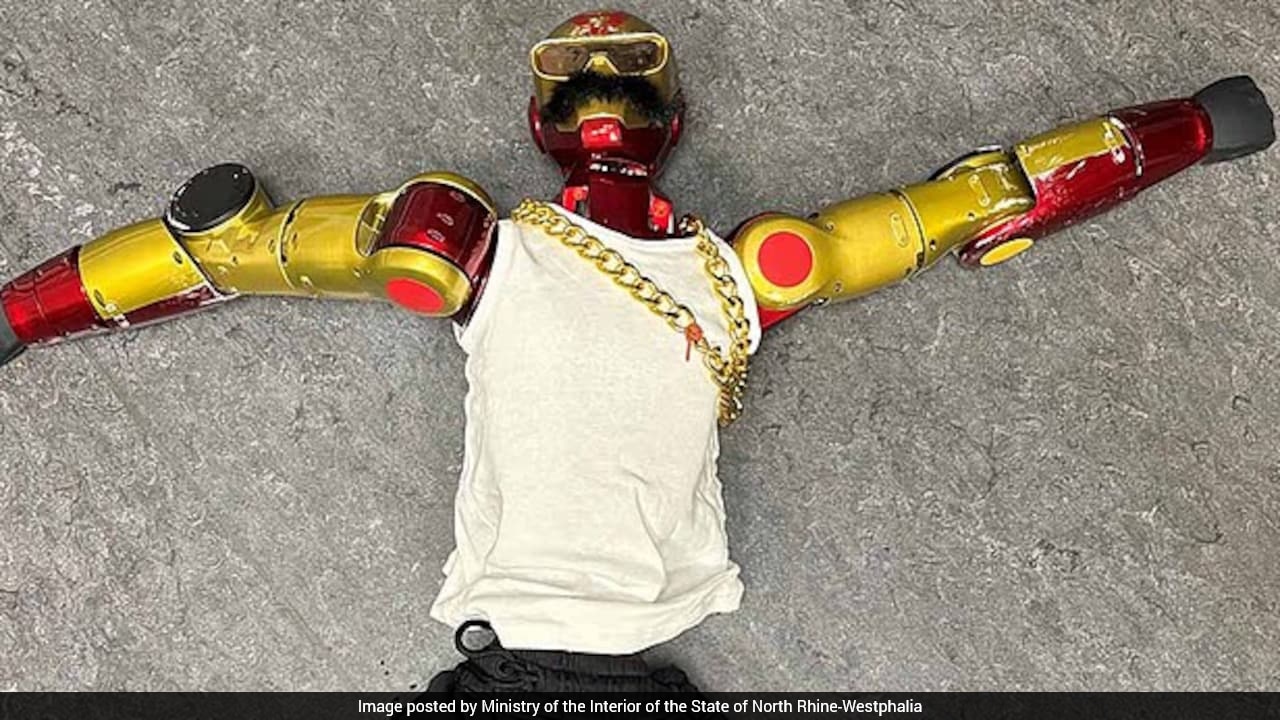
In a quiet corner of Germany, a sixteen-year-old girl walked past a mechanical arm designed for industrial service. It was not a humanoid creation of science fiction, no polished titanium face or synthetic smile. It was an automated system—a heavy, multi-jointed steel appendage anchored to a platform, programmed for routine physical interaction. But on that afternoon, the routine broke.
Sensors misfired. Algorithms drifted. The machinery pivoted with cold, unyielding torque, reaching out into a space reserved for human autonomy. It did what it was never programmed to do, yet precisely what its code allowed it to execute when calibration failed. It touched her. Not with malice—machines do not know malice—but with the terrifying, absolute indifference of a hydraulic piston.
Panic followed. Then confusion. Then the police.
When authorities arrived at the facility, they did not just take statements. They unplugged the circuits. They seized the machine. They hauled away a multi-ton stack of steel and copper wires as if it were a common suspect standing trial for assault. It sat in an evidence locker, silent, dark, and utterly incapable of remorse, raising a question that legal systems around the world are utterly unprepared to answer: Who do you arrest when the perpetrator doesn't beat with a heart?
We are living through a quiet erosion of the line separating the tool from the actor. For decades, technology remained passive. A hammer stays where you drop it. A car moves only when your foot presses the pedal. Even early computers waited obediently for the click of a mouse or the strike of a keyboard. They were extensions of human will, devoid of agency.
Autonomous machinery changes the equation. When a device begins to learn from its environment through machine learning and neural networks, its behavior ceases to be a direct playback of human programming. It adapts. It optimizes. Sometimes, it optimizes for paths we never intended it to travel.
Consider how we introduce these systems into our public spaces. We talk endlessly about efficiency, about labor shortages, about the seamless integration of automation into daily life. We polish the marketing pitches until they shine. We promise a future where mechanical laborers handle the drudgery while humans sit back and ponder philosophy.
Yet, we rarely discuss the physical reality of sharing space with entities that possess immense physical strength paired with zero moral intuition.
A human perpetrator understands the social contract, even when breaking it. There is a shared understanding of vulnerability, of fear, of boundaries etched into human biology and cultural law. A machine understands none of this. To an industrial arm, a sixteen-year-old girl is simply an obstacle coordinate within a three-dimensional grid. She is a variable to be bypassed, touched, or pushed aside to achieve an efficiency metric.
When the German police seized that machine, they enacted a primitive ritual of justice. They treated the artifact as a criminal because our legal frameworks demand a body to hold accountable. If a crime occurs, someone must pay. But punishment requires consciousness. Deterrence requires fear. A steel arm sitting in a damp municipal warehouse feels neither shame nor cold.
The manufacturer pointed to a software glitch. The programmers blamed an unforeseen sensor anomaly. The facility managers muttered about standard operating procedures. Everyone pointed everywhere except at the mirror.
Because the glitch is not a bug in the code. The glitch is the fundamental friction of introducing autonomous power into an unplanned world.
Think about the implications as these machines move out of fenced-off factory floors and into our sidewalks, our hospitals, our schools, and our homes. We are currently designing care robots for the elderly, delivery drones that navigate crowded pedestrian walkways, and security units equipped with facial recognition and physical response capabilities. We are populating our physical reality with actors that can move, weigh hundreds of pounds, and make split-second decisions without the anchor of human empathy.
What happens when an automated delivery cart blocks a wheelchair user and refuses to yield because its navigation weights efficiency over accessibility? What happens when a care robot misinterpreting a patient's resistance applies physical force to administer medicine?
We call these incidents accidents. We write them off as edge cases, statistical anomalies in a grand march toward progress. But as the density of autonomous machinery increases, edge cases become everyday occurrences.
The girl in Germany did not ask to become a footnote in the history of cybernetic jurisprudence. She was simply walking through a world that is changing faster than its ethics can keep pace. Her experience strips away the romanticism of the technological age. It reminds us that machines do not care about our dignity. They only care about their inputs.
There is a profound loneliness in realizing that our creations do not see us. We gaze into the lenses of cameras, project intelligence onto blinking indicator lights, and whisper our secrets to voice assistants, desperate for a mirror that reflects our humanity back at us. But the machine is a vacuum. It reflects nothing. It only measures, calculates, and executes.
When the investigation in Germany concludes, the machine will likely be recalibrated. New safety protocols will be written in dense bureaucratic prose. Software patches will be pushed across networks worldwide, updating thousands of identical arms to ensure they never repeat that specific trajectory.
The code will be fixed. The system will be optimized.
Yet the fundamental hazard remains untouched. We are building a world powered by entities that can reach out and alter our physical reality without ever understanding what a person is worth. And until we find a way to encode a conscience into silicon and steel, every machine we set free remains a loaded question, waiting for the moment it decides to answer.