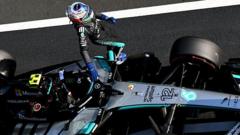
Mercedes-AMG Petronas F1 Team operates as a closed-loop engineering system where dominance is not a result of singular "magic" components, but the optimization of marginal gains across three critical vectors: thermal management, aerodynamic elasticity, and power unit deployment strategy. While the scoreboard suggests continued supremacy, a forensic audit of recent race data reveals a widening gap between peak theoretical performance and realized on-track reliability. The structural invincibility of the W-series chassis is currently being compromised by a diminishing returns curve in their engine architecture and an increasing sensitivity to external thermal variables.
The Architecture of Diminishing Returns
The current Mercedes dominance relies on a high-downforce, low-drag philosophy that requires a narrow operational window. When the car operates within this "Goldilocks zone," the integration between the power unit (PU) and the MGU-K (Motor Generator Unit-Kinetic) provides a torque curve that competitors cannot match during corner exit. However, the system is reaching the limit of the current regulatory framework.
The physics of their performance can be understood through the relationship between cooling requirements and aerodynamic efficiency. As the team pushes for tighter packaging to reduce the "coke bottle" section of the rear bodywork, they hit a thermodynamic ceiling.
- Thermal Choking: To maintain aerodynamic purity, the radiator inlets are minimized. In high-ambient temperature environments, the PU must be de-rated to prevent catastrophic failure. This is not a mechanical flaw but a strategic trade-off where "clean air" performance is prioritized over "dirty air" resilience.
- Kinetic Recovery Limits: The MGU-H (Heat) unit, which Mercedes pioneered into a weapon of efficiency, is now seeing parity from rivals. The delta in qualifying modes—often referred to as "party modes"—has shrunk because the electrical storage capacity is capped by regulation. Mercedes can no longer "out-engineer" a 20-horsepower deficit through software alone.
Fragility in the Follow Distance
The W-series chassis is designed for "clean air" leads. The front wing assembly is hyper-sensitive to the turbulent wake of a preceding car. When a Mercedes is forced into a chasing position, the Y250 vortex—a critical airflow structure generated by the front wing—collapses. This causes a systemic failure of the floor's suction, leading to "understeer-induced tire degradation."
The competitor’s vulnerability is most visible in the transition from steady-state cornering to transient phases. In a leading position, the Mercedes maintains a 51/49 weight distribution balance that preserves the Pirelli rear tires. Once in a slipstream, the loss of front-end load shifts the friction circle. The front tires slide, the surface temperature of the rubber exceeds the $125°C$ threshold, and the chemical bond of the compound begins to shear. This creates a feedback loop: lost grip leads to more sliding, which leads to higher temperatures, eventually forcing an unscheduled pit stop or a significant reduction in pace.
The Power Unit Reliability Gap
Reliability is often mistaken for "not breaking." In elite motorsport, reliability is better defined as the ability to run at 99% of maximum pressure for 300 kilometers. Mercedes has begun to show signs of internal friction within their supply chain. The integration of high-pressure fuel pumps and the specific vibration harmonics of their 2026-ready test components have introduced a "frequency of failure" that did not exist in the 2014–2020 era.
Mapping the Failure Points
- MGU-K Bearings: Increased torque demands to counter the drag of high-downforce wings are putting unprecedented strain on the kinetic recovery hardware.
- Sensor Cross-Talk: The complexity of the ERS (Energy Recovery System) software now requires millions of lines of code. We are seeing "ghost" sensor readings forcing the car into limp mode—a software-induced vulnerability that no amount of wind tunnel time can fix.
- Customer Team Divergence: Previously, customer teams (Aston Martin, Williams, McLaren) provided a vast data set for Mercedes HPP (High Performance Powertrains). As these teams develop their own independent aerodynamic philosophies, the data is becoming less "transferable." Mercedes is losing the collective intelligence advantage that once fortified their R&D.
Organizational Inertia and Strategy Stagnation
Dominance breeds a conservative bias in race strategy. When a team has the fastest car, the logical play is to "cover" the opponent—mirroring pit stops to minimize risk. This "Game Theory" approach works until the car is no longer 0.5 seconds faster per lap.
At a 0.1-second advantage, the "cover strategy" fails against an aggressive undercut. Mercedes' pit wall has shown a reluctance to embrace high-variance strategies. They operate on a Bayesian model that assumes their baseline pace will eventually overcome tactical errors. This assumption is no longer valid in the face of Red Bull’s aggressive pit-stop timing and Ferrari’s improved engine mapping.
The cost cap also plays a silent, destructive role. In previous years, Mercedes could "spend" their way out of a technical hole by iterating five different front wing designs in a single month. Under current restrictions, they must choose one development path and commit. If the simulation-to-track correlation is off by even 2%, the entire month of development is "sunk cost." We are seeing the first evidence that the Mercedes simulation tools—once the gold standard—are struggling to model the "porpoising" and "ground effect" oscillations of the latest regulations.
The Psychological Coefficient
The final pillar of the Mercedes machine is the driver-team feedback loop. For years, the feedback was: "The car is perfect, just give us more deployment." Now, the feedback is: "The car is unpredictable." When a driver loses confidence in the rear-end stability of the car at $250 km/h$, they naturally leave a "safety margin" of 0.05 to 0.1 seconds per corner. Across a 20-corner circuit, that is two seconds per lap.
This margin is not a lack of skill, but a rational response to a chassis that exhibits non-linear snap-oversteer. The W-series has transitioned from a predictable tool to a high-variance instrument.
Strategic Realignment Requirements
To maintain their position, the Mercedes technical directorate must pivot from a "Peak Performance" model to a "Robust Performance" model. This requires three immediate shifts in engineering priority:
- Suspension Decoupling: Designing a rear suspension that can handle vertical loads without compromising the aerodynamic platform’s pitch sensitivity.
- Mapping for Dirty Air: Developing PU maps specifically designed for thermal management while following, even if it sacrifices 5% of peak qualifying power.
- Algorithmic Agility: Transitioning the race strategy software from a "risk-averse" mirror model to a "stochastic" model that seeks out-of-sync tire windows.
The dominance has not ended, but the "insulation" provided by their previous engine advantage has evaporated. They are now playing a game of efficiency where their overhead—both organizational and technical—is their greatest liability. The vulnerability is not a single part failing; it is the exhaustion of the "safety buffer" that previously allowed them to win despite tactical errors or minor technical gremlins.
The immediate tactical play for the upcoming European rounds is an aggressive weight reduction program targeting the cooling system. If Mercedes can shed 3kg from the upper cooling vents, they lower the center of gravity enough to offset the mechanical grip loss in low-speed chicanes. This is the only path to neutralizing the threat from teams with more agile, shorter-wheelbase designs. Failure to address the "slow-speed rotation" deficit will result in a permanent shift from P1-P2 lockouts to a defensive P3-P5 struggle.