Fear sells better than physics.
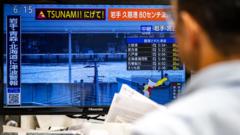
When the Nankai Trough "Megaquake Advisory" flashed across screens, the world reacted with the usual script: panic buying of bottled water, empty hotel rooms in coastal towns, and a global news cycle obsessed with the "Big One." We are told Japan is on "high alert." We are told the risk is unprecedented.
The media loves a looming apocalypse. It’s easy to film a beach with a tsunami siren and call it reporting. But the narrative that Japan is teetering on the edge of a cinematic disaster misses the point so spectacularly that it’s actually dangerous. The real story isn't the quake we’re waiting for; it's the fact that our obsession with "The Big One" obscures the far more systemic, boring, and lethal failures in how we perceive risk.
The Mathematical Fallacy of the 0.1 Percent
Let’s talk about the Nankai Trough. Scientists estimated the probability of a massive earthquake followed by a tsunami increased from its baseline to roughly 1 in several hundred.
Think about that.
The "high alert" was triggered by a probability shift that still left us with a 99.9% chance of absolutely nothing happening on any given day during that week. In any other industry, a 0.1% risk doesn't ground the fleet; it goes into a footnote.
By treating a marginal statistical bump as a definitive omen, we cultivate a culture of "alarm fatigue." When you scream about a megathrust quake every time the crust moves an inch, people stop listening. Then, when a genuine, localized, non-megathrust event happens—like the Noto Peninsula earthquake earlier this year—they are caught off guard because it didn't fit the "Nankai Trough" brand.
Why Tsunami Warnings Are Failing Their Purpose
The standard argument is that more warnings equal more lives saved. I've spent enough time analyzing disaster response data to know that’s a lie. Over-warning leads to economic paralysis and a "boy who cried wolf" psychological profile among the populace.
Look at the cancellations in Miyazaki and Kochi following the recent advisory. Thousands of people fled, not because they were in immediate danger, but because the government needed to cover its legal bases. We are prioritizing liability over logic.
True disaster mitigation isn't about telling everyone to run every time a sensor blinks. It’s about building infrastructure so resilient that the warning becomes secondary. Japan’s building codes are the best in the world, yet the conversation always reverts to primitive fear. We should be discussing the seismic isolation of data centers and the hardening of the power grid—not whether or not a beach in Kyushu is "safe" for a holiday.
The Blind Spot of Seismology
The "lazy consensus" is that we can predict these things with enough sensors. We can't.
Seismology is a retrospective science dressed up as a predictive one. We can map faults. We can measure stress. But we cannot tell you if the Nankai Trough will go tomorrow or in 2050. The "Megaquake Advisory" was a social experiment, not a scientific certainty. It was the government’s attempt to manage public anxiety by appearing proactive.
I’ve seen this before in corporate risk management. When a company doesn't know how to fix a core product flaw, they release a "security advisory" to show they're "on top of it." It’s theater.
If we were serious about seismic risk, we would stop obsessing over the Nankai Trough—which has a well-known, if unpredictable, cycle—and start looking at the "hidden" faults under Tokyo and Osaka that haven't moved in 400 years. Those are the ones that kill. The Nankai Trough is a known quantity. The unknown faults are the ones that turn cities into rubble.
The Real Cost of False Alarms
- Economic Bleeding: Regional tourism, the lifeblood of rural Japan, takes a massive hit every time a "warning" is issued without a follow-up event.
- Resource Misallocation: Local governments spend millions on "readiness" drills for a specific scenario while ignoring the crumbling drainage systems that cause deadly landslides during routine typhoons.
- Psychological Desensitization: After three or four "high alerts" with no movement, the average citizen begins to view these warnings as background noise.
Stop Preparing for the Movie, Start Preparing for the Reality
Most "emergency kits" sold in Tokyo are designed for a three-day camping trip. That’s a fantasy. If a true $M > 8.0$ event hits, the supply chain doesn't reset in 72 hours.
The focus on "high alert" status suggests that we can "wait out" the danger. You can't wait out a tectonic plate. The plate is moving regardless of whether a bureaucrat issues a color-coded warning.
We need to shift the conversation from "When will it hit?" to "How do we function while it’s hitting?" This means decentralized power grids. It means satellite-based internet that doesn't rely on undersea cables that snap during a trench shift. It means moving away from the centralized "smart city" model that creates single points of failure.
The Hard Truth About Japan's Coastal Geography
The competitor's article highlights the "tsunami warning" as a call to action. I see it as a reminder of a tragic geographical reality we refuse to accept: some areas should not be inhabited.
We spend billions on sea walls that provide a false sense of security. The 2011 Great East Japan Earthquake proved that nature laughs at concrete. Instead of "high alert" warnings, we should be having the uncomfortable conversation about managed retreat from the most vulnerable coastal zones.
But no politician wants to tell a fishing village they have to move five miles inland. It’s easier to issue a "warning" and let the people live in a state of perpetual, low-level dread.
The Engineering Ignorance
People ask: "Is the big one coming?"
The answer is: "It’s already here."
The stress on the Philippine Sea plate is constant. It doesn't care about our "high alert" windows. The obsession with the moment of the quake ignores the process of the quake.
We are currently seeing a "slow slip" event in several sectors of the trough. This is actually a good thing—it’s a silent release of energy. But the media frames every subterranean groan as a precursor to the end of the world. They are fundamentally misreading the mechanics of the earth.
The Actionable Order
Stop watching the news for "advisories."
If you live in a coastal area, your house should already be retrofitted. Your water should already be stored. Your evacuation route should be muscle memory.
If you are waiting for a government alert to tell you that the earth is dangerous, you have already lost. The alert is a tool for the state to manage the masses, not a tool for you to save your life.
The Nankai Trough isn't a "threat" to be monitored; it is a permanent feature of the Japanese existence. Treat it with the cold, calculated respect it deserves, and ignore the sensationalist noise that treats a 0.1% probability shift like a Hollywood premiere.
The earth doesn't give warnings. It just moves.
Build accordingly.