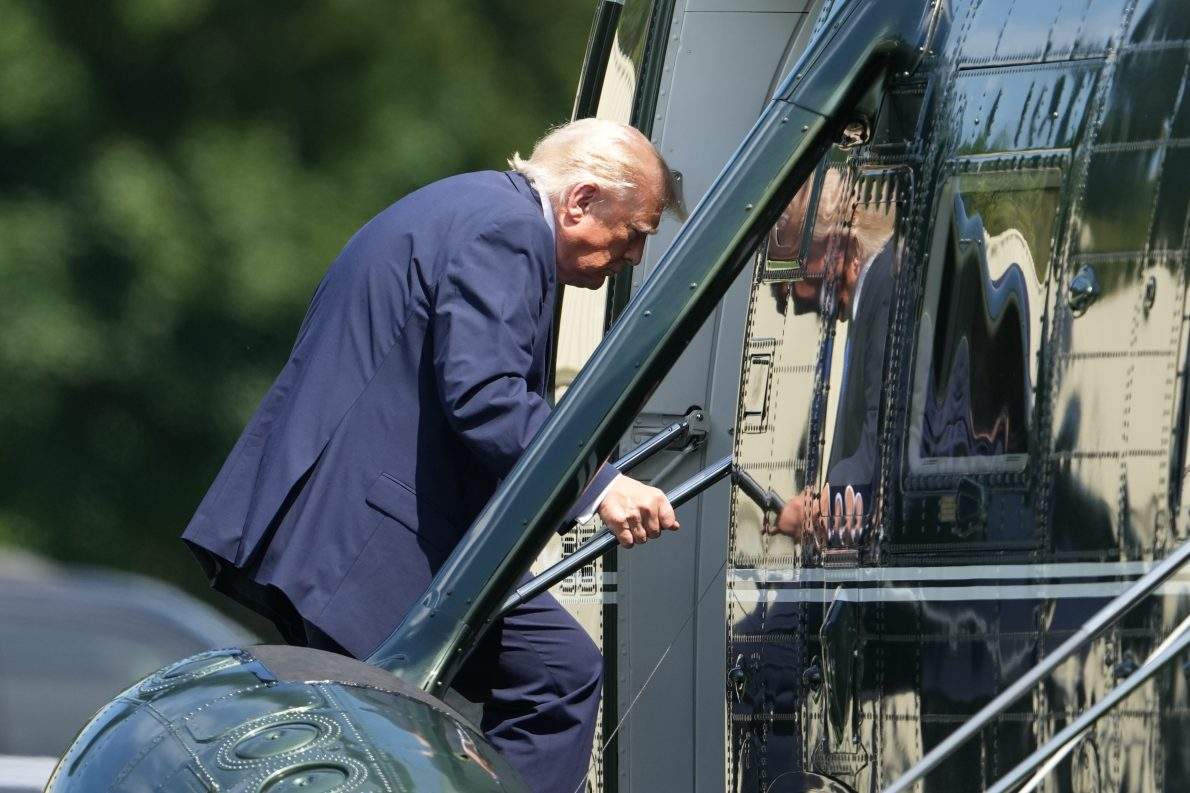
Every time a presidential helicopter shares airspace with a commercial jet and a mainstream outlet catches wind of it, the narrative machine shifts into instant hysterics. Headlines scream about catastrophic near misses, split-second brushes with disaster, and reckless disregard for aviation safety. It makes for fantastic clickbait. It also reveals a profound, embarrassing ignorance of how high-density airspace actually functions above the capital region.
I have spent decades watching armchair commentators freak out over routine separation standards, treating standard vectoring as if it were a high-stakes game of aerial chicken. Let us strip away the sensationalism and look at the actual physics, protocols, and redundancy layers governing the skies around Washington, D.C. If you found value in this post, you might want to check out: this related article.
The Myth of the Narrow Escape
The lazy consensus in modern aviation reporting is that any time two aircraft pass within a mile of each other in restricted airspace, someone nearly died. This is flatly false.
Modern air traffic management relies on precise geometric separation, automated conflict resolution, and layered safety buffers. When a helicopter designated as Marine One encounters a commuter flight or a private twin-engine aircraft near Ronald Reagan Washington National Airport, the public envisions a hair-raising panic in the cockpit. For another angle on this event, see the latest coverage from Al Jazeera.
The reality is radically different.
Commercial and military pilots operate within a strictly choreographed ballet of transponders, Traffic Alert and Collision Avoidance Systems, and direct air traffic control oversight. A proximity event that triggers a mandatory safety report on a desk in Oklahoma City usually registers to the flight crew as a routine adjustment on a radar scope.
The Complexity of the D.C. Corridor
Washington, D.C., features some of the most restricted, heavily monitored, and congested airspace on the planet. The Special Flight Rules Area surrounding the capital is a labyrinth of restricted zones, provisional corridors, and military intercept sectors.
Critics love to point at this density and declare that mixing presidential transport with commercial traffic is an accident waiting to happen. That argument assumes zero redundancy.
Imagine a scenario where a commercial jetliner experiences a complete loss of radio communication while a presidential rotorcraft transits the Potomac corridor. Even in that extreme thought experiment, secondary radar tracks, TCAS resolution advisories, and automatic dependent surveillance-broadcast networks kick in to maintain separation long before visual contact is ever required.
The system is designed to handle human error, mechanical hiccups, and unexpected vector adjustments without breaking a sweat.
Why the Media Keeps Missing the Mark
Journalists covering aviation safety often lack the baseline operational background to distinguish between a safety hazard and a procedural anomaly. They see phrases like deviation from standard altitude or close proximity and translate them into impending doom.
Let us be precise about the terminology. A proximity warning is not a near miss. A separation decrease below a nominal baseline is not a collision course. Controllers routinely compress separation margins in high-density terminal environments to maintain throughput, relying on precise instrument flight rules that have been vetted and refined over half a century.
When a high-profile aircraft like Marine One is involved, the threshold for what constitutes an incident drops to nearly zero. A lateral separation buffer that would go entirely unnoticed over rural Kansas becomes front-page panic when it happens within sight of the Washington Monument.
The Real Vulnerability in the System
If you want to worry about aviation safety, stop staring at professional military pilots flying state-of-the-art rotorcraft with dual-redundant systems and multiple crew members.
The real vulnerability lies in general aviation compliance within congested transitional airspace, where weekend pilots occasionally misread flight plan clearances or drift across boundaries. Even there, the intercept protocols and air defense identification zones ensure that stray aircraft are handled swiftly and professionally by NORAD assets and local controllers.
The obsession with presidential close calls distracts from actual systemic challenges in air traffic control infrastructure, staffing shortages among certified professional controllers, and aging ground-based radar arrays that are slowly transitioning to digital architectures.
Focusing on a routine vector adjustment near a major hub because a VIP happened to be on board is lazy journalism. It sells subscriptions, but it contributes zero value to the conversation on modern airspace safety.
Next time you see a breathless headline about a presidential transport brushing paths with a regional jet, remember that you are reading a story written by people who think an air traffic controller's radar screen looks like a video game.
The sky is vast, the technology is unforgivingly precise, and the professionals running the show know exactly what they are doing. Stop buying the panic.