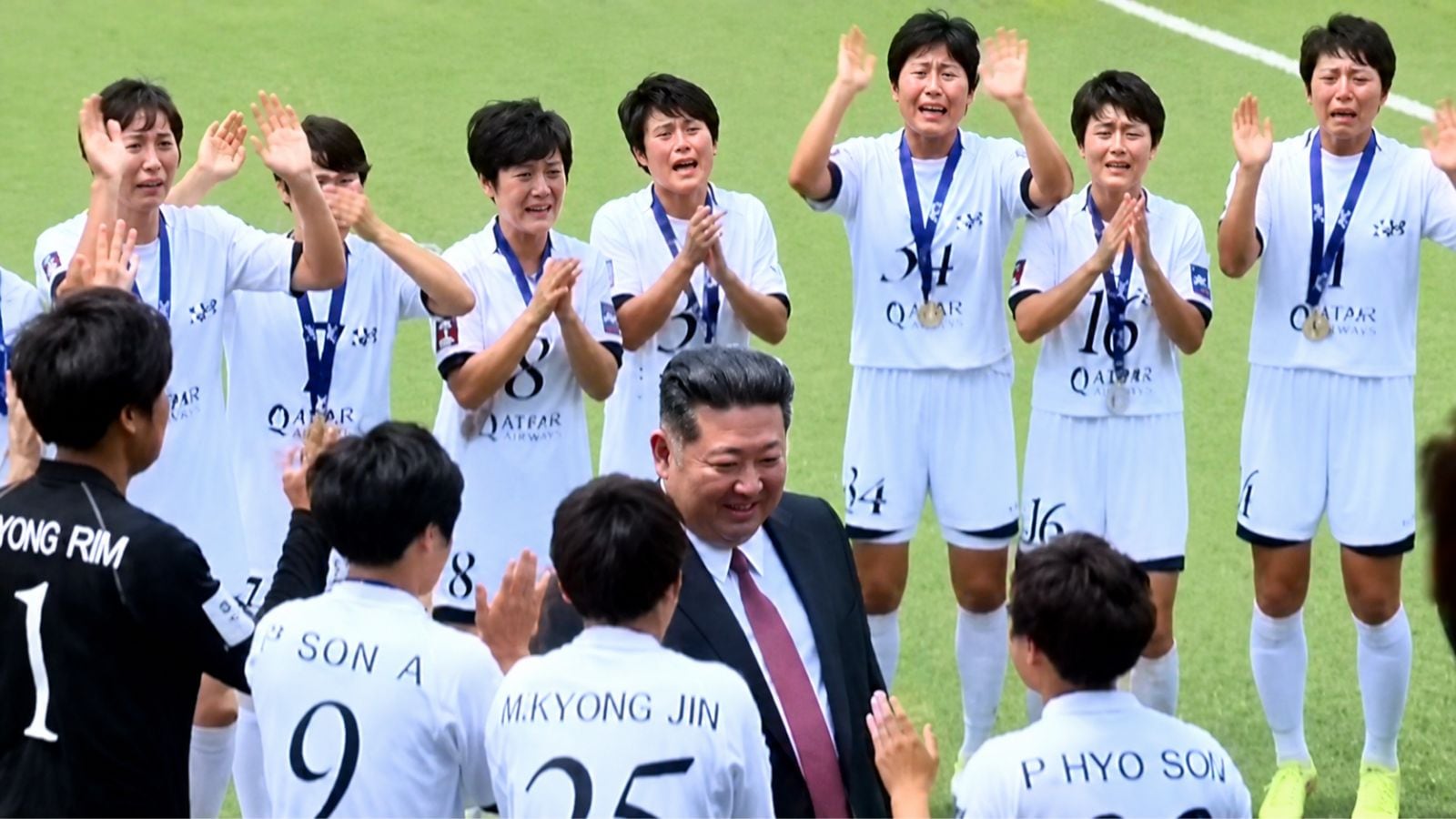
The international dominance of the North Korean Under-20 women’s football team presents an anomaly in sports science and geopolitical analysis. Winning the AFC Champions League and subsequent global titles reveals an underlying operational framework that diverges sharply from Western commercial sports models. Where traditional football programs rely on market incentives, talent scouting pipelines, and corporate sponsorships, the North Korean model operates as a closed-loop system where athletic output is directly tied to political capital and state survival strategies.
Understanding this system requires breaking down the convergence of high-intensity athletic conditioning, psychological engineering, and institutional rewards that dictate the lives of these athletes. The public display of intense emotion during their homecoming—juxtaposing a stoic competitive demeanor with visible weeping upon meeting Kim Jong-Un—is not an isolated psychological event. It is the logical output of a highly calculated optimization function where the state acts as the sole investor, trainer, and arbiter of value.
The Dual Variable Operational Model
The North Korean athletic apparatus operates on two distinct, interacting axes: absolute physical isolation and hyper-centralized resource allocation. Traditional sports management theories analyze performance through the lens of individual autonomy and economic incentive. To decode the North Korean methodology, analysts must apply a state-centric utility model.
State Input (Resource Allocation + Isolation) ➔ Systemic Output (International Prestige + Internal Propaganda)
Absolute Isolation as a Performance Multiplier
In commercial football, players manage competing demands: brand endorsements, club-versus-country conflicts, media scrutiny, and personal agency. The North Korean state eliminates these variables entirely.
- Complete Environmental Control: Athletes train within sealed environments, primarily the Pyongyang International Football School. This eliminates external distractions, cultural shifts, or competing economic incentives.
- Homogenized Tactical Conditioning: Because the player pool remains isolated from global club transfers, the national team functions as a permanent club side. Tactical cohesion reaches levels unattainable by Western national teams that gather only during FIFA international windows.
- Information Asymmetry: Players operate under a single narrative of geopolitical struggle, transforming every international fixture into a high-stakes proxy conflict.
Hyper-Centralized Resource Allocation
North Korea operates under severe macroeconomic constraints, yet its sports development programs receive asymmetric funding. The state applies a strict optimization matrix, directing scarce capital into specific sports that yield the highest return on investment in international prestige. Women's football presents a high-yield opportunity due to lower global historical investment compared to the men's game, allowing a centralized system to bridge the competitive gap rapidly.
The Psychological Cost Function of Elite Performance
The emotional manifestation observed during the team’s return to Pyongyang is often dismissed by casual observers as mere theater or acute stress. A structural analysis reveals it is the manifestation of a complex psychological cost function.
The Asymmetry of Outcomes
For a North Korean athlete, the payoff matrix for international competition is binary and carries extreme variance.
- Victory Payoffs: Elite status, housing allocations in Pyongyang, exemption from manual labor, elevated societal tier (Songbun), and national heroism.
- Defeat Penalties: Loss of state patronage, career termination, ideological re-education, and systemic downgrading of family status.
This structural reality creates a cognitive framework where performance is driven by survival utility rather than self-actualization. The weeping observed in the presence of the leadership is the psychological release of a high-pressure system where the penalty for failure is total, and the reward for success is survival and elevation within a closed hierarchy.
Ideological Syntonization
The training regimen embeds political indoctrination directly into physical conditioning. Tactical errors are categorized not merely as technical deficiencies but as ideological failures. Conversely, physical endurance is framed as a manifestation of revolutionary will. When the team wins, the credit is systematically decoupled from individual agency and assigned entirely to the state's leadership. The athlete becomes an extension of the state's apparatus, validating the systemic efficacy of the regime on the global stage.
Tactical Integration and Physical Metrics
The on-pitch performance of North Korean youth teams reflects their structural conditioning. Analysts monitoring their matches observe specific physical and tactical patterns that correlate directly with their training environments.
Hyper-Pressing and Metabolic Efficiency
The team’s tactical identity relies on a relentless, high-intensity pressing system sustained across 90 minutes. In Western clubs, this style is limited by player fatigue management and injury prevention protocols dictated by player asset value. In the North Korean model, the state prioritizes immediate collective output over long-term individual career longevity. The training emphasizes extreme metabolic conditioning, resulting in a physical work rate that systematically disrupts the rhythmic possession play of technically superior opponents.
Systemic Redundancy
Because the talent pipeline is standardized across the country's specialized sports academies, individual players are highly interchangeable. If a player suffers an injury or experiences a drop in form, the system replaces them with an identical asset trained under the exact same tactical blueprint. This eliminates the dependency on "star players" that characterizes Western squads, making the team highly resilient to individual variance.
Institutional Limitations and Systemic Fragility
While the closed-loop model produces highly disciplined, physically dominant youth teams, it encounters a structural bottleneck when transitioning to senior-level global football.
The Innovation Deficit
Isolation prevents exposure to evolving tactical trends, sports science innovations, and advanced analytical software utilized in top-tier global leagues. While raw physical conditioning and rigid tactical adherence suffice at the U-20 level, senior international football requires fluid adaptation, individual creativity, and real-time problem-solving—traits that a hyper-regimented system inadvertently suppresses.
Geopolitical Constraints on Development
The inability of North Korean players to sign with elite European or American clubs limits their exposure to the highest levels of competition. Without this weekly pressure cookers, senior squads plateau, explaining why their youth teams frequently win World Cups while the senior team struggles to maintain a consistent top-ten global ranking.
The emotional homecoming of the North Korean women’s national team is the visible baseline of a highly sophisticated, high-stakes state enterprise. It serves as a reminder that sports, under specific geopolitical parameters, ceases to be entertainment and becomes a core instrument of statecraft, powered by an optimization engine that trades individual autonomy for collective geopolitical utility.