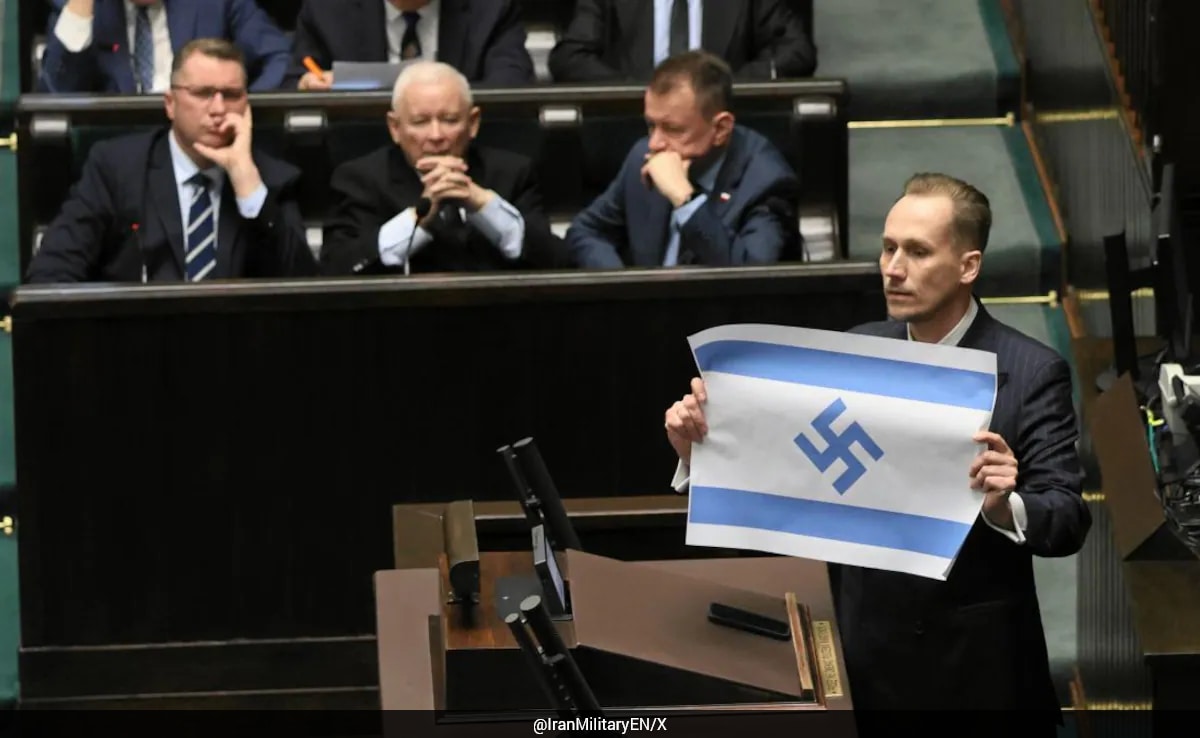
The incident involving a member of the Polish Parliament defacing the Israeli flag with a swastika is not a random outburst of bigotry; it is a calculated application of Symbolic Escalation Theory. This tactic functions by hijacking the national media cycle to consolidate a fringe base through high-stakes social transgression. By superimposing the primary symbol of the Holocaust onto the flag of the Jewish state, the actor forces a binary choice upon the public: total condemnation or unspoken alignment. This creates a feedback loop that increases the actor's visibility while simultaneously degrading the diplomatic capital of the state.
The Architecture of Political Transgression
To understand the strategic utility of this act, we must categorize the maneuver into three distinct operational pillars.
1. Information Asymmetry and Attention Capture
In a crowded political marketplace, attention is the scarcest resource. Traditional legislative work offers a low Return on Effort (ROE) regarding public visibility. Conversely, the use of high-charge symbols (the swastika and the Star of David) triggers an immediate, visceral response from both domestic and international media. The "cost" of the act—international condemnation and potential legal repercussions—is viewed by the provocateur as a capital investment in brand differentiation. The goal is to occupy the "Maximum Friction" quadrant of the political spectrum, ensuring that no other news story can compete for the 24-48 hour window following the event.
2. The Inversion of Historical Narratives
The specific choice to use a swastika on an Israeli flag represents a deliberate narrative inversion. This is a psychological operation intended to strip the target of their status as a historical victim and reframe them as an aggressor. By utilizing the iconography of the Third Reich—the very entity that carried out the Holocaust on Polish soil—the actor attempts to short-circuit the historical memory of the Polish public. This creates a cognitive dissonance where the symbol of the oppressor is used to "brand" the descendant of the victim, effectively neutralizing the moral weight of historical precedents in modern debate.
3. Intra-Coalition Stress Testing
Provocations of this magnitude serve as a stress test for governing coalitions. When a member of the opposition or a fringe element of a coalition performs such an act, it forces the executive branch into a defensive posture. The government must choose between:
- Aggressive Censure: Risking the alienation of the far-right voter bloc.
- Passive Disavowal: Damaging international relations, specifically with the United States and Israel.
- Legal Prosecution: Risking the creation of a political martyr.
Quantifying the Diplomatic Decay Function
The impact of this incident on Polish-Israeli relations can be measured through the Diplomatic Decay Function. This model suggests that every instance of state-sanctioned or high-level political antisemitism reduces the efficacy of formal diplomacy by a measurable percentage.
The primary bottleneck in Polish foreign policy remains the "History Laws" and the ongoing tension regarding Holocaust restitution and narrative control. When a Member of Parliament (MP) engages in blatant antisemitic imagery, the following structural damage occurs:
- Trust Deficit Accrual: Diplomatic backchannels, which rely on the assumption of shared basic values, are shuttered.
- Security Cooperation Friction: Poland and Israel maintain significant intelligence and defense interests. Public outrages force these collaborations into the shadows, making them harder to sustain and fund.
- Economic Risk Premiums: While trade rarely halts over a single flag-burning incident, the accumulation of "instability markers" increases the perceived risk for international investors sensitive to social governance (ESG) metrics.
The Legal and Parliamentary Mechanism of Accountability
The Polish Sejm (Parliament) operates under a specific set of rules regarding "Deputy Immunity" and the "Ethics Committee." Understanding the limitations of these systems explains why such provocations often go unpunished for long periods.
Parliamentary Immunity as a Shield
In many European democracies, immunity is not just a perk but a constitutional safeguard designed to prevent the executive from arresting political opponents. However, this creates a loophole where "hate speech" or "desecration of national symbols" (which is a crime in Poland) becomes difficult to prosecute. The process to strip a deputy of immunity is cumbersome, requiring a majority vote that is often delayed by procedural maneuvering.
The Ethics Committee Bottleneck
The Ethics Committee often lacks the "teeth" to do more than issue a reprimand or a fine. In the context of a politician seeking to appeal to a radicalized base, a fine is not a deterrent; it is a marketing expense. The reprimand is framed to their followers as "persecution by the globalist elite," further fueling the actor’s narrative of being a truth-teller suppressed by the system.
Psychological Triggers and the "Overton Window"
The ultimate strategic goal of the swastika incident is the manipulation of the Overton Window—the range of policies or ideas acceptable to the mainstream population. By introducing an extreme, taboo-breaking act, the provocateur makes previously "extreme" rhetoric (such as general anti-immigrant sentiment or standard nationalism) appear moderate and reasonable by comparison.
This is a Phase Shift strategy:
- Phase 1 (The Outrage): Perform an act so offensive it dominates the conversation.
- Phase 2 (The Reframing): Defend the act as "freedom of speech" or "historical critique," shifting the debate from the symbol itself to the right to express it.
- Phase 3 (The New Baseline): The public becomes desensitized. The next time a slightly less offensive act occurs, the reaction is muted.
The systemic failure to address the first phase effectively ensures the success of the subsequent phases.
Strategic Risks and the Law of Unintended Consequences
While the provocateur gains short-term visibility, the long-term risks to the Polish state are non-linear. The primary risk is International Pariah Status. Poland has spent decades positioning itself as the primary eastern flank of NATO and a key player in the European Union. These types of incidents provide ammunition to geopolitical rivals who wish to frame Poland as a regressive, unstable democracy.
Furthermore, there is the risk of Reciprocal Radicalization. When one side of the political aisle utilizes extreme symbols, the opposing side often feels compelled to adopt equally extreme measures to signal their opposition. This erodes the "Civic Center," making bipartisan governance on critical issues—such as energy security or defense spending—nearly impossible.
The Execution of a Counter-Strategy
To neutralize a provocation of this nature, the response must move beyond rhetoric and into structural reform.
The first step is the Decoupling of Visibility from Validation. Media outlets must report the incident without providing the actor a live platform to justify the act. Reporting should focus on the legal and diplomatic consequences rather than the "meaning" of the symbol, which denies the actor the narrative control they crave.
The second step is the Acceleration of Parliamentary Sanctions. The time between the act and the punishment must be compressed. In logistics, this is known as "reducing lead time." By stripping immunity or imposing maximum financial penalties within 72 hours, the state demonstrates that the cost of provocation exceeds the marketing benefit.
Finally, the state must engage in Pre-emptive Narrative Anchoring. This involves the government taking a proactive stance on historical education and international friendship before crises occur. This builds a "Resilience Buffer" in the public consciousness, making it harder for a single MP to derail the national image with a single piece of cloth and a marker.
The path forward requires a cold, clinical application of rule-of-law principles. Relying on "outrage" is a losing game; outrage is exactly what the provocateur is selling. The only effective counter-measure is a systematic increase in the cost of such political theater until the ROE becomes negative. The state must move from a reactive posture to a proactive enforcement of the standards of civil discourse, ensuring that the parliamentary seal is not used as a shield for the desecration of the very values it is meant to uphold.