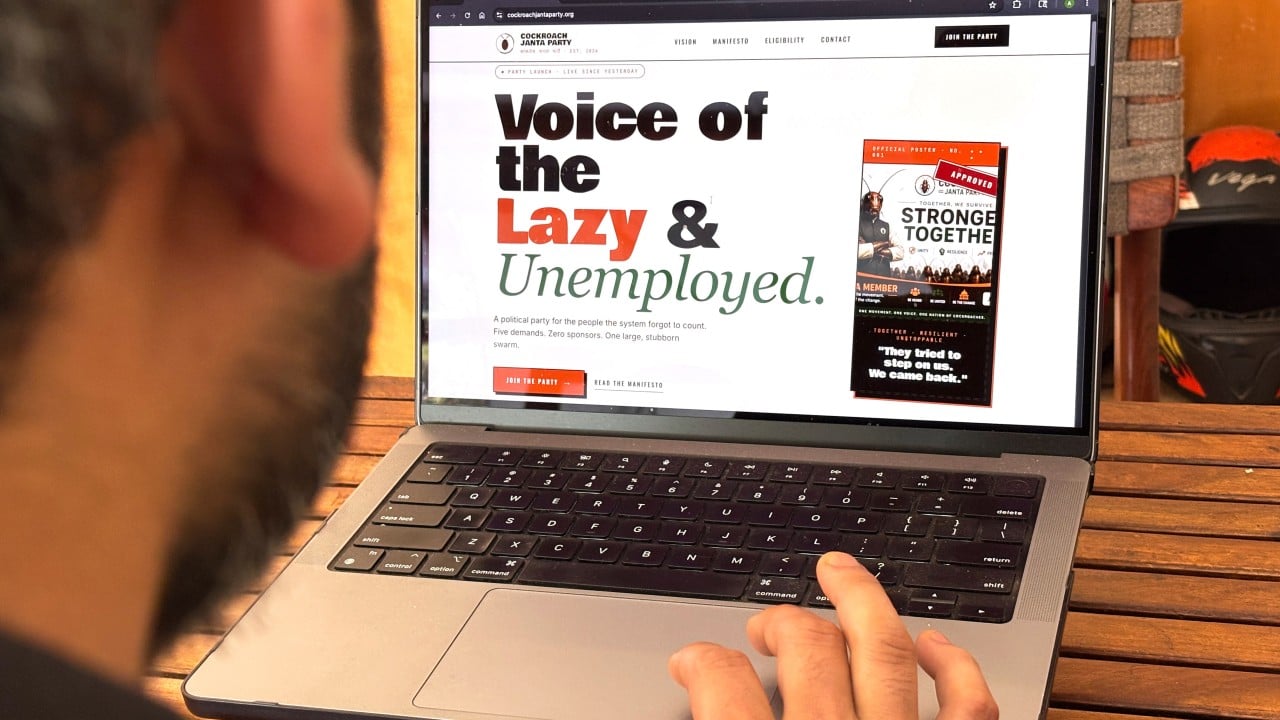
The emergence of the "Cockroach Party" in India represents a sophisticated shift in the cost-structure of political dissent. While traditional protests rely on physical massing—a high-friction activity subject to state regulation and logistical exhaustion—parody movements utilize asymmetric psychological warfare to degrade the perceived authority of the ruling class. This movement is not merely a display of youthful frustration; it is a strategic application of the "carnivalesque" theory of social disruption, where the subversion of symbols creates a low-cost, high-visibility entry point for political participation. By adopting the identity of an insect characterized by resilience and unwanted ubiquity, these protestors have institutionalized a metaphor for the survival of the marginalized within a hostile urban ecosystem.
The Symbolic Arbitrage of the Cockroach Identity
In political communications, the choice of a mascot dictates the boundaries of the discourse. Unlike the lion or the lotus, symbols that imply nobility or purity, the cockroach is a biological extreme defined by high adaptability and low social status. The strategic utility of this choice lies in its immunity to traditional political attacks. You cannot "insult" a group that has already claimed the lowest rung of the biological hierarchy. This creates a defensive shield: when the state or opposing parties attempt to disparage the protestors, they merely reinforce the protestors’ chosen identity.
The movement operates on three structural pillars:
- De-escalation of Physical Risk: By framing dissent as a "parody," participants create a legal and social buffer. Traditional protests often carry the risk of criminal charges; parody movements exist in a grey zone where the state’s use of force appears disproportionate to the "absurdity" of the gathering.
- Radical Inclusivity through Low Barriers to Entry: Traditional political affiliation requires ideological alignment and often financial or temporal commitments. The "Cockroach" identity requires only the admission of shared struggle, effectively lowering the "transaction cost" of joining a protest movement.
- Viral Portability: Parody is optimized for the attention economy. A visual image of people mocking the formal structures of a political party is more likely to achieve organic reach than a standard list of grievances.
The Economic Logic of Political Parody
The "Cockroach Party" functions as a response to the narrowing of the formal political marketplace. In an environment where the costs of starting a legitimate political party—capital, licensing, media buy-in, and grassroots infrastructure—are prohibitively high, parody serves as a "bootleg" version of political competition. It occupies the same mindshare as a real party without the overhead.
This phenomenon can be analyzed through the lens of Incentive Compatibility. For a young Indian citizen facing high unemployment and inflation, the return on investment for traditional voting may feel negligible. However, the return on investment for participation in a parody movement is immediate: social validation, the psychological relief of humor, and the visibility of one's grievances.
The Bottleneck of Absurdity
While effective at capturing attention, parody movements face a structural bottleneck regarding policy impact. The very humor that makes the movement viral limits its ability to negotiate with formal institutions. This creates a Credibility Gap. If a movement is built on the premise of being a joke, it finds difficulty in pivoting to serious legislative demands without losing its core identity.
The transition from parody to policy requires a "translation layer"—usually a secondary group of serious political actors who take the energy generated by the parody and channel it into specific legal or social reforms. Without this layer, the "Cockroach Party" risks becoming a closed-loop system: it generates high levels of internal satisfaction and social media engagement but fails to alter the external political reality.
The Signaling Function of Resilience
The choice of the cockroach as a totem is a specific signal of Long-term Persistence. In biological terms, cockroaches are known for surviving extreme conditions that kill more "advanced" organisms. By adopting this label, the youth are signaling to the government that they are prepared for a war of attrition. They are stating that even if their formal organizations are disbanded or their leaders are suppressed, the underlying sentiment will persist in the "cracks and crevices" of society.
This is a direct challenge to the state's traditional methods of suppression. Governments are designed to fight organized hierarchies. They struggle to combat decentralized, fluid metaphors. The "Cockroach Party" does not have a central headquarters that can be raided; it is a memetic infection that lives in the collective consciousness of the disillusioned.
Strategic Implications for Governance and Opposition
The rise of parody-based dissent changes the risk assessment for state actors. The traditional "Iron Fist" approach—arrests and crackdowns—becomes a liability when used against a group that is essentially mocking itself. If the state arrests someone for pretending to be a "cockroach," the state appears to have lost its sense of proportion, which further erodes its authority.
For the opposition, the "Cockroach Party" provides a roadmap for Asymmetric Brand Building. It demonstrates that you do not need a massive budget to dominate the news cycle; you need a compelling, self-deprecating narrative that resonates with the lived experience of the majority.
The critical path forward for this movement lies in its ability to convert its "metaphorical capital" into "social capital." This involves moving beyond the parody and into the space of mutual aid—using the network of "cockroaches" to provide the very services (education, food, legal aid) that the formal parties have failed to deliver. This shift transforms the group from a satirical performance into a shadow social infrastructure.
The state must recognize that the "Cockroach Party" is a lead indicator of structural systemic failure. When a significant portion of the youth finds more dignity in identifying as a pest than as a citizen of the current political order, the "Social Contract" has effectively breached. The response cannot be more propaganda; it must be a fundamental recalibration of the economic and social opportunities provided to the demographic that currently sees itself as the "unwanted" survivors of the nation’s progress.
Future political stability depends on whether the formal system can re-absorb this energy or if the parody becomes the primary vehicle for political expression, leading to a permanent decoupling of the citizenry from the state. The move from parody to utility is the only sustainable trajectory for a movement that seeks more than a momentary laugh at the expense of the powerful.