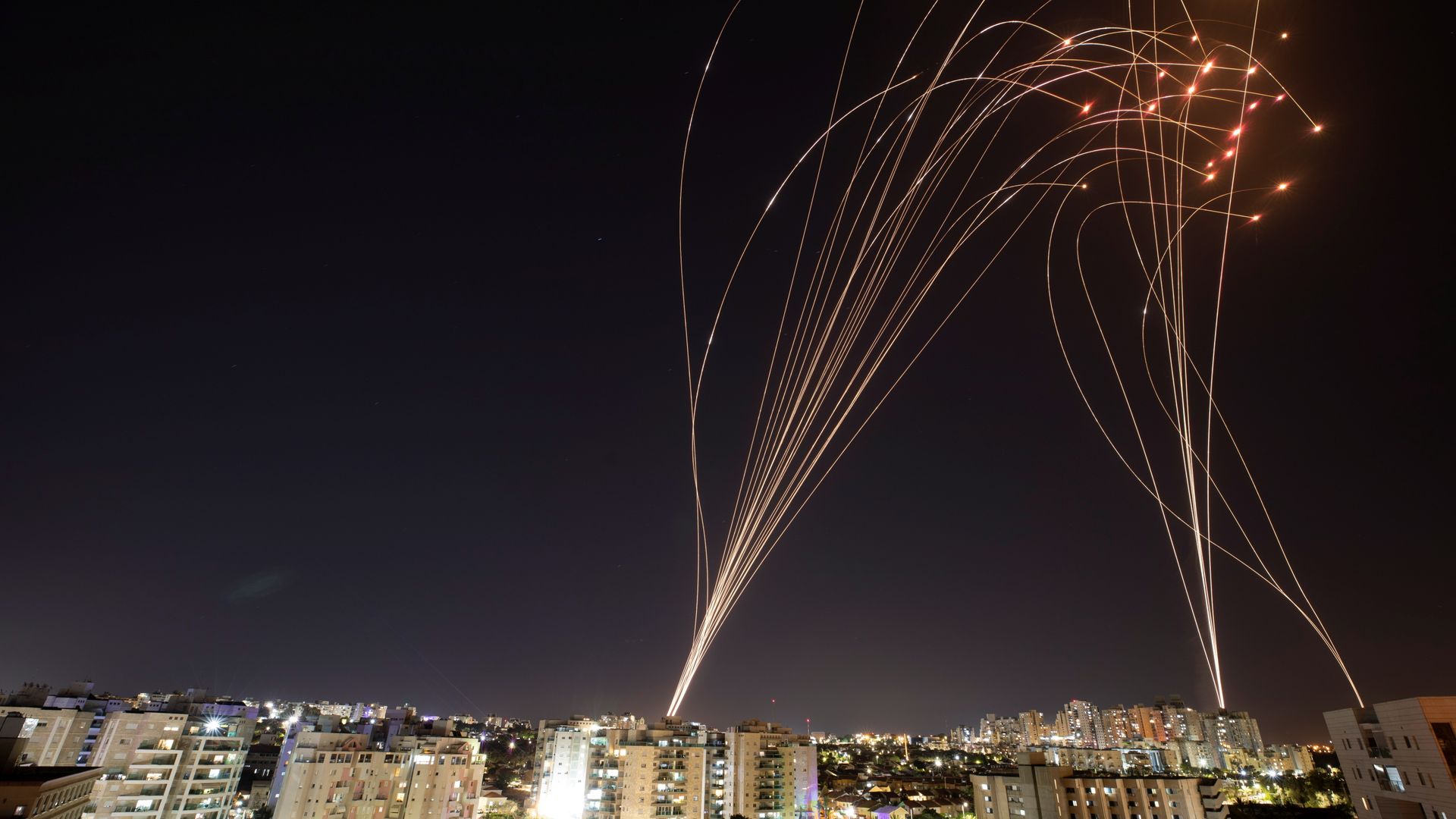
When the state-owned defense manufacturer Rafael Advanced Defense Systems reported that the Iron Dome air defense system achieved an interception rate fluctuating between 98% and 99% across a pool of roughly 40,000 short-range rockets, the figure was widely repeated as an absolute measure of strategic invulnerability. This interpretation mistakes a localized mathematical tracking metric for a complete geopolitical solution. Air defense is not a static shield; it is a dynamic resource-allocation problem defined by finite sensor bandwidth, precise kinematic constraints, and asymmetrical economic math.
To understand why a system can be 99% effective yet remain vulnerable to saturation requires breaking down the system into its component functional parts, analyzing its optimization algorithms, and calculating the structural cost curves that govern its long-term viability.
The Three Pillars of Kinetic Interception
The Iron Dome operates as a distributed, modular network designed to solve an optimization problem under extreme time constraints. A single operational battery does not function as a self-contained unit in isolation; instead, it relies on a tripartite structural division of labor that isolates detection, processing, and kinetic execution into distinct nodes.
[Inbound Threat]
       │
       ▼
 1. DETECTION ──────► EL/M-2084 Active Electronically Scanned Array (AESA) Radar
       │
       ▼
 2. PROCESSING ─────► Battle Management & Weapon Control (BMC) Algorithmic Filtering
       │
       ▼
 3. EXECUTION ──────► Tamir Interceptor Missile Firing Unit (MFU) Engagement
1. Detection: The EL/M-2084 Radar
The initial layer is the EL/M-2084 Active Electronically Scanned Array (AESA) radar, developed by Elta Systems. Unlike legacy mechanically scanned radar dishes that physically rotate to scan the horizon, an AESA radar utilizes an array of hundreds of miniature transmit/receive modules. By electronically shifting the phase of the radio waves emitted by these modules, the radar steers its beam across a 360-degree hemispheric volume almost instantaneously. This configuration allows the system to detect unguided short-range rockets, artillery shells, and mortar rounds (RAM) at distances ranging from 4 to 70 kilometers, even under adverse weather conditions or high-clutter environments.
2. Processing: The Battle Management & Weapon Control (BMC)
Once the radar registers an airborne contact, the raw tracking data is passed to the Battle Management & Weapon Control (BMC) center. The BMC is the algorithmic core of the platform. It calculates the ballistic trajectory of the incoming projectile by mapping its velocity, altitude, and deceleration profile against a known gravitational model.
Because the unguided projectiles fired by regional adversaries like Hamas or Hezbollah follow fixed, predictable ballistic arcs once their rocket motors burn out, the BMC can extrapolate the precise coordinates of the impact point within seconds of launch. If the calculated impact coordinates fall inside a designated open area—such as empty desert, agricultural fields, or the sea—the system classifies the threat as a zero-value target and declines to engage. An interceptor is only committed if the predicted impact point intersects with a designated defended zone, such as high-density urban populations or critical infrastructure.
3. Execution: The Tamir Interceptor
The final element is the Missile Firing Unit (MFU). A standard operational battery features three to four independent launchers, each housing 20 Tamir interceptor missiles. The launchers are intentionally decoupled from the radar and BMC, communicating via secure wireless data links. This scattered footprint prevents an enemy from destroying an entire battery with a single counter-battery strike.
When a launch command is given, the Tamir missile is expelled from its canister. The Tamir is not a simple heat-seeking missile; it is a highly maneuverable kinetic asset equipped with steering fins and an advanced electro-optical seeker. While in transit, the missile receives real-time trajectory updates from the BMC via a command data link to correct its course. As it approaches the intercept point, its onboard proximity fuse activates, detonating its warhead near the incoming rocket to neutralize the target's payload mid-air before it reaches its terminal descent phase.
Deconstructing the 99 Percent Efficiency Metric
The claim of "almost 99% effectiveness" requires strict qualification. In combat systems engineering, effectiveness is not measured against the total volume of ammunition fired by an adversary; it is measured exclusively against the subset of threats that the system deliberately chooses to engage.
$$Interception\ Rate = \frac{Successful\ Interceptions}{Total\ Interceptors\ Launched}$$
Consider a hypothetical operational scenario where an adversary launches a salvo of 1,000 short-range unguided rockets:
- Initial Filtering: The EL/M-2084 radar detects all 1,000 projectiles. The BMC processes their trajectories and determines that 800 of them will land harmlessly in uninhabited terrain. These 800 are intentionally ignored.
- The Threat Pool: The remaining 200 rockets are calculated to hit a major civilian population center. These 200 represent the actual threat pool.
- Engagement: The system fires Tamir interceptors to neutralize these 200 targets. If 198 are destroyed in flight and 2 bypass the defense to strike the city, the statistical success rate of the interceptor mechanism is calculated as $198 / 200$, yielding a 99% interception rate.
While mathematically accurate, the real-world consequence is that two high-explosive warheads still impact an urban center. If the incoming salvo scales up by an order of magnitude—a strategy routinely deployed to pressure air defense networks—the absolute number of leaks grows, even if the system retains its high percentage efficiency.
The Strategic Saturation Bottleneck
The primary vulnerability of any modern air defense architecture is not a failure of accuracy, but the physics of saturation. This bottleneck is governed by a strict mathematical function involving tracking bandwidth, engagement cycle times, and interceptor depth.
A single Iron Dome battery protects an estimated area of 150 square kilometers. However, the system's ability to defend this footprint is constrained by the maximum number of simultaneous targets the BMC can track and guide interceptors toward at any single moment.
If an adversary fires a coordinated, synchronized volley that exceeds the real-time tracking capacity of the radar or the processing throughput of the BMC, the system encounters a software bottleneck. The algorithm must prioritize targets based on a hierarchy of lethality, allowing lower-priority threats to pass unengaged.
The second, more absolute bottleneck is physical inventory depletion. Each launcher holds 20 missiles, giving a standard four-launcher battery a maximum immediate capacity of 80 interceptors. Because the system frequently fires two Tamir missiles at a single incoming threat to maximize the probability of kill ($P_k$) against high-value vectors, a battery can deplete its ready-to-fire inventory after engaging fewer than 50 real threats.
Once these canisters are empty, the battery must undergo a physical reload process. This creates a critical window of vulnerability where the defended zone is entirely exposed to subsequent waves of attack.
The Cost Function of Asymmetrical Attrition
The long-term sustainability of an air defense framework is dictated by an economic equation: the cost-exchange ratio between the offensive vector and the defensive interceptor.
[Adversary Offense]                         [Israeli Defense]
Qassam/Katyusha Rocket                      Tamir Interceptor
Cost: $300 - $1,000                         Cost: $40,000 - $50,000
    │                                           │
    └───────────────────► ASYMMETRY ◄───────────┘
                    Ratio: ~40:1 to 160:1
A standard unguided Qassam rocket produced in localized clandestine workshops costs between $300 and $800 to manufacture. Factory-grade Katyusha or Grad rockets imported or smuggled through regional networks cost roughly $1,000 to $5,000 per unit. These weapons are fundamentally cheap, relying on basic industrial steel tubes, solid propellant mixers, and rudimentary impact fuses.
In stark contrast, a single Tamir interceptor missile costs between $40,000 and $50,000. This price tag reflects the precision engineering required for miniaturized solid-fuel rocket motors, dynamic steer-by-wire fin actuators, high-bandwidth data receivers, and advanced electro-optical proximity sensors.
When mapping this onto an economic cost function, the asymmetry is stark:
$$\text{Cost-Exchange Ratio} = \frac{\text{Cost of Tamir Interceptor}}{\text{Cost of Offensive Rocket}}$$
Using conservative estimates, this yields a ratio ranging from 40:1 to more than 160:1 in favor of the attacker.
For every million dollars an adversary spends on mass-produced artillery rockets, the defending nation must expend between $40 million and $160 million in high-tech interceptors to neutralize the subset of threats threatening populated zones. While the economic value of a human life or a critical electrical grid node justifies this expenditure in the short term, this fiscal divergence creates a structural drain on national defense budgets during a prolonged war of attrition.
This financial strain is partially mitigated by foreign military financing—specifically multi-billion-dollar emergency replenishment packages provided by the United States government—but the underlying macroeconomic imbalance remains an structural vulnerability.
Network Architecture and Layered Vulnerabilities
To accurately assess contemporary air defense, the Iron Dome must not be evaluated as a standalone solution for every airborne threat. It is explicitly optimized for short-range, low-velocity, unguided ballistic trajectories. It lacks the kinematic capability to intercept high-altitude, high-velocity theater threats.
To address this, Israel utilizes a strictly defined multi-layered defense architecture. Each layer is engineered to address a specific kinematic envelope, with higher layers stepping in when a threat's speed, altitude, or maneuverability outstrips the layer below it.
| Layer | System | Target Profile | Operational Range |
|---|---|---|---|
| Lower | Iron Dome | Short-range rockets, artillery, mortars, small unguided UAVs | 4 – 70 km |
| Intermediate | David's Sling | Large-caliber tactical rockets, short-range ballistic missiles, cruise missiles | 40 – 300 km |
| Upper | Arrow 2 & Arrow 3 | Exo-atmospheric theater ballistic missiles, long-range heavy payloads | Up to 2,400 km |
This specialization means that if an adversary alters its attack mix—for example, by bypassing short-range salvos and launching low-flying, terrain-hugging cruise missiles or maneuvering loitering munitions (drones)—the Iron Dome's radar and interceptor configuration can face operational challenges.
Cruise missiles do not follow a predictable ballistic arc; they utilize active guidance to change direction, flying underneath traditional radar horizons to exploit terrain masking. While recent software updates have expanded the Iron Dome's capabilities to engage slower-moving unmanned aerial vehicles (UAVs), high-speed maneuvering cruise missiles or medium-range ballistic missiles require handing off tracking data to the more expensive David's Sling or Arrow networks, where an individual interceptor can cost upwards of $1 million to $3 million.
The Strategic Shift to Laser Integration
The operational realities of saturation vulnerability and severe economic asymmetry have forced a pivot away from purely kinetic-based interception models. The future configuration of this defensive network relies on integrating directed-energy weapons, specifically the Iron Beam laser air defense system.
The Iron Beam is engineered to complement, rather than replace, the Iron Dome by addressing its primary structural vulnerabilities:
- Zero-Cost Per Interception: Unlike the $40,000 Tamir missile, a high-energy laser system costs roughly $2 to $5 per shot—the raw electricity cost required to generate and sustain the thermal beam. This completely flips the cost-exchange ratio back in the defender's favor.
- Infinite Magazine Depth: A laser weapon is never subject to a physical reload bottleneck. As long as the underlying electrical generators remain operational and the cooling loops can dissipate excess thermal buildup, the system can continuously engage incoming targets without a drop in readiness.
- Sub-Second Speed-of-Light Engagement: By targeting threats with a high-energy fiber laser at the speed of light, the time between target allocation and target destruction is reduced to a fraction of a second, significantly increasing the system's real-time bandwidth against dense salvos.
However, directed energy introduces its own rigid physical limitations. Laser beams suffer from atmospheric attenuation, meaning that fog, heavy rain, low-altitude cloud cover, or airborne dust particles scatter the light energy and drastically reduce the system's effective range and thermal focus.
Furthermore, a laser requires a persistent "dwell time" of several seconds on a single spot of an incoming rocket casing to heat the metal to its structural failure point or detonate its warhead. During this dwell time, the system cannot engage other targets, meaning that it can still be overwhelmed by large, simultaneous salvos.
The long-term operational play is a hybrid deployment. The Battle Management Computer will algorithmically route incoming targets based on real-time atmospheric data and salvo density. Under clear skies, the low-cost laser system will be assigned to destroy the bulk of the unguided short-range rockets, preserving the expensive, all-weather kinetic Tamir interceptors exclusively for high-value threats, maneuvering vectors, or periods of adverse weather. This hybrid integration represents the necessary evolutionary step to make modern air defense sustainable against the realities of modern asymmetric warfare.



