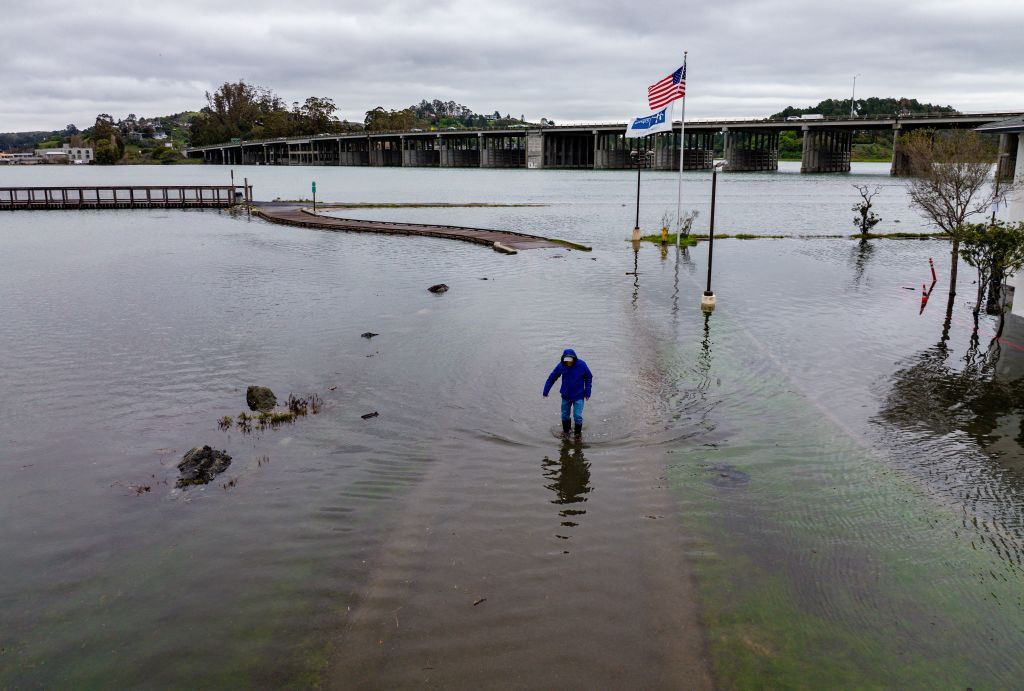
Current global coastal risk assessments are built upon a structural failure of measurement. The narrative that sea-level rise is a "future" threat ignores the immediate reality that millions are currently living below the high-tide line, undetected by standard satellite topography. This discrepancy is not a matter of climate uncertainty, but a technical bottleneck in how we interpret the Earth’s surface. By transitioning from traditional Digital Elevation Models (DEMs) to neural-network-corrected datasets, the calculated population at risk of displacement by 2050 increases by a factor of three.
The crisis is fundamentally a data-fidelity problem. Most global elevation data has historically relied on NASA’s Shuttle Radar Topography Mission (SRTM), which measures the "tops" of things—tree canopies, rooftops, and dense urban infrastructure—rather than the actual ground. In low-lying coastal zones, a vertical error of just two meters can be the difference between a dry city center and a permanent seabed.
The Triple Variable Framework of Coastal Vulnerability
To quantify the actual threat to global infrastructure, we must move beyond simple "bathtub models" that show water rising linearly. Accurate risk assessment requires the integration of three distinct variables:
- Static Sea Level Rise (SSLR): The global mean increase driven by thermal expansion and cryospheric melt.
- Episodic Extreme Sea Level (EESL): The height of the sea during storm surges, astronomical high tides, and wave run-up.
- Local Land Motion (LLM): The vertical movement of the land itself, often dominated by subsidence due to groundwater extraction or tectonic shifts.
The intersection of these variables defines the True Flood Threshold. When a coastal city experiences 0.5 meters of SSLR, but is also subsiding at a rate of 10mm per year, the effective sea-level rise is doubled. Current risk assessments fail to integrate LLM as a primary driver, treating it as a secondary or localized variable when, in many of the world's fastest-growing megacities, it is the primary threat to structural integrity and drainage systems.
The Precision Deficit: From SRTM to CoastalDEM
The primary source of error in coastal mapping is the "Vegetation and Building Offset" inherent in radar-based topography. The SRTM mission produced a global map of the Earth’s surface, but what it actually recorded was the Digital Surface Model (DSM). In dense, low-lying regions like the Mekong Delta or coastal Bangladesh, the DSM records the tops of mangroves and rice paddies, not the ground level.
The transition to CoastalDEM, which uses multilayered neural networks to strip away these vertical offsets, reveals a stark reality:
- Vertical Error Reduction: SRTM datasets typically include a positive vertical bias of 2 to 4 meters in coastal areas.
- The Exposure Gap: When the bias is removed, the number of people living below the projected high-tide line in 2050 jumps from roughly 100 million to over 300 million globally.
- The Asia Concentricity: Approximately 70% of the newly identified vulnerable populations reside in eight Asian nations: China, Bangladesh, India, Vietnam, Indonesia, Thailand, the Philippines, and Japan.
This is not a change in the physical height of the ocean, but a correction of the baseline elevation of the land. It means that the infrastructure we have already built is significantly lower than we previously measured.
The Economic Cost Function of Forced Relocation
The financial implications of this corrected data extend far beyond the direct loss of real estate. We must evaluate the Cascading Economic Risk (CER), which follows a non-linear path:
Stage 1: The Insurance Tipping Point
Insurance premiums are the first line of defense in coastal economies. As flood frequency increases from a 100-year event to a 10-year event, the actuarial risk becomes uninsurable. Once properties cannot be insured, they cannot be mortgaged, leading to a collapse in asset values and a freeze in local real estate markets.
Stage 2: Critical Infrastructure Failure
Coastal cities depend on gravity-fed drainage and wastewater systems. Even before a city is permanently submerged, its infrastructure becomes non-functional. Saltwater intrusion into freshwater aquifers and the failure of sewage systems during high tides render urban environments uninhabitable long before they are "underwater" in a literal sense.
Stage 3: The Productivity Drain
The cost of maintaining sea walls and massive pumping stations creates a permanent drag on municipal budgets. These "defensive expenditures" are a direct diversion of capital from productive investments in technology, education, and health. In many developing coastal nations, the cost of defense will soon exceed the local GDP generated by the protected areas.
The Dynamics of Managed Retreat and Engineering Defiance
The strategic response to this refined data split into two categories: Physical Fortification and Managed Retreat.
Physical Fortification relies on the assumption that the economic value of a coastal asset exceeds the cost of a seawall. However, the "levee effect" creates a moral hazard: by building a wall, a city encourages further development in a high-risk zone. If the wall is eventually breached, the catastrophic loss is far greater than if the area had remained undeveloped.
Managed Retreat is the strategic withdrawal of populations and infrastructure from high-risk zones. This is politically fraught and economically complex. It requires:
- Asset Devaluation Mechanisms: Government-led buyouts of high-risk properties before they become unmarketable.
- Zoning Overhauls: Preventing new construction in the "corrected" inundation zones revealed by high-precision elevation data.
- Inland Migration Incentives: Building the necessary infrastructure in higher-elevation "receiver cities" to accommodate displaced populations.
The second limitation of this strategy is the massive loss of cultural and historical capital. Many of the world’s most significant urban centers—London, New York, Shanghai—cannot be simply "moved." The engineering challenge then becomes a permanent war of attrition against a rising baseline.
The Role of Compound Events in Risk Acceleration
The most significant risk ignored by standard models is the Compound Event. Traditionally, flood risk is modeled as a single-driver event: a storm surge or a heavy rainfall. In reality, these events are often correlated.
The physics of a tropical cyclone involve low atmospheric pressure (which "pulls" the sea level up) and extreme rainfall. If the surge occurs during an astronomical high tide, and the rainfall cannot drain because the sea level is higher than the discharge pipes, the resulting flood is an order of magnitude more destructive than its component parts.
Current planning often ignores these correlations, leading to the systemic under-engineering of drainage systems. We must shift toward Bivariate Return Periods, which calculate the probability of two or more risk factors occurring simultaneously. This shift in logic increases the "effective" flood frequency, turning what was once a 50-year event into a near-annual occurrence.
Structural Bottlenecks in Data Dissemination
Despite the availability of high-precision models like CoastalDEM, a significant gap remains between scientific consensus and municipal policy. This bottleneck is driven by three factors:
- Legal Liability: Adopting a more accurate—and more dire—flood map can trigger immediate lawsuits from property owners and developers whose assets are suddenly devalued.
- Municipal Budgeting Cycles: Most city planning operates on 5-to-10-year horizons, which is fundamentally incompatible with the 30-to-80-year timelines required for climate adaptation.
- The "Certainty" Fallacy: Policymakers often demand exact numbers (e.g., "how many centimeters exactly?") before committing to multi-billion-dollar infrastructure projects. This ignores the fact that in risk management, the trend is the actionable signal, not the specific decimal point.
Strategic Execution: A Roadmap for Resilient Infrastructure
To navigate this corrected reality, institutional investors and municipal planners must execute the following logic:
- Implement Dynamic Adaptation Pathways: Instead of building a single, massive seawall designed for 2100, infrastructure should be modular. This allows for incremental height increases as the SSLR data is updated, preserving capital in the short term while maintaining long-term optionality.
- Decouple Infrastructure from the Coast: Critical utilities—power substations, water treatment plants, and data centers—must be relocated inland or elevated above the corrected 2050 high-tide line immediately. These are the "nervous system" of a city; if they fail, the city fails.
- Adopt LiDAR-Based Local Mapping: While global satellite models have improved, they are still no substitute for local, aircraft-based Light Detection and Ranging (LiDAR) surveys. Every coastal municipality must establish its own high-precision ground-truth data to override the vertical biases of global datasets.
- Mandate Flood-Risk Disclosure: Financial regulators must require the use of high-precision elevation models in all property disclosures and corporate ESG filings. This forces the market to price in the risk correctly, preventing an eventual "climate Minsky moment"—a sudden, chaotic collapse of asset prices.
The data is clear: the ground beneath our feet is lower than we thought, and the water is rising faster than our infrastructure was designed to handle. The transition from reactive to proactive coastal management is no longer a matter of environmental stewardship; it is a fundamental requirement for economic survival.
The most effective strategic move is to initiate the decommissioning of high-risk coastal assets while the market still has liquidity. Waiting for the physical inundation to occur ensures a total loss of value. The leaders who recognize this data-driven reality first will be the ones to successfully transition their capital and populations to the resilient zones of the 21st century.