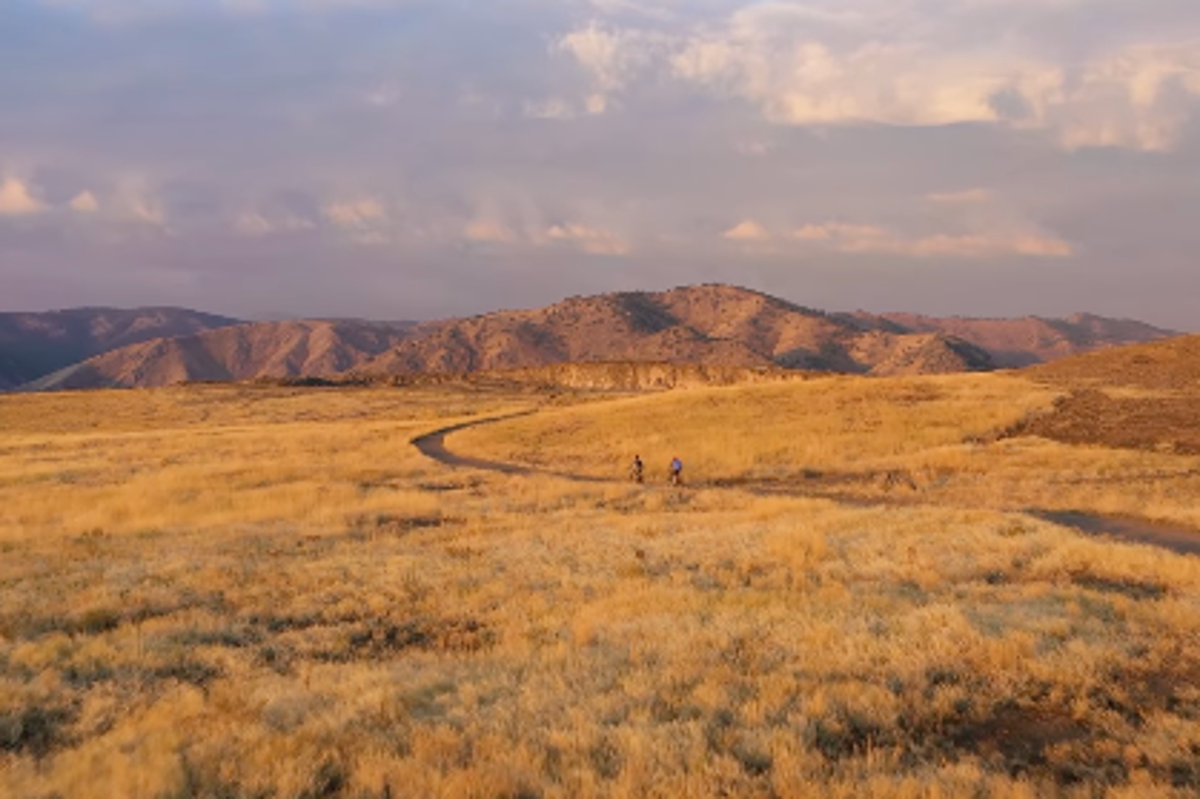
The failure of a political communication asset to align its visual metadata with its geographic mandate represents more than a simple clerical error; it is a breakdown in the logic of regional representation. When Representative Lauren Boebert’s office released a promotional video intended to highlight her legislative work for Colorado’s 3rd Congressional District, the inclusion of the Maroon Bells—peaks situated in the 2nd Congressional District—created a fundamental semiotic disconnect. This error functions as a case study in the tension between idealized "brand" imagery and the rigid boundaries of jurisdictional accountability.
The Taxonomy of Visual Credibility
Political legitimacy in a representative democracy relies on a specific "spatial contract." A representative is not an at-large advocate for a state’s aesthetic; they are a granular advocate for a defined set of coordinates. When a communications team selects B-roll footage based on "vibe" rather than "location," they prioritize the Aesthetic Variable over the Authenticity Variable.
The Maroon Bells, while iconic to Colorado, are located near Aspen. Aspen is not merely outside the 3rd District; it represents a distinct socioeconomic and political antithesis to the rugged, often more conservative leaning of the district Boebert represents. This creates a Cognitive Dissonance Gap where the messenger claims to be "fighting for you" while visually standing (metaphorically or literally) in someone else’s backyard.
The Error Chain: A Process Failure
The production of high-stakes political media usually follows a linear workflow. The appearance of "out-of-district" assets suggests a failure at one of three critical nodes:
- The Sourcing Bottleneck: Stock footage libraries often tag clips with broad descriptors (e.g., "Colorado Mountains") rather than specific GPS coordinates or congressional district overlays.
- The Curation Blind Spot: Editorial staff may lack the localized "spatial literacy" required to distinguish one mountain range from another, favoring high-contrast or high-resolution imagery over geographic accuracy.
- The Narrative Shortcut: The "Maroon Bells" are arguably the most photographed peaks in North America. Using them is a tactical shortcut to signal "Colorado-ness" to a national audience, even if it alienates the local constituency that knows the terrain intimately.
The Cost Function of Geographic Inaccuracy
In an era of hyper-local digital scrutiny, the cost of a visual error is not distributed evenly. It follows a Logarithmic Decay of Trust.
- Phase 1: Local Detection. Residents of the 3rd District, particularly those in the agricultural or mountain-adjacent sectors, recognize the landmarks immediately. This creates a "Tourist Perception" of the representative—the idea that they view their own district through the lens of a visitor rather than a native.
- Phase 2: Digital Amplification. Political opponents utilize the error as a proxy for "out-of-touch" leadership. The mountain becomes a metaphor for a representative who spends more time in the national media spotlight than on the ground in their home precincts.
- Phase 3: The National Punchline. The story shifts from a local geographic dispute to a national narrative about competence. At this stage, the original legislative message of the video is entirely cannibalized by the debate over the footage.
This sequence demonstrates that in political branding, Precision is a Hedge against Derailment.
Mapping the Strategic Disconnect
The 3rd District of Colorado is a massive, diverse geographic entity covering the Western Slope and the San Luis Valley. It includes the San Juan Mountains and the Uncompahgre Plateau. These are distinct, rugged landscapes that define the identity of the voters there. By bypassing these local landmarks in favor of the "prettier" Maroon Bells of the 2nd District, the communication strategy inadvertently signals that the actual district is not "scenic" enough for the brand.
The Identity Calculus
The logic of representation suggests that a representative should be a mirror of their district. When the mirror reflects a different district, the "Representation Signal" is corrupted.
- Variable A: Voter Identity (Ground Truth)
- Variable B: Representative’s Visual Messaging (The Signal)
- The Delta: The distance between A and B.
As The Delta increases, voter alienation increases. In Boebert’s case, the use of Aspen-adjacent imagery in a video about "delivering for the district" creates a maximum Delta. It suggests a lack of investment in the specific visual vernacular of the people she represents.
The Professionalization of Political Geospatial Assets
To prevent these "unforced errors," political operations must treat visual assets with the same rigor as legislative text. This requires the implementation of a Geospatial Verification Framework.
The Three-Tier Verification Protocol
- Coordinate Tagging: Every piece of B-roll must be metadata-verified to ensure the latitude and longitude fall within district boundaries.
- Socio-Political Layering: Beyond physical location, assets must be screened for political "landmines." (e.g., Is this mountain located in a town known for policies the representative opposes?)
- Constituency Resonance Testing: Does the image evoke the specific daily reality of the district’s voters, or does it look like a postcard?
The failure to apply this framework results in a "Generic Politician" profile. When a representative from Colorado uses the wrong mountains, or a representative from Iowa uses a photo of a Nebraska cornfield, they signal that their "Brand" is a standardized product rather than a localized service.
The Structural Incentives for Error
Why does this happen repeatedly across the political spectrum? The answer lies in the Nationalization of Local Politics.
Most modern political media is produced by D.C.-based agencies. These firms prioritize "The National Narrative" because that is where the fundraising occurs. To a consultant in Alexandria, VA, a mountain in Colorado is just "The Rockies." They are optimizing for a viewer in Florida or New York who will donate $20 after seeing a "strong" video. They are not optimizing for the rancher in Pueblo who knows exactly what the Sangre de Cristo Mountains look like and realizes they are missing from the frame.
This creates a Resource Allocation Conflict:
- Goal A: National Fundraising (Requires generic, high-gloss "State" imagery).
- Goal B: Local Re-election (Requires specific, grit-filled "District" imagery).
The Boebert video error is the physical manifestation of Goal A winning over Goal B.
Strategic Correction and Risk Mitigation
For a political figure already under intense scrutiny for their "carpetbagging" or "district hopping" (as Boebert has faced following her move from the 3rd to the 4th District), geographic precision is the only defense. A visual error is not just a mistake; it is "Evidence." It reinforces the pre-existing opposition narrative that the candidate is a political actor looking for a seat, rather than a leader rooted in a place.
The solution is a pivot toward Hyper-Local Visualism.
- Avoid stock footage entirely.
- Utilize "Rough-Cuts": Lower production value footage shot on-site within the district has higher authenticity markers than 4K stock footage from a different zip code.
- Prioritize human-land interaction: Show the representative interacting with specific, identifiable local infrastructure (dams, bridges, main streets) that cannot be mistaken for another jurisdiction.
The "Mountain Gaffe" serves as a definitive warning: in the digital age, your background is your biography. If the background is false, the biography is questioned.
Move all visual asset management to a localized "In-District" review team. Every frame of video must pass a "Native Eye" test before release. If a landmark cannot be named and located by a local staffer within ten seconds, it is discarded. Stop chasing the "National Aesthetic" and start documenting the "Jurisdictional Reality." The primary risk to a modern political brand is not "looking cheap"; it is "looking fake." Authentic, grainy footage of the actual district will always outperform high-gloss footage of a neighbor’s district.

.png?width=1200&auto=webp&trim=0%2C113%2C0%2C87)