The mahogany doors of the Supreme Court do more than just muffle the noise of Washington. They create a vacuum. Inside that silence, the air feels heavy with the weight of decades—centuries, even—of precise, agonizing thought. Every word spoken in that chamber is weighed on a jeweler’s scale. Every sentence written into the record is a brick in the foundation of the law.
Justice Ketanji Brown Jackson sits in that stillness. She earned her seat through a grueling climb, one marked by the kind of academic and professional rigor that leaves no room for luck. She is a product of Harvard, a former public defender, and a judge who has spent her life navigating the dense thicket of American jurisprudence. Her mind is her instrument. It is sharp, disciplined, and refined. If you liked this post, you should read: this related article.
Then comes the noise from the outside.
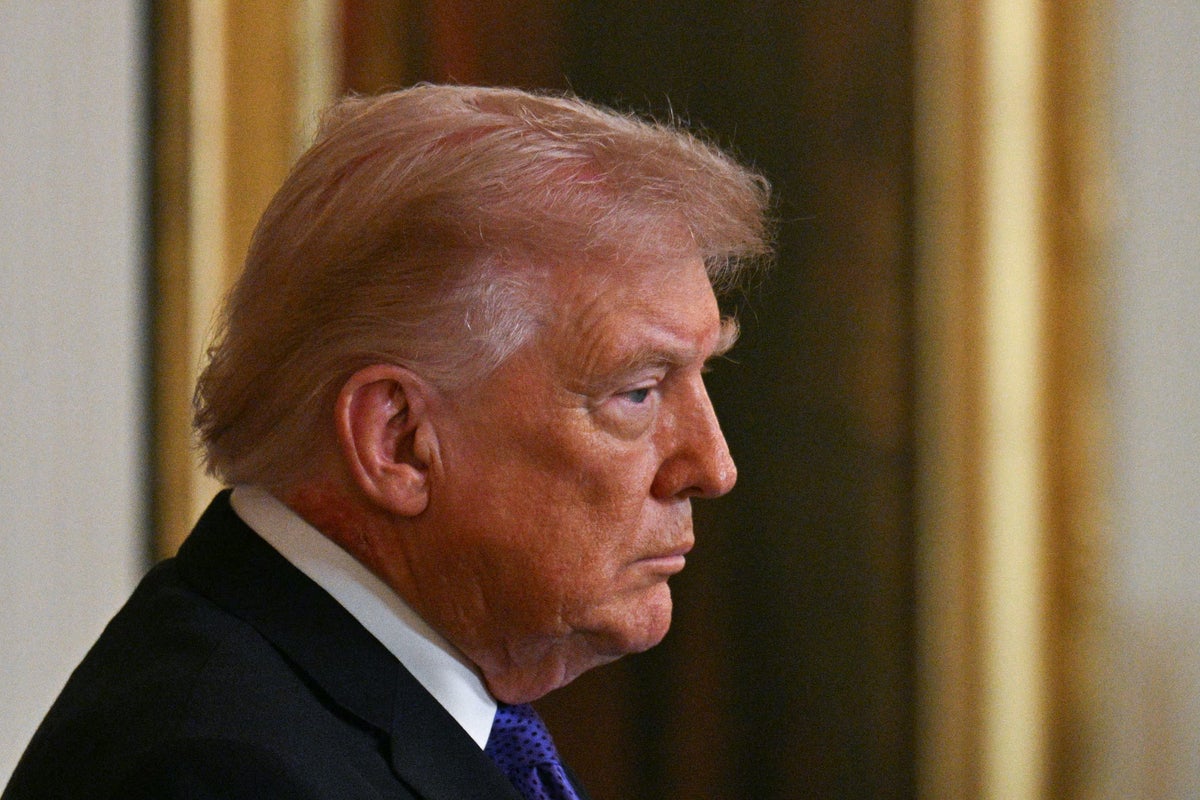
It usually arrives in the form of a late-night social media post or a shouted remark at a rally. President Donald Trump recently directed his attention toward her, reaching for a familiar weapon in his rhetorical arsenal. He called her "low IQ." For another look on this story, refer to the recent coverage from USA Today.
The phrase is a blunt object. It isn't a critique of a legal opinion. It isn't a disagreement over the interpretation of the Constitution. It is an attempt to strip away the very thing that defines a judge: their intellect. When we talk about "IQ" in the political arena, we aren't talking about cognitive science. We are talking about status. We are talking about who is allowed to hold the gavel and who is meant to be judged by it.
The Architecture of an Insult
To understand why this specific slur matters, we have to look at the history of how we measure human worth. For a century, the concept of intelligence has been used as both a ladder and a cage. In the early 20th century, pseudo-scientists used rudimentary testing to justify the exclusion of entire groups of people from the American experiment. They wanted a "scientific" way to say that some people were simply born to be less.
When a public figure uses this language against a woman of color who has reached the pinnacle of the legal profession, it isn't accidental. It’s a callback. It is a signal to a specific worldview that suggests excellence is a fluke and authority is an inheritance.
Imagine a young law student sitting in a library tonight. Let’s call her Maya. Maya is the first in her family to graduate college. She spends fourteen hours a day highlighting case law, her eyes burning under fluorescent lights. She looks up to Justice Jackson not just because of her title, but because Jackson represents the idea that if you are twice as prepared and three times as diligent, the system will eventually have to recognize you.
When Maya hears the highest office in the land—or a man who formerly held it—dismiss that level of achievement as "low IQ," the insult doesn't just hit the Justice. It vibrates through the library. It tells Maya that no matter how many exams she aces or how many briefs she wins, she will always be one remark away from being reduced to a trope.
The Contrast of the Quiet Room
There is a profound irony in the timing of these attacks. While the political world brawls in the mud, the Supreme Court is grappling with questions that require the highest possible level of cognitive nuance. They are deciding the boundaries of presidential immunity, the reach of federal agencies, and the very definition of rights in a digital age.
Justice Jackson’s contributions to these debates are characterized by a relentless focus on the text and a deep curiosity about history. She asks questions that probe the "original intent" of the Reconstruction-era amendments. She forces her colleagues to look at the human consequences of technical rulings.
Consider a hypothetical case regarding sentencing guidelines. A "low IQ" approach would be to look at a chart and pick a number. Jackson’s approach involves dissecting the legislative history, understanding the intent of Congress, and weighing the precedents that have stood for fifty years. This is "slow thinking"—the kind of deep, analytical work that is the opposite of a thirty-second soundbite.
The contrast is jarring. On one hand, you have the deliberate, agonizingly careful work of the judiciary. On the other, you have the impulsive, ego-driven language of the campaign trail. One builds a society. The other seeks to burn the blueprints.
The Invisible Stakes of Language
Words are the currency of the law. If a word loses its meaning, the law loses its power. When we allow the language of "low IQ" to become a standard political critique, we are participating in the devaluation of expertise. We are saying that facts don't matter, and that the work required to become an expert is irrelevant.
This isn't about being "offended." The word "offense" is too small for what is happening here. This is about the erosion of the standards we use to judge our leaders and our thinkers. If a Supreme Court Justice—a person who has passed every possible test of intellectual merit—can be dismissed as unintelligent, then the word "intelligence" has ceased to mean anything at all.
It becomes a proxy for "I don't like you" or "You don't look like what I imagine a genius to be."
This is a dangerous game to play in a democracy. A democracy requires a shared reality. It requires us to agree that certain things are true: that two plus two equals four, that the law applies to everyone, and that a person’s intellect is measured by their work, not by the color of their skin or the political party that appointed them.
The Sound of the Gavel
The real tragedy of the "low IQ" slur is that it forces us to spend our energy defending the obvious. We find ourselves listing Justice Jackson's credentials like a defense attorney presenting evidence. Magna cum laude. Editor of the Law Review. Federal judge. We do this because we feel the need to prove she belongs in the room.
But Justice Jackson doesn't need to prove she belongs. The gavel in her hand is the proof. The opinions she writes, which will be studied by law students for the next half-century, are the proof.
The noise from the rallies will eventually fade. The social media posts will be buried under the weight of newer, louder outrages. But the work remains. In the quiet of the Court, Justice Jackson will continue to sift through the nuances of the law. She will continue to ask the hard questions. She will continue to be the living embodiment of the fact that excellence is not a gift, but a discipline.
The sound of the gavel is final. It is a sharp, wooden crack that signals the end of the argument and the beginning of the law. It is a sound that doesn't care about insults. It is a sound that belongs to the person who did the work.
When we look back at this era, we won't remember the petty names used to describe the thinkers of our time. We will remember the thoughts they had, the justice they dispensed, and the quiet dignity they maintained while the world outside tried to scream them down. The mahogany doors will stay closed. The work will continue. The mind will remain sharp.
Some things are too heavy to be moved by a tweet.