Two years.
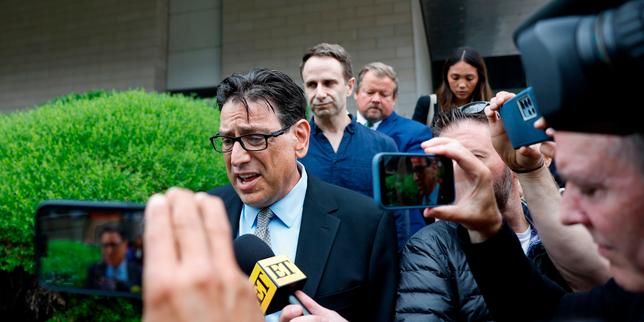
That is the price of a life in the eyes of the federal justice system when the defendant is a failed Hollywood producer and the victim is a beloved sitcom icon. While the tabloids scream about "justice served" in the sentencing of Erik Fleming, they are missing the forest for the trees. This isn't a victory for the rule of law. It is a masterclass in how the industry and the legal system collaborate to scapegoat mid-tier facilitators while protecting the structural rot that makes these tragedies inevitable.
The mainstream narrative is simple, clean, and entirely wrong. It tells a story of a "rogue" producer who exploited a vulnerable star. It frames Fleming as a predatory outlier. In reality, Fleming is the logical byproduct of a system that treats celebrity addiction as a logistical hurdle rather than a medical crisis.
The Scapegoat Protocol
Erik Fleming didn't invent the "concierge" drug pipeline. He just got caught holding the invoice.
The two-year sentence handed down to Fleming for distributing the ketamine that killed Matthew Perry is a slap on the wrist disguised as a hammer blow. To understand why this is a failure, you have to look at the mechanics of the Hollywood ecosystem. For decades, producers have acted as "fixers." Their job isn't just to manage schedules; it is to manage the existence of the talent. If a star needs a specific substance to get through a shoot, or to wind down after one, the producer is the one who "knows a guy."
By focusing the entire weight of public outrage on Fleming and the "Ketamine Queen" Jasveen Sangha, the Department of Justice is allowing the broader industry to wash its hands. We are being told that if we just lock up the "bad" producers and the "unlicensed" doctors, the problem goes away.
It won't.
I have spent twenty years watching talent agencies, production houses, and management firms look the other way while their primary assets—the actors—dissolve in real-time. As long as the actor shows up to the junket, the source of their "energy" is treated as a trade secret. Fleming was a cog. A greasy, opportunistic cog, but a cog nonetheless.
The Ketamine Myth vs. The Reality of Administration
Let’s dismantle the "medical" defense. The media loves to use the term "therapeutic ketamine" to soften the blow. They want to draw a line between the "good" ketamine Perry received at clinics and the "bad" ketamine Fleming delivered in vials.
This is a distinction without a difference when it comes to the physiology of an addict.
- The Dosage Fallacy: The argument suggests that if Perry had stayed within the clinic system, he would be alive. This ignores the reality of tolerance.
- The Supervision Mirage: Perry was being injected by his live-in assistant, Kenneth Iwamasa.
The prosecution of Fleming hinges on the idea that he facilitated a dangerous "off-book" operation. But in Hollywood, the "off-book" operation is the operation. When you have enough money, the pharmacy comes to your living room. The legal system is punishing Fleming for the lack of a medical license, not for the ethical void of supplying a known addict with a dissociative anesthetic.
Why Two Years is a Tactical Retreat
The DOJ didn't give Fleming two years because they were being "soft." They gave him two years because they needed his cooperation to go after the bigger fish—or so they say.
But look at who isn't being charged. Look at the people who knew Perry was spiraling and did nothing because a sober Perry was a less profitable Perry. In Hollywood, a "clean" star often means a star who is difficult to control. An addict is grateful. An addict is compliant. An addict is someone you can "handle."
If the government actually wanted to stop the next Matthew Perry from dying, they wouldn't be counting vials in a producer’s trunk. They would be subpoenaing the communications of the agencies that collect 10% of these tragic checks. They would be looking at the production insurance policies that incentivize "chemical maintenance" over actual rehabilitation.
The Cost of Doing Business
We need to stop asking "How did this happen?" and start asking "Why did it take this long?"
The "People Also Ask" sections of the internet are flooded with queries about Perry’s last days. They want the gory details. They want to know about the "vultures." This voyeurism serves the industry perfectly. It turns a systemic failure into a true-crime drama.
Fleming’s sentence is a line item on a balance sheet. It is the "cost of doing business" for a culture that views human beings as depreciating assets. Two years in a federal facility is a small price for the system to pay to keep the spotlight off the executives who signed the checks that paid for those vials.
The tragedy of Matthew Perry isn't that he met a man like Erik Fleming. The tragedy is that the industry is designed to ensure there is always a man like Erik Fleming waiting in the wings.
If you think this sentence changes anything, you haven't been paying attention. The pipeline is already being rebuilt. The names will change, the substances will evolve, but the "fixers" aren't going anywhere. They are too useful to the people who actually run this town.
Stop looking at the producer. Look at the machine that needed him.