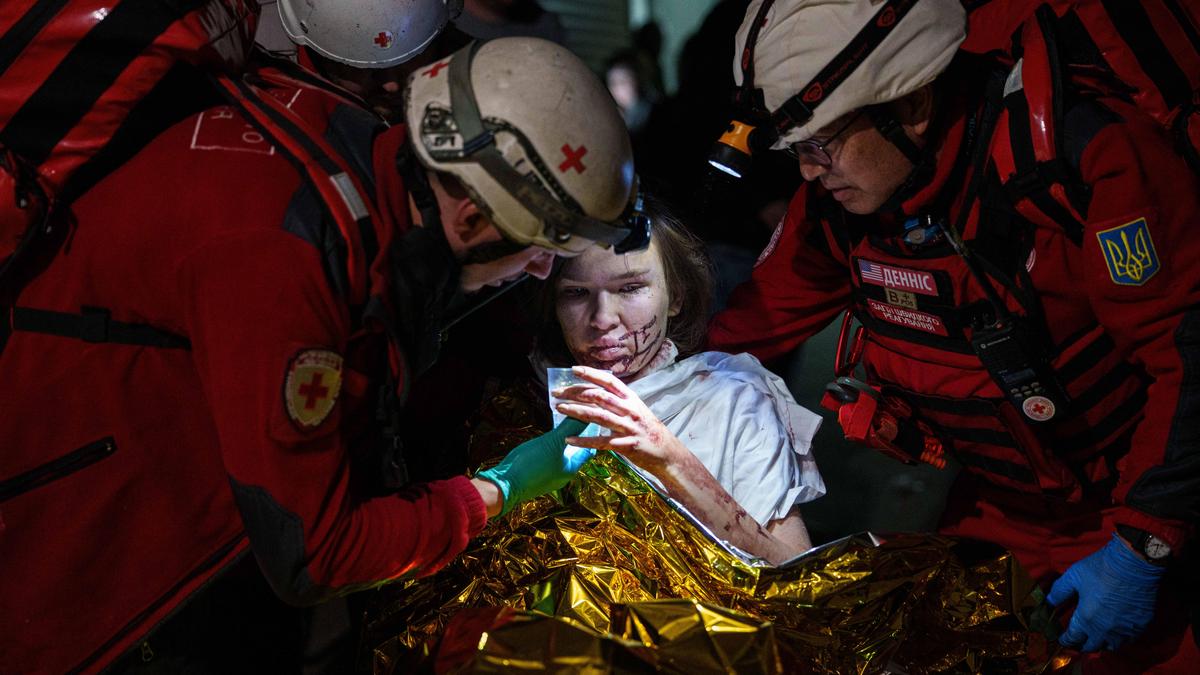
The siren starts long before you see the shadow. In the early hours of Monday, June 1, 2026, a wave of 265 Russian combat drones flooded Ukrainian airspace. Think about that scale for a second. It's not a localized skirmish. It is a sweeping, automated aerial assault stretching from the northern border town of Chernigiv down to the southern port of Odesa.
When the smoke cleared, local authorities confirmed one person died in Kherson and two dozen others suffered injuries across the country.
People reading standard headlines want to know what this actually means for the trajectory of the war. Is Ukraine running out of air defense? Why is Russia relying so heavily on these massive drone swarms now? The answer lies in a shifting, high-tech war of attrition where both sides are trading blows far behind the front lines while conventional diplomatic tracks remain completely frozen.
Breaking Down the Monday Morning Drone Attrition
The raw numbers from the Ukrainian Air Force tell a story of intense pressure. Out of 265 Iranian-designed Shahed variants and domestic Russian combat drones launched in the barrage, Ukrainian air defense units managed to shoot down 228 of them. That's an intercept rate of roughly 86%.
In any traditional military playbook, hitting 86% of incoming targets is an incredible feat. But with drone warfare, the math favors the attacker. The 37 drones that slipped through the defensive net caused widespread civilian suffering and infrastructure chaos.
- Chernigiv: Eight people were wounded in this northern town. The strikes targeted local infrastructure, cutting off electricity to more than 10,000 residents instantly. Emergency crews spent the night fighting massive fires under the threat of secondary strikes.
- Odesa: Seven civilians were injured when debris and direct impacts hit the Black Sea port city, which remains a vital, yet constantly targeted, economic lifeline for Ukrainian grain exports.
- Kharkiv and Zaporizhzhia: Air defenses active over these major hubs couldn't stop everything. Four people were wounded in Kharkiv and another civilian was hurt in Zaporizhzhia.
- Kherson: The southern front-line city took the heaviest blow, recording the solo fatality of the raid alongside at least two other civilian injuries.
The Grim Math of Cheap Drones vs Expensive Air Defense
I've been tracking these strike patterns for years, and the fundamental issue isn't a lack of tactical skill on Kyiv's part. It's a supply problem. Russia uses mass-produced, low-cost loitering munitions to accomplish two goals simultaneously. They hit fixed infrastructure, and they force Ukraine to burn through its limited stockpiles of Western-supplied air defense missiles.
Firing a high-end air defense missile that costs hundreds of thousands of dollars to bring down a drone built for a fraction of that price isn't sustainable long-term. Ukraine relies heavily on mobile fire groups—pickup trucks outfitted with searchlights, heavy machine guns, and short-range man-portable missiles—to preserve their heavy systems like Patriots and NASAMS for incoming ballistic missiles. But when Russia sends nearly 300 drones in a single night, those mobile teams get stretched to a breaking point.
What the Stalled Peace Talks Mean for the Ground War
The escalation in long-range strikes happens to directly correlate with a complete lack of movement on the diplomatic front. Peace talks are completely stalled. Neither side has an incentive to blink right now.
Moscow uses these nightly bombardments to break civilian resolve and degrade the Ukrainian energy grid before summer demands spike. Conversely, Ukraine isn't just taking punches. Kyiv has significantly amplified its own long-range strike capabilities. Ukrainian drones regularly hit oil refineries, fuel depots, and military logistics hubs deep inside Russian territory, including recent operations targeting logistics routes across occupied Luhansk and Crimea.
This is no longer a localized war of trenches in the Donbas. It's a cross-border, deep-strike dynamic where both capitals are trying to choke out the other's economic capability to wage war.
Preparing for a Long Summer of Air Raids
If you're looking at what comes next, don't expect these numbers to drop. The production lines for these unmanned aerial vehicles are humming. Air raid alerts will remain part of daily life in Ukrainian cities for the foreseeable future.
For observers trying to gauge where this goes, look closely at the energy grid resilience and the speed of Western air defense resupply. The ability of Ukraine to weather these nightly 200-plus drone barrages depends entirely on keeping those defensive interceptor pipelines full. If those supplies lag, that 86% shoot-down rate drops, and the civilian casualty list grows exponentially.