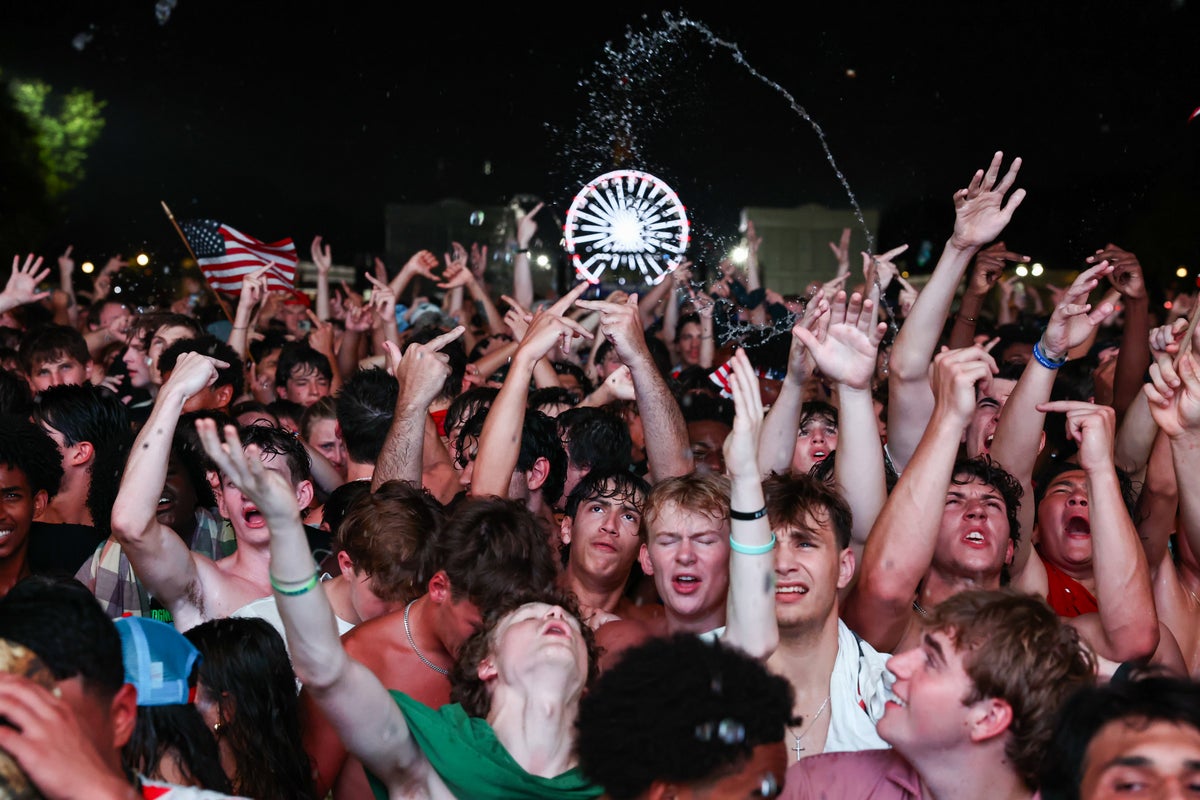
The media found a crowd in Washington. Naturally, they botched the math and misread the room.
When thousands of people packed the DC National Mall on Wednesday night, mainstream newsrooms instantly deployed their favorite narrative device. They took aerial photos, contrasted them with political rallies, and implied a profound cultural shift. The consensus across the media was uniform: look at this massive turnout, note who it wasn't for, and draw a sweeping conclusion about the state of American enthusiasm.
It is a comforting narrative for pundits. It is also completely wrong.
Using the physical volume of human bodies on a public lawn as a proxy for political momentum or cultural dominance is an archaic metric. It ignores urban geography, basic logistics, and the psychological difference between passive entertainment and active mobilization. The lazy assumption that a packed National Mall inherently signals a shift in tribal alignment shows how out of touch traditional reporting remains.
The Logistics of Free Entertainment
Let’s dismantle the foundational misunderstanding of public gatherings in the nation's capital. Washington, DC, sits at the center of a metropolitan area housing over six million people. The National Mall is a federal park integrated directly into a massive public transit system.
When you offer a high-profile, free cultural event or concert on a pleasant weeknight, you are not testing political willpower. You are lowering the barrier to entry to zero.
I have spent over a decade analyzing public assembly logistics and media metrics. If you give urbanites an excuse to sit outside on a Wednesday evening without charging them a ticket fee, they will show up. They are not there to make a statement. They are there because human beings naturally gravitate toward open spaces and shared experiences when the cost of participation is nothing.
Comparing a free, non-partisan cultural gathering to a ticketed, hyper-specific political rally is an analytical failure. A political rally requires participants to self-identify with a faction, travel long distances, navigate heavy security, and endure hours of partisan rhetoric. A weeknight event on the Mall requires a Metro pass and a blanket.
The Myth of the Accurately Counted Crowd
Newsrooms love to throw around definitive numbers to make their headlines sound authoritative. They use words like "massive," "unprecedented," or "packed" to paint an emotional picture.
Here is the truth the National Park Service understands but reporters ignore: accurately counting an open-air crowd on the National Mall is nearly impossible.
Crowd Estimation Variables:
+-----------------------+---------------------------------------+
| Metric Variable       | The Flaw in Measurement               |
+-----------------------+---------------------------------------+
| Aerial Photography    | Blocked by tree canopies and shadows |
| Turnstile Counts       | Non-existent in open public parks     |
| Throughput Dynamics   | Ignores people leaving and arriving   |
+-----------------------+---------------------------------------+
The National Park Service officially stopped providing crowd size estimates after the Million Man March in 1995, following intense political fallout and threats of lawsuits over undercounting. Today, any number you see reported in the press is a combination of organizer hyperbole, political wishful thinking, and flawed grid-system guesswork.
When an article notes that a crowd was bigger or smaller than a specific political event, it is relying on visual manipulation. A tight camera angle can make five thousand people look like a movement. A wide, elevated shot can make fifty thousand people look like a scattered gathering.
Passive Aggregation vs. Active Mobilization
The core error of modern media analysis is confusing passive aggregation with active mobilization.
- Passive Aggregation: People gathering because an event is happening near them. The primary driver is convenience and general interest.
- Active Mobilization: People gathering because they are driving the event. The primary driver is conviction and sacrifice.
Imagine a scenario where a popular food truck festival fills a city square. No serious political scientist would look at that crowd and declare that the local mayor has won reelection. Yet, when a cultural event fills the National Mall, pundits immediately attempt to translate that physical footprint into electoral data.
This distinction matters because passive crowds do not translate to votes, systemic change, or sustainable engagement. They dissolve the moment the event ends and the clean-up crews arrive. By treating a transient crowd as a monolithic political force, journalists create a false sense of momentum that vanishes under the slightest pressure.
Why the Media Keeps Chasing the Crowd Scoreboard
Mainstream journalism relies on visual shortcuts. Nuance requires long-form analysis, data validation, and historical context. A crowded National Mall, photographed from a helicopter, provides an instant, low-effort visual narrative.
It allows outlets to score cheap engagement by validation. They feed the biases of an audience desperate to believe that their side, or their preferred cultural vibe, is winning the numbers game. It turns complex societal dynamics into a high school pep rally stadium count.
This obsession obscures the real shifts happening in American organization. Power is no longer concentrated in how many bodies can be forced onto a single piece of grass in Washington, DC. Influence has decentralized. It exists in distributed digital networks, hyper-localized community actions, and asymmetric media channels that never show up on an aerial camera.
Relying on the physical real estate of the National Mall to gauge the mood of the country is like reading a sundial in a dark room. It is a monument to how things used to be measured, utilized by an industry that refuses to update its tools.
The crowds on Wednesday night were large because the weather was good, the event was accessible, and the location was iconic. Stop looking for a deeper political prophecy in a collection of people who simply wanted somewhere to go on a Wednesday night. The reality is far more mundane than the headlines suggest, and the sooner we abandon the crowd-size scoreboard, the sooner we can understand how modern influence actually moves.