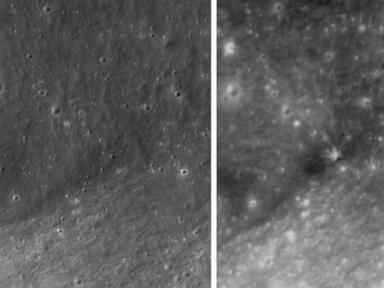
The unplanned intersection of a four-metric-ton SpaceX Falcon 9 upper stage with the lunar surface provides an empirical baseline for hyper-velocity impact physics. Captured by the Korea Aerospace Research Institute orbiter Danuri, the before-and-after telemetry offers structural insight into how spent hardware alters planetary geology. Far from a routine debris event, this occurrence serves as a high-energy benchmark, demonstrating the complex mechanics of orbital perturbations, kinetic energy transfer, and remote sensing recovery.
The Orbital Mechanics of Passive Decay
Spent rocket bodies left in high-eccentricity orbits do not remain static. The trajectory that culminated near the lunar Einstein crater originated from a January 2025 launch carrying private lunar landers. Once the payload separated, the empty second stage—measuring roughly 14 meters in length and weighing approximately 4,000 kilograms—entered a deep-space orbit subject to complex multi-body gravitational forces.
Predicting the lifetime of high-apogée hardware requires accounting for three primary perturbation vectors:
- Solar Radiation Pressure: Photons exerting continuous, minute force on the large surface area of the cylindrical booster, slowly altering semi-major axes over extended periods.
- Earth-Moon Gravitational Tug-of-War: Non-uniform gravitational fields interacting with the elliptical path, creating secular resonance effects.
- Third-Body Perturbations: Solar gravitational influences compounding over dozens of orbital revolutions, shifting perigee and apogée parameters outside initial operational tolerances.
Over eighteen months, these cumulative forces altered the energy state of the booster, converting a stable heliocentric-adjacent drift into an unrecoverable descent trajectory. Because the upper stage lacked residual propellant reserves sufficient to execute a retrograde disposal burn, passive orbital decay governed its final operational phase.
Kinetic Energy Transfer and Crater Morphometry
When the booster impacted the lunar regolith at approximately 8,700 kilometers per hour, the resulting kinetic energy dissipation equaled roughly three metric tons of TNT. This energy release transformed instantly into shockwaves propagating through the basaltic and anorthositic lunar crust.
The physical mechanics of this hyper-velocity impact govern the resulting crater dimensions:
- Shockwave Compression: The initial contact generates a high-pressure shock front that vaporizes and melts portions of the projectile and target material, exceeding the material strength limits of the surface rock.
- Excavation Flow: Rarefaction waves follow the compression front, directing material outward and upward, establishing ballistic ejecta curtains that distribute pulverized regolith across the surrounding terrain.
- Final Crater Geometry: Based on mass-velocity parameters, the resulting depression is estimated to span up to 30 meters in diameter and several meters in depth, exposing darker, sub-surface strata previously shielded from space weathering.
The absence of an atmospheric buffer on the moon ensures that even light components of the kinetic energy profile translate directly into mechanical work on the surface, maximizing excavation efficiency compared to similar events on Earth or Mars.
Remote Sensing and Empirical Validation
Observing an impact of this scale presents severe optical constraints. Because the collision occurred on the daylit hemisphere of the moon, the initial thermal flash and kinetic burst were obscured by solar glare, rendering ground-based telescopic detection of the flash phase statistically improbable. Direct telemetry relied entirely on orbital assets equipped with specialized imaging systems.
Danuri executed a pre-planned orbital adjustment sequence, capturing multiple imaging sessions approximately thirty minutes before and immediately following the event. By comparing pre-collision topography with post-impact frames, analysts isolated the specific signatures of the event:
- Albedo Variations: The excavation exposes un-weathered, low-reflectance sub-surface materials, creating a visibly darker central footprint relative to the sun-bleached mature regolith surrounding it.
- Ejecta Distribution: Symmetrical ray patterns of high-velocity pulverized dust extend outward from the central cavity, mapping the ballistic trajectory of displaced mass.
Subsequent passes by NASA assets coordinate with these findings to refine impact modeling software. Planetary scientists treat this unplanned event as a calibrated experiment. Because the mass, velocity, composition, and impact angle of the projectile are known with high fidelity, the resulting crater morphology provides ground truth for calibrating numerical codes used to simulate asteroid impacts and ancient crater formation rates.
Systemic Vulnerabilities in Orbital Management
The event highlights systemic challenges in deep-space asset tracking and end-of-life disposal protocols. While regulatory frameworks mandate strict mitigation guidelines for low Earth orbit, high-energy cislunar trajectories present distinct monitoring thresholds.
Tracking objects in high-Earth or lunar-resonant orbits involves significant observational bottlenecks:
- Optical Sensor Limitations: High-altitude debris possesses low angular velocities relative to ground-based tracking systems, complicating continuous cataloging.
- Ephemeris Degradation: Unmodeled solar pressure variations compound rapidly over multi-year timelines, widening uncertainty ellipses for position predictions.
Mitigating future uncontrolled impacts necessitates integrating terminal passivation protocols for trans-lunar injection stages. Without active propulsive disposal or purposeful heliocentric disposal burns, deep-space upper stages remain latent kinetic hazards influenced by chaotic gravitational dynamics.
Implement autonomous depletion algorithms for all residual tank pressures and propellant fractions immediately following payload separation to eliminate secondary fragmentation risks during long-term orbital decay.