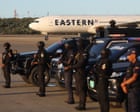
A passport is supposed to be an anchor. It is a blue book or a green slip that says you belong to a map, that a specific government acknowledges your birth, your face, and your right to walk beneath an open sky without being questioned by a man with a rifle. But what happens when that book becomes blank paper? What happens when a human being is unmoored from every legal coordinate they have ever known, stripped of citizenship, caught in the bureaucratic gravity well of a superpower, and dropped onto the tarmac of a country they have never seen?
We speak of geopolitics as if it were a game of chess played by ghosts in glass towers. We talk about agreements, memorandums of understanding, diplomatic channels, and bilateral compacts. Words like "third-country migrant deportees" roll off the tongues of news anchors as dry statistics, neat rows of digits on a spreadsheet designed to measure administrative efficiency. In similar developments, we also covered: When Celebrity Megaphones Clash With the Wall of Male Silence.
Let us drop the spreadsheet.
Imagine standing on the tarmac at Bujumbura International Airport under a heavy, equatorial sun. The air smells of damp earth, woodsmoke, and the diesel fumes of a tarmac shuttle bus. You do not speak Kirundi. You do not know the layout of the streets winding down toward the glittering, vast expanse of Lake Tanganyika. You have spent the last five, ten, or fifteen years building a life three thousand miles away—paying taxes in a suburb of Ohio or a cramped apartment in Queens, raising children who speak English with Midwestern or Eastern Seaboard accents, commuting to a job at a warehouse or a diner. Then, a predawn knock on the door. A cold metal cuff. A flight with drawn window shades. The Washington Post has provided coverage on this important topic in extensive detail.
And now, Burundi.
The recent agreement between the United States and the Republic of Burundi to accept third-country migrant deportees is not merely a headline about foreign policy adjustments. It is a seismic shift in how nations dispose of human complexity. To understand why this matters, we have to look past the official press releases and examine the machinery of modern displacement.
The Geography of Exile
Burundi is a nation of stunning, heartbreaking verticality. Known as the Heart of Africa, its landscape is a dramatic folding of green hills, terraced farms, and deep valleys. It is a place of profound resilience, having clawed its way back from the brink of devastating civil conflict and political trauma in recent decades. Yet, it is also one of the poorest nations on earth, wrestling with its own demographic pressures, economic constraints, and a fragile infrastructure.
When a government with the economic might of the United States looks across the globe for a partner willing to absorb individuals who cannot be easily returned to their countries of origin—perhaps because of generalized violence, diplomatic stalemates, or political persecution back home—it searches for nations where sovereignty is elastic, where diplomatic leverage can be secured through foreign aid, security cooperation, or strategic alignment.
Burundi said yes.
Why? Because in the high-stakes poker of international relations, cooperation with Washington carries weight. It opens doors to multilateral institutions, financial lifelines, and diplomatic favor. But the transactional nature of this agreement leaves behind a profound humanitarian void. The individuals arriving on these flights are not citizens of Burundi. They share no linguistic, cultural, or familial ties to the communities receiving them. They are legal ghosts, deposited into an environment ill-equipped to integrate them, and cut off from the legal recourses they might have fought for years to secure within the American court system.
To grasp the human toll, consider the concept of administrative limbo. For decades, immigration enforcement relied on a relatively straightforward binary: you belong here, or you return to where you came from. But what happens when the place you came from refuses to take you back, or when returning you would violate international norms against sending someone to face torture or death?
International law calls this the principle of non-refoulement. It is a bedrock of post-World War II human rights architecture. But governments, pressed by domestic political demands to show force at the border and reduce backlogs, have begun seeking lateral workarounds. If you cannot send them home, and you do not want them here, you send them elsewhere. You outsource your legal obligations to a third party.
The Mechanics of Erasure
The mechanics of this outsourcing are chillingly efficient. A deportation flight departs under the cover of administrative privacy. Passengers are handed a single plastic bag containing their few remaining personal effects—a wedding band, a wallet with expired identification, a notebook filled with phone numbers of cousins in Chicago or relatives in Caracas.
When the cabin door opens in Bujumbura, the immediate reality is disorientation. Where do they sleep? Who feeds them? Are they detained in local facilities, or are they handed over to local non-governmental organizations that are already stretched past their breaking point? The US Department of Homeland Security maintains that these arrangements comply with human rights standards, offering assurances that receiving nations will treat transferees humanely. But assurances from afar rarely match the gritty, chaotic reality on the ground.
History offers uncomfortable echoes here. Other nations have experimented with offshore processing and third-country transfer models—arrangements that critics have repeatedly denounced as externalizing human rights responsibilities beyond judicial oversight. When responsibility is fragmented across multiple sovereign borders, accountability evaporates. If a deportee’s rights are violated, to whom do they appeal? The American courts lose jurisdiction the moment the plane’s wheels lift off from US soil. The Burundian legal system may view the transferees through the narrow lens of national security and immigration status rather than constitutional rights.
It is a legal vacuum engineered to swallow human stories whole.
We must ask ourselves what this says about the societies we are building. In the name of border management, we are normalizing the idea that human beings can be treated as fungible commodities—shipped across continents not based on their individual merits, their ties to communities, or their contributions to the social fabric, but based on the cold calculus of diplomatic convenience.
The Long Shadow Home
Back in the neighborhoods these individuals left behind, the absence is quiet. A locker stays empty at the warehouse. A desk chair remains vacant in the back of a kitchen. A child asks why coach or neighbor or friend is not coming home from work, and the adults struggle to find words simple enough to explain the invisible walls of immigration enforcement.
The agreement between Washington and Bujumbura is framed by diplomats as a pragmatic solution to an intractable problem. But pragmatism that erases human agency is a dangerous narcotic. It allows powerful states to wash their hands of complex moral dilemmas by paying another nation to hold the pieces out of sight.
The hills of Burundi will watch these newcomers arrive. The local shopkeepers in Bujumbura will wonder who these strangers are, speaking languages born of struggles half a world away. And the world will turn its gaze to the next crisis, the next headline, the next emergency demanding our fleeting attention.
Yet, somewhere in that high, green landscape, a person who once bought coffee at a corner bodega in Ohio will sit by a window at dusk, listening to the unfamiliar calls of tropical birds, wondering how a human life could be folded up so neatly and filed away in a foreign archive.
The map of the world is changing. The borders are hardening, not just with steel and concrete, but with quiet, transactional agreements signed in dim conference rooms. And as we watch these quiet shifts redraw the boundaries of human dignity, we are forced to confront a sobering truth. When we make human beings disposable for the sake of administrative ease, we do not just alter the lives of those on the plane. We quietly dismantle the very foundation of our own humanity.


