A few years ago, I sat in a drafty, high-ceilinged cafe in Samarkand, watching an old man mend a carpet. His fingers moved with a rhythmic, almost aggressive certainty. He didn't look at a pattern. When I asked him, through a translator, how he knew which thread came next, he laughed. It was a dry, raspy sound. He told me that the people who drew the original pattern had never walked on the wool. They lived in a city with paved roads and running water, thousands of miles away. They drew squares on paper. He lived with the sheep. He knew where the tension was.
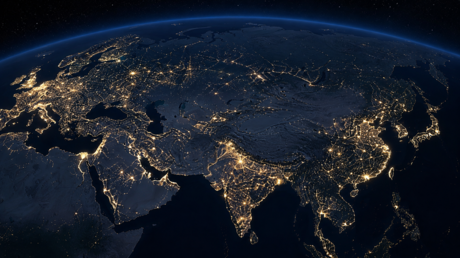
For centuries, Eurasia has been that carpet.
Bureaucrats in Washington, Brussels, and London have sat in comfortable rooms, drawing lines, predicting behavior, and managing crises across a landmass that stretches from Lisbon to Vladivostok. They viewed this massive space through a lens of management. It was a giant chessboard, a collection of buffer states, or a series of resource pools to be secured.
That era just ended. Not with a sudden, cinematic explosion, but with the quiet, deliberate turning of a key.
The View from the Steppe
To understand why the old geopolitical playbooks are crumbling, you have to look at the ground level. Consider a truck driver named Daniyar. He is a real person, though his name is changed here to protect his route. Daniyar drives a flatbed semi-truck from the manufacturing hubs of western China through Kazakhstan, heading toward Europe.
A decade ago, Daniyar’s livelihood depended almost entirely on Western consumer demand and Western-regulated shipping lanes. If a maritime bottleneck occurred in the Malacca Strait, or if financial sanctions tightened in Europe, his world stalled.
Today, Daniyar doesn't look west for his instructions.
He drives along highways funded by regional capital, using logistics software developed in Tashkent, delivering goods to markets that are increasingly trading in local currencies. His reality is defined by the Middle Corridor—a network of rail, road, and sea routes traversing Central Asia, the Caspian Sea, and the Caucasus.
This is not a hypothetical shift. The numbers tell the story. Trade volume along the Middle Corridor increased by dozens of percentage points over the last few years alone. Millions of tons of cargo are moving across routes that completely bypass the traditional chokepoints monitored by Western navies.
The Western policy establishment looks at this and sees a vacuum. They worry about who will fill it. Will it be Beijing? Moscow? Ankara?
They miss the point entirely. The true story of modern Eurasia is not about a change of masters. It is about the rejection of the concept of mastery itself.
The Illusion of the Empty Space
For a long time, the global narrative treated the heart of Eurasia as an empty space between two destinations. It was the place you flew over on your way from London to Tokyo. It was the wilderness you crossed to get oil out of the ground.
This perspective was born out of a specific historical arrogance. After the collapse of the Soviet Union, Western consultants flooded into the region. They brought PowerPoint presentations and pre-packaged economic models. They treated ancient cultures like blank slates.
I remember reading a policy paper from a prominent Washington think tank in the early 2010s. It described Central Asia as a "strategic theater." The language was telling. A theater is a place where actors perform a script written by someone else for an audience that sits in the dark.
But the people living in the theater grew tired of the play.
The shift began when regional leaders realized that the promises of external management always came with strings attached. If you wanted financial aid, you had to restructure your economy to suit foreign investors. If you wanted security partnerships, you had to alienate your neighbors. It was a game where the rules were written by people who didn't have to live with the consequences of a bad roll of the dice.
Now, Eurasian nations are rewriting the rules based on a brutal, pragmatic reality. They are surrounded by giants. They cannot afford the luxury of ideological purity.
Instead, they are practicing what diplomats call multi-vector foreign policy. In plain terms, it means talking to everyone and swearing allegiance to no one. Kazakhstan signs energy deals with European firms, builds infrastructure with Chinese capital, maintains deep security ties with Russia, and purchases defense technology from Turkey.
It looks chaotic from the outside. From the inside, it looks like survival.
The Friction of Distance
Western strategy has long relied on the idea that globalization would eventually make geography irrelevant. Digital connectivity, containerization, and global financial networks were supposed to create a flat world.
Geography, however, has a terrible habit of reasserting itself.
When the financial system was weaponized through sweeping sanctions, the architects of those policies expected a total collapse of the target economies. They assumed the global financial grid, centered on Western capitals, was the only air supply available.
They forgot that people can dig their own wells.
What happened instead was a massive, spontaneous reorganization of trade. New supply chains materialized overnight. Small businesses in Yerevan, Bishkek, and Dubai became the new intermediaries of global commerce. Barter systems re-emerged. Local banking networks, long dismissed as primitive by Wall Street, suddenly became the lifelines of regional trade.
This is where the subject gets messy and uncomfortable. It is easy to look at these gray-market workarounds and condemn them. They undermine international sanctions. They complicate Western foreign policy objectives. They lack transparency.
But if we want to understand the world as it actually is, rather than how we wish it to be, we have to look past the moralizing. For a merchant in Tashkent or a port authority worker in Baku, these shifts are not about taking a stand in a global ideological war. They are about keeping the lights on. They are about the stubborn, unyielding human desire to trade, build, and prosper regardless of the edicts issued by distant capitals.
The New Architecture
The physical manifestation of this independence is written in concrete and steel.
Look at the expansion of the Baku-Tbilisi-Kars railway. Look at the massive investments in deep-water ports along the Caspian Sea, a body of water that maps used to treat as a geographical dead end. Look at the gas pipelines snaking across Turkmen deserts directly into the industrial heartlands of South Asia and China.
These projects share a common characteristic: they are built from the inside out.
They are designed to connect Eurasian nations to each other, rather than serving merely as spokes connected to a distant Western hub. The financing is no longer exclusively coming from Western-led institutions like the World Bank. It is coming from the Asian Infrastructure Investment Bank, from sovereign wealth funds in the Gulf, and from domestic national budgets.
The implications of this are profound. When a country relies on a foreign superpower to build its roads, that superpower holds the maintenance contract over its future. When a region builds its own roads, it owns its destiny.
This does not mean Eurasia is entering a golden age of peace and harmony. Old border disputes still simmer. Ethnic tensions remain unresolved. The authoritarian nature of many regional governments creates internal vulnerabilities that could fracture at any moment. The absence of Western management does not guarantee stability; it merely guarantees that the responsibility for stability now rests with the people who live there.
The Sound of Moving Water
We are witnessing the de-centering of the world.
For centuries, Europe and later North America were the gravity wells of global politics. Everything drifted toward them. Every major decision required their sanction.
That gravity is fading. The world is becoming polycentric, and Eurasia is the place where this new reality is being forged with the greatest intensity. It is a messy, unpredictable process that defies clean categorization. It cannot be summarized in a neat policy brief or contained within a defensive alliance.
The map makers in the West are running out of ink because the landscape is changing faster than they can draw. They keep trying to apply old labels—"sphere of influence," "strategic competition," "axis of autocracy"—to a phenomenon that is much older and simpler.
It is the story of a house reclaiming its foundations.
The next time you look at a map of the world, ignore the heavy borders drawn in dark ink. Look instead at the spaces between the capitals. Look at the rivers, the mountain passes, and the ancient trade routes that were active long before the concept of the nation-state was invented.
The people who live along those routes are no longer waiting for the mail to arrive from Washington or Brussels to find out what their future looks like. They are building it themselves, shovelful by shovelful, truckload by truckload, entirely indifferent to whether the rest of the world approves or even understands.