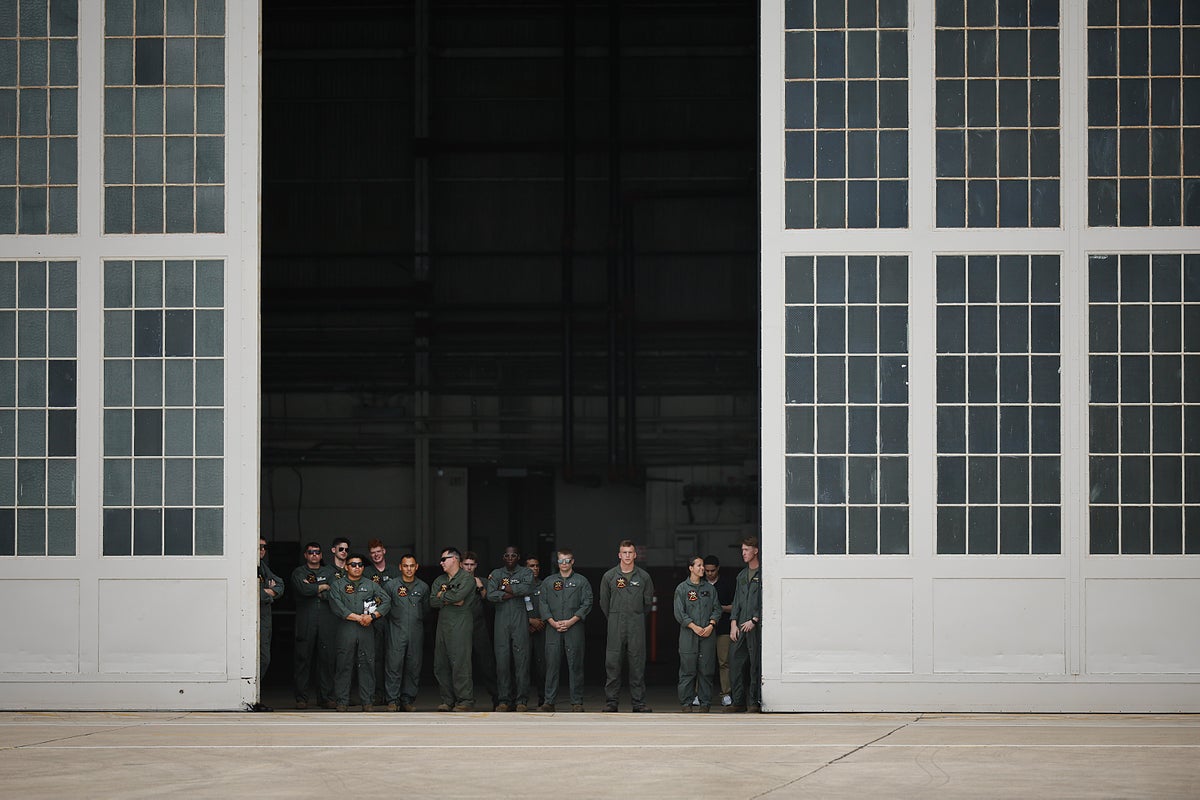
Viruses don't care about political ideology. They care about proximity. When you pack thousands of teenagers into open-bay barracks, make them sleep on bunk beds spaced inches apart, and force them to eat at communal dining tables, you create a paradise for respiratory pathogens.
In April 2026, Defense Secretary Pete Hegseth scrapped the U.S. military's 70-year-old universal flu vaccine mandate, calling it an overreaching policy that weakened war-fighting capabilities. He declared that taking the shot was a matter of personal freedom and individual choice.
Fast forward less than two months.
A severe influenza outbreak tore through Joint Base San Antonio-Lackland in Texas, the primary training hub for the Air Force and Space Force. More than 200 basic trainees fell sick in a matter of weeks, crowding medical wings and forcing military officials to isolate entire units. Worse, the outbreak coincided with the tragic death of 19-year-old recruit Keon McDaniel, who suffered a medical emergency in his sixth week of training, prompting a full military investigation into whether flu complications were to blame.
Faced with a rapidly spreading virus that threatened to paralyze basic training, the Air Force quietly executed a massive U-turn. Officials utilized a loophole in Hegseth's directive to reinstate a localized flu vaccine mandate for all new recruits at Lackland.
It turns out that individual freedom gets complicated when it starts compromising national defense readiness.
The Closed Door Reality of Basic Training
To understand why this outbreak happened so fast, you have to look at how basic training actually operates. This isn't a normal corporate office or a college campus where people can isolate when they feel a sniffle coming on.
New recruits are immunologically vulnerable. Most are 18 or 19 years old. They've moved from different corners of the country, bringing regional viral strains with them, and are suddenly thrown into a high-stress, sleep-deprived environment. Stress elevates cortisol, which naturally suppresses the immune system.
Historically, basic training centers have always been the epicenter of military disease transmission. A report from the Armed Forces Health Surveillance Division highlighted that between 2010 and 2024, the highest rates of influenza hospitalizations across all active-duty troops were consistently among personnel under 25, heavily skewed toward new recruits. Specifically, data from earlier surveillance windows showed that the hospitalization rate for flu among recruits was 70 per 100,000, compared to a mere 7.4 per 100,000 for the career military population.
When Hegseth lifted the mandate, the vaccination rate among Air Force trainees plummeted. Only about 40% of incoming recruits chose to get the voluntary shot. You don't need a degree in epidemiology to see what happens next. Herd immunity vanished in an environment designed for maximum physical contact.
The Loophole that Allowed the Reversal
When the Pentagon announced the policy shift in April, the official memorandum signed by Hegseth stated that the annual influenza vaccine was voluntary for all active and reserve components. However, the policy left a quiet backdoor open. The Pentagon granted specific exceptions allowing individual service branches—including the Army, Navy, and Air Force—to reinstate narrower mandates under tight, localized circumstances to protect operational capability.
The 37th Training Wing at Lackland, working alongside the 59th Medical Wing, didn't wait for the virus to clear on its own. They triggered that exception.
While the Pentagon publicly defended the overarching voluntary policy as a move designed to maximize force generation, local commanders had to deal with the immediate reality of an expanding quarantine wing. Sick trainees were put on antiviral medications like Tamiflu and isolated until cleared by doctors. To stop the bleed, the local mandate was slapped back down. If you want to train at Lackland right now, you are getting the shot.
This tension highlights a fundamental flaw in trying to run a military like a civilian workplace. Since George Washington ordered the mandatory inoculation of the Continental Army against smallpox in 1777, the American military has operated on the principle that the health of the unit supersedes the medical philosophy of the individual.
What the Reversal Means for the Broader Force
The disaster at Lackland isn't just an isolated Texas problem. It acts as an early warning signal for the rest of the armed forces as we move deeper into the year.
Public health specialists and military veterans have voiced sharp criticism over the policy change. Senate Armed Services Committee Chair Roger Wicker, a Republican from Mississippi and an Air Force veteran, openly called ending the requirement a mistake, noting that global readiness depends on a healthy, predictable force. When hundreds of troops are benched simultaneously by a preventable respiratory illness, training schedules slip, deployments get delayed, and operational costs spike.
If a localized outbreak can force the Air Force's hand in June—traditionally a low-point for seasonal flu activity—the upcoming winter season will pose a massive challenge for non-mandated units. Other major training pipelines, like the Army's Fort Moore or the Navy's Great Lakes Lakes Training Center, are watching Lackland closely. They will likely be forced to use the same bureaucratic loopholes to protect their own pipelines the moment their numbers tick upward.
Next Steps for Personnel and Trainees
If you are currently preparing for basic military training or are an active-duty service member navigating the shifting rules, you need to manage your medical preparation proactively rather than waiting for command policies to shift back and forth.
- Check base-specific briefs: Do not assume the voluntary policy applies to your specific training location. Check the latest incoming orders from your training wing, as localized mandates can be triggered with zero public notice.
- Get the shot voluntarily before arriving: If you are heading to a base where the vaccine remains optional, getting immunized at least two weeks before shipping out gives your body time to build antibodies before you enter the high-stress environment of the barracks.
- Track local medical wing notifications: Stay updated through your unit's medical readiness officer. If your base activates a localized health exception, failure to comply can disrupt your graduation timeline or lead to administrative delays in your training pipeline.