The Franco-German Main Ground Combat System (MGCS) is structurally bound to a design and operational gridlock that mirrors, and in some aspects amplifies, the friction points of the Système de Combat Aérien du Futur (SCAF). Rather than evaluating this defense program through the lens of political rhetoric or superficial bilateral cooperation, an objective analysis requires breaking down the project into its foundational pillars: industrial-capacity allocation, divergent operational doctrines, and the economics of defense procurement. The trajectory of MGCS is not determined by diplomatic goodwill, but by a rigid set of structural variables that currently point toward a fracturing of the joint initiative.
The Tri-Factor Conflict of Industrial Capabilities
The primary friction point within MGCS does not stem from ideological disagreements, but from the industrial overlap between the participating corporate entities. Unlike aerospace programs where competencies can sometimes be partitioned into clean structural modules (e.g., wings, propulsion, avionics), armored vehicle manufacturing features highly concentrated, overlapping intellectual property and manufacturing infrastructure.
The industrial framework is divided across three main vectors:
- System Architecture and Integration: The entry of Rheinmetall into the Franco-German joint venture KNDS (Nexter and Krauss-Maffei Wegmann) disrupted the initial 50-50 balance of power between France and Germany. This created a tri-party struggle for the prime contractor role. Nexter and Krauss-Maffei Wegmann (KMW) had achieved a delicate equilibrium, which was destabilized when Germany demanded the inclusion of Rheinmetall, effectively giving German industry a two-thirds structural advantage in the program's core architecture.
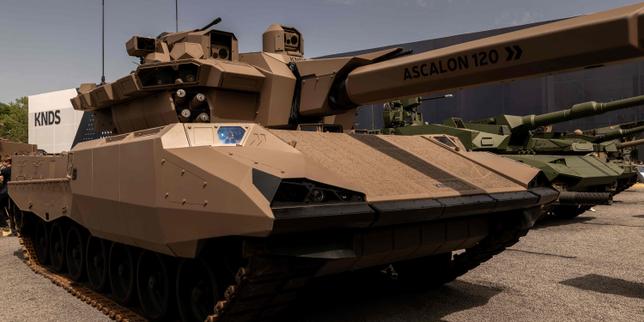
- Main Armament and Lethality Systems: A critical bottleneck exists in the selection of the primary weapon system. Nexter is advancing its 140mm ASCALON (Autoloaded and Scalable Cannon for an Innovative Lethality) system, designed for high-energy kinetic defeat mechanisms and optimized for future armored threats. Conversely, Rheinmetall is leveraging its 130mm Rh-130 L/51 smoothbore gun, integrated into its independent KF51 Panther platform. Because the main armament dictates the turret design, internal volume, hull dimensions, and weight distribution of the entire vehicle, this choice is a zero-sum game for the respective engineering teams.
- Digital Architecture and Vetronics: The "brain" of the MGCS—encompassing secure cloud networking, artificial intelligence for target prioritization, and unmanned ground vehicle (UGV) command interfaces—presents a battleground for sovereign IP ownership. The country that secures the design rights for the electronic architecture effectively controls the long-term modernization and upgrade cycles of the platform for the next fifty years.
Doctrine Divergence: Expeditionary Agility vs. Central European Mass
The technical specifications of a main battle tank are direct derivatives of a nation's military doctrine. France and Germany operate under profoundly different geopolitical assumptions and operational environments, which translates into conflicting engineering requirements for a next-generation platform.
French Operational Doctrine                  German Operational Doctrine
(Expeditionary / High Mobility)               (Territorial Defense / Heavy Mass)
      │                                             │
      ▼                                             ▼
Weight Cap: ~50-55 Tonnes                    Weight Cap: ~65-70+ Tonnes
Airlift / Rapid Deployment                    Heavy Armor / Maximum Survivability
French military doctrine historically emphasizes strategic mobility, rapid intervention, and expeditionary capability, heavily influenced by its operations across Africa and overseas territories. The French Army requires a platform that can be rapidly deployed via strategic airlift or maritime transport, necessitating a strict weight cap—ideally between 50 and 55 tonnes. Lower weight allows for higher operational tempo, lower fuel consumption, and compatibility with standard European transport infrastructure, such as bridges and rail networks optimized for lighter loads.
German military doctrine is anchored in NATO collective territorial defense, focusing on the flat, open plains of Central and Eastern Europe. The German Army prioritizes maximum survivability, heavy passive and active armor suites, and sustained high-intensity firepower to counter peer-state mechanized forces. This doctrine accepts, and even expects, a vehicle weight exceeding 65 to 70 tonnes.
Attempting to reconcile these two doctrinal requirements into a single hull design yields a mathematical contradiction. A vehicle cannot simultaneously possess the low mass required for rapid expeditionary deployment and the heavy, layered armor configurations required for static, high-survival continental defense. The result of compromising on these metrics is a platform that satisfies neither doctrine efficiently: too heavy for French deployment constraints, and too lightly protected for German defensive requirements.
The Economic Cost Function and the Export Bottleneck
The financial viability of any modern defense program relies on scale economies. The domestic procurement volumes of France and Germany alone are statistically insufficient to amortize the massive research and development (R&D) expenditures required for a completely clean-sheet, next-generation combat system. Consequently, the platform must be designed with an eye toward the global export market.
Here, the program encounters a structural bottleneck driven by divergent export control regimes. France maintains a pragmatic, industry-led approach to arms exports, viewing foreign sales as a necessary economic lever to subsidize its sovereign defense industrial base. Germany operates under a significantly more restrictive, politically sensitive export control framework, guided by the Federal Security Council (Bundessicherheitsrat).
This divergence introduces severe financial risk for industrial partners. If a component designed by a German firm is integrated into a critical subsystem of the MGCS, the German government retains veto power over the export of the entire weapon system. For France, this creates an unacceptable risk of asset stranding, where a multi-billion-euro project could be barred from lucrative international markets due to a shift in a coalition government's foreign policy in Berlin.
This risk function explains why both nations have actively maintained parallel, unilateral development tracks while publicly committing to the joint project:
- The German Hedge: Germany continues to iterate on the Leopard 2 platform (introducing the Leopard 2A8 and developing the 2AX variants) while Rheinmetall independently markets the KF51 Panther. These platforms serve as immediate commercial and operational insurance policies should MGCS collapse.
- The French Hedge: France has focused on upgrading its Leclerc fleet to the Leclerc XLR standard to extend its operational life into the late 2030s, while Nexter continues independent testing of the ASCALON gun system on modified chassis to ensure it retains sovereign capability in heavy turret design.
Quantitative Assessment of Program Fragmentation
To quantify the probability of program completion versus fragmentation, we must analyze the utility function of each state actor based on three variables: strategic autonomy, industrial return (juste retour), and interoperability.
Utility = w1(Strategic Autonomy) + w2(Industrial Return) + w3(Interoperability)
For France, the weight of Strategic Autonomy ($w1$) is traditionally high, demanding complete control over critical technologies to maintain independent deterrence and intervention capabilities. For Germany, Industrial Return ($w2$) and the preservation of its domestic armored vehicle manufacturing sector carry immense political weight, especially given the employment and economic significance of companies like KMW and Rheinmetall.
When these utility functions are mapped against the current tripartite structure of KNDS and Rheinmetall, the Nash equilibrium shifts away from cooperation. The introduction of the European Defence Fund and various unilateral procurement decisions—such as Germany’s €100 billion Sondervermögen (special defense fund), which prioritized off-the-shelf acquisitions like the American F-35 over joint European developments—signals a structural preference for immediate capability over protracted bilateral alignment.
The structural flaw of MGCS is that it attempts to merge two mature, highly competent, and fiercely competitive national defense industries into a single project without a clear, singular command authority. In successful joint programs, such as the Horizon frigates or even the multi-national Tornado fighter, there was either a clear dominant partner or a clean separation of operational domains. MGCS lacks both.
The Strategic Playbook for Sovereign Survival
Given the structural bottlenecks within the Franco-German framework, waiting for a political breakthrough is an inefficient strategy that risks creating a capability gap by 2040. Defense planners and industrial leaders must pivot toward a modular, decoupled approach to secure sovereign operational requirements.
First, the program must be re-architected from a single, unified vehicle platform into an open-architecture ecosystem. Instead of trying to build a shared hull and turret, France and Germany should focus exclusively on standardizing the digital backbone (vetronics, data links, and AI target-acquisition protocols). This allows for complete operational interoperability within NATO networks while permitting each nation to build its own physical hardware.
France must proceed with developing a lighter, highly mobile chassis equipped with the ASCALON 140mm turret and an advanced active protection system (APS) to mitigate the lack of heavy passive armor. This configuration addresses the expeditionary requirement and preserves French industrial sovereignty. Germany should be left to develop a heavy, heavily armored chassis utilizing its 130mm smoothbore system to satisfy its territorial defense doctrine.
Second, industrial workshares must be decoupled from the rigid 50-50 or 33-33-33 political formulas. Components should be sourced based on verified technology readiness levels (TRL) rather than geographic distribution. If a nation wishes to prioritize a specific capability—such as France prioritizing light weight and high mobility, or Germany prioritizing heavy passive protection—that nation must fully fund and manage that specific module's R&D, avoiding cross-border vetoes on subsystem components.
Ultimately, the survival of European armored capability relies on abandoning the illusion of a singular, universal main battle tank. True strategic resilience is achieved by acknowledging doctrinal differences and building an interchangeable, modular system of systems that respects the hard realities of geography, economics, and industrial sovereignty.