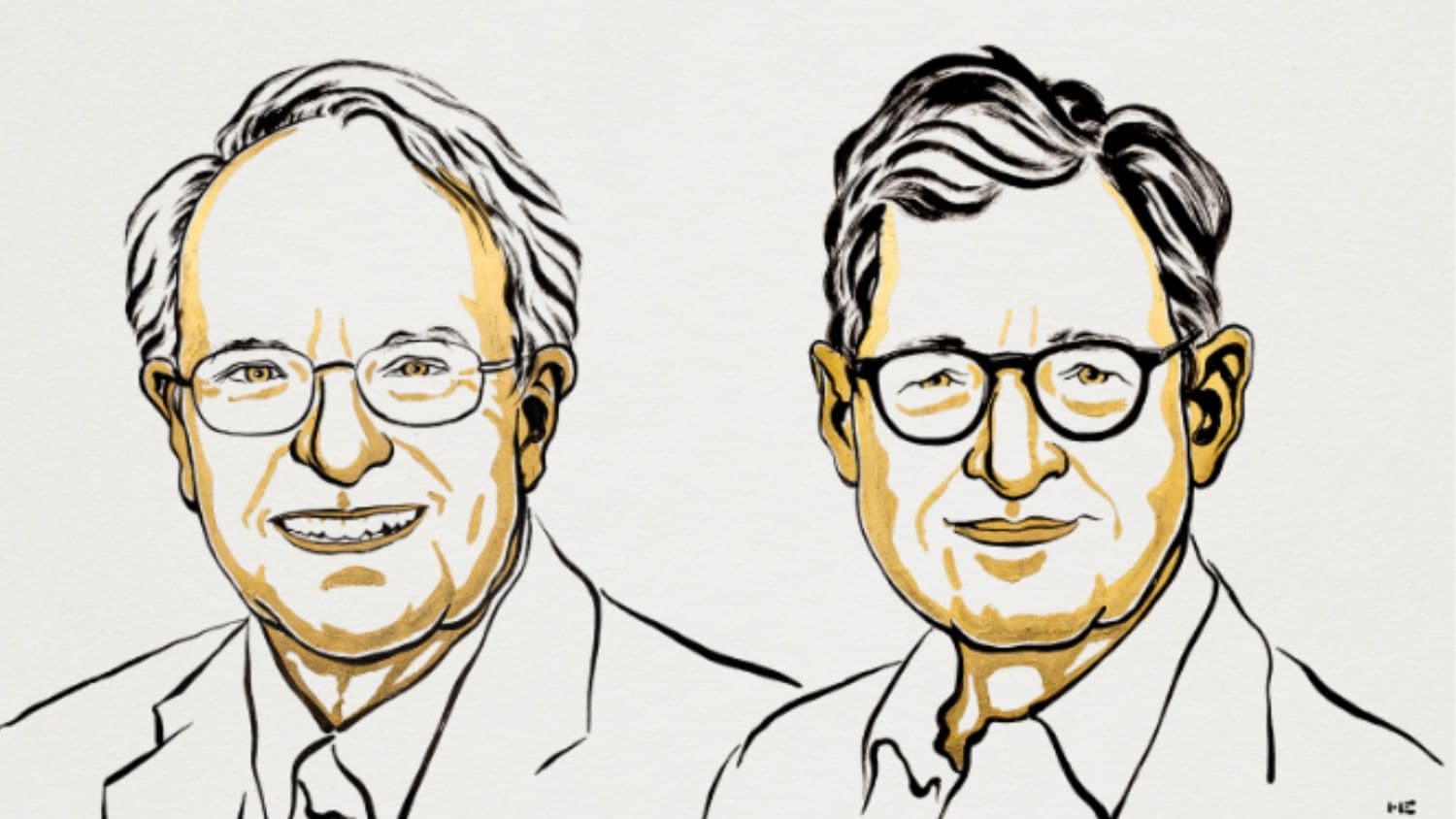
Aggregate macroeconomic rules fail whenever households and firms update expectations faster than policymakers adjust nominal instruments. The 2026 Sveriges Riksbank Prize in Economic Sciences, awarded jointly to Robert E. Hall and Michael Woodford on October 12, 2026, for the microeconomic foundations of macroeconomic stabilisation, formalises why central banks and finance ministries cannot treat the economy as a mechanical dial. When a standard news report simply announces that two American academics won 12 million Swedish kronor for smoothing crises, it misses the analytical shift underneath: macro policy only works when it aligns with individual forward-looking decisions rather than relying on fragile historical correlations.
A reader examining the 2026 prize needs three things immediately: the exact intellectual problem Hall and Woodford dismantled, the structural mechanics of how micro-level expectations propagate into business cycles, and the operational limits central banks face when applying these models in real time.
Why Legacy Aggregate Models Broke Down
Mid-twentieth-century stabilisation policy rested on a tempting statistical shortcut. Economists observed historical co-movements among aggregate output, unemployment, inflation, and government spending or money supply, then treated those empirical relationships as invariant engineering laws. When unemployment rose, policy models prescribed stimulus; when demand ran hot, they prescribed restraint.
That architecture buckled during the stagflation of the 1970s. Western economies confronted low growth, elevated unemployment, and persistent inflation simultaneously, exposing a fatal flaw in backward-looking correlations. Historical averages reflect past policy regimes and past expectation formations. Once the policy rule changes—or once private actors anticipate future deficits, interest rate paths, or price adjustments—the old statistical relationship stops holding.
Treating aggregate time series as fixed levers creates a second structural error: it conflates correlation with causal control. A central bank can adjust a short-term policy rate, and a legislature can alter taxes or transfers, yet neither controls private spending directly. Spending is an outcome of decentralised optimisation by households facing income uncertainty and firms setting prices amid friction.
The Microeconomic Architecture of Stabilisation
To build a durable theory of business cycles and stabilisation, economists had to trace aggregate fluctuations back to individual decision rules. The work recognised by the 2026 prize establishes two core analytical pillars.
The Cost Function of Premature Consumption Shifts
Robert E. Hall shifted consumption research in his landmark 1978 work—and later extensions with Fredric Mishkin in 1982—by focusing on how forward-looking households smooth consumption over time. Households do not simply spend a fixed fraction of today's paycheck; they weigh current income against expected lifetime resources, real interest rates, and risk.
Under Hall's framework, if households already use all publicly available information to form rational expectations of future income, then changes in consumption between periods are driven by new information (shocks) rather than predictable movements in known income. Consider a household that learns of a permanent productivity gain versus a temporary bonus. Shifting consumption abruptly in response to noisy signals or misread income paths carries welfare costs: over-consuming early leaves a painful adjustment later, while under-consuming sacrifices utility when marginal value is high.
This mechanism explains why simple "pump-priming" assumptions often misfire. If households view a temporary tax rebate as fleeting or expect future taxes to rise to pay for it, their consumption response is muted compared to what a naive aggregate multiplier predicts. Conversely, when a genuine shock hits expectations—such as an energy supply disruption or a sudden shift in confidence—consumption adjusts immediately across millions of budgets, moving aggregate demand before slow-moving statistical indicators register the turn.
Forward-Looking Price Setting and Policy Credibility
Michael Woodford's contributions anchor the New Keynesian framework by connecting forward-looking private behaviour directly to monetary and fiscal rules. In an economy where firms do not continuously reset every price at zero cost, current inflation depends not only on current demand pressures and marginal costs, but also on what firms expect future inflation and future demand to be.
This forward loop changes the mechanics of stabilisation:
- Expectations precede policy transmission. A central bank move affects real economic activity largely through how markets and price-setters revise their expectations of future real interest rates and future inflation, not merely through today's overnight rate.
- Rules dominate ad-hoc discretion. When policy follows a systematic, transparent rule tied to inflation and real activity, private actors anchor their expectations accordingly, reducing the size of the output disruption required to keep inflation contained.
- Fiscal and monetary regimes interact. Price stability is not purely a monetary arithmetic problem; fiscal sustainability and expectations about future debt financing shape whether nominal anchors hold.
Put together, Hall and Woodford's insights show that stabilisation is a coordination problem across time. Smoothing peaks and troughs works best when policy shapes expectations credibly so private agents do not amplify a shock through defensive price hikes or sudden spending retrenchment.
Cause-and-Effect Chains Standard Coverage Misses
Surface-level coverage of the 2026 Nobel announcement often treats "smoothing crises" as a straightforward technical upgrade: better models yield better forecasts, which yield calmer business cycles. That framing skips three causal links that determine whether stabilisation succeeds in practice.
First, distributional asymmetry turns aggregate volatility into unequal harm. A macroeconomic downturn is not an average experience; households with thin liquid buffers face tighter credit constraints and sharper income risk than wealthier households with diversified balance sheets. When stabilisation policy is delayed or poorly calibrated, the welfare loss is concentrated among lower-margin households, even if headline aggregate averages recover later.
Second, supply shocks and demand shocks require different causal diagnosis. A sudden jump in energy prices or a supply bottleneck raises production costs while squeezing real purchasing power. Responding with a pure aggregate demand push can entrench inflation expectations, whereas tightening too aggressively can deepen real output losses. Microfounded models force policymakers to separate cost pressures from demand gaps rather than treating every fluctuation as excess or deficient spending.
Third, expectation shocks travel faster than data revisions. Economic statistics arrive with lags and undergo subsequent revisions. By the time aggregate indicators confirm a turning point, households and firms have already altered hiring, inventory, and spending plans based on their reading of current and future conditions.
Operational Playbook for Policy and Strategy Teams
Understanding microfounded stabilisation is not just an academic exercise for central bankers; it is an operating discipline for treasury teams, corporate planners, and policy analysts navigating rate and demand cycles.
- Audit assumptions against regime shifts. Whenever a forecasting model relies on a historical relationship between two macro variables, test whether a change in monetary regime, fiscal stance, or shock type would alter how people form expectations. Treat past correlations as conditional hypotheses, not permanent laws.
- Separate permanent from transitory cash-flow signals. Whether evaluating household spending sensitivity or corporate capital expenditure, distinguish shocks that alter long-run wealth or unit costs from temporary disturbances. Decisions anchored to transitory noise generate costly reversals.
- Track forward expectations alongside lagging prints. Pair lagging macroeconomic releases with market-implied inflation compensation, credit spreads, survey expectations, and forward pricing signals to spot inflection points before backward-looking series catch up.
- Define contingency rules before a shock hits. Pre-commit to clear decision triggers and communication principles during calm periods. Ad-hoc policy reversals during acute stress erode credibility and force larger adjustments later.
Known Facts Versus Educated Hypotheses
Rigorous analysis requires separating established facts from analytical interpretation:
- Known facts: On October 12, 2026, the Royal Swedish Academy of Sciences awarded the 2026 Sveriges Riksbank Prize in Economic Sciences in Memory of Alfred Nobel jointly to Robert E. Hall (Stanford University) and Michael Woodford (Columbia University) for their work on the microeconomic foundations of macroeconomic stabilisation, with a prize of 12 million Swedish kronor shared equally. Hall's foundational work on consumption and expectations dates back to 1978 and 1982, and both laureates' contributions underpinned the New Keynesian shift in macroeconomics.
- Educated hypotheses: While microfounded New Keynesian frameworks provide a rigorous benchmark for analysing expectations and policy rules, how closely real-world households and firms match rational-expectations optimisation—and how much weight to place on financial frictions, heterogeneity, or non-linearities during severe crises—remains an ongoing empirical and modelling judgment call in modern policy design.
Where Microfounded Models Hit Their Limits
No macroeconomic framework is a silver bullet. Microfounded models require simplifying assumptions about how agents process information and interact in markets. When real-world behaviour diverges from frictionless optimisation—due to bounded attention, liquidity traps, balance-sheet constraints, or severe structural shocks—a model can look mathematically coherent while mispricing real-world tail risks.
Furthermore, better models do not eliminate political constraints or measurement error. Policymakers still operate with incomplete real-time data, competing institutional mandates, and uncertainty over the exact structural parameters of the current cycle. Treating any single model's output as ground truth invites overconfidence; treating it as a structured map of trade-offs sharpens judgment.
The Strategic Play for Navigating Volatility
Build decision systems around expectation sensitivity and balance-sheet resilience rather than point forecasts of macroeconomic variables. For policy institutions and commercial operators alike, the highest-value move in the post-2026 analytical era is to stress-test every strategy against two questions: how will counterparties and consumers revise their expectations if policy shifts, and can the balance sheet absorb a mistimed adjustment without forced liquidation? Stabilisation succeeds not by predicting every gust of wind, but by designing rules and buffers that keep the vessel upright when expectations turn.