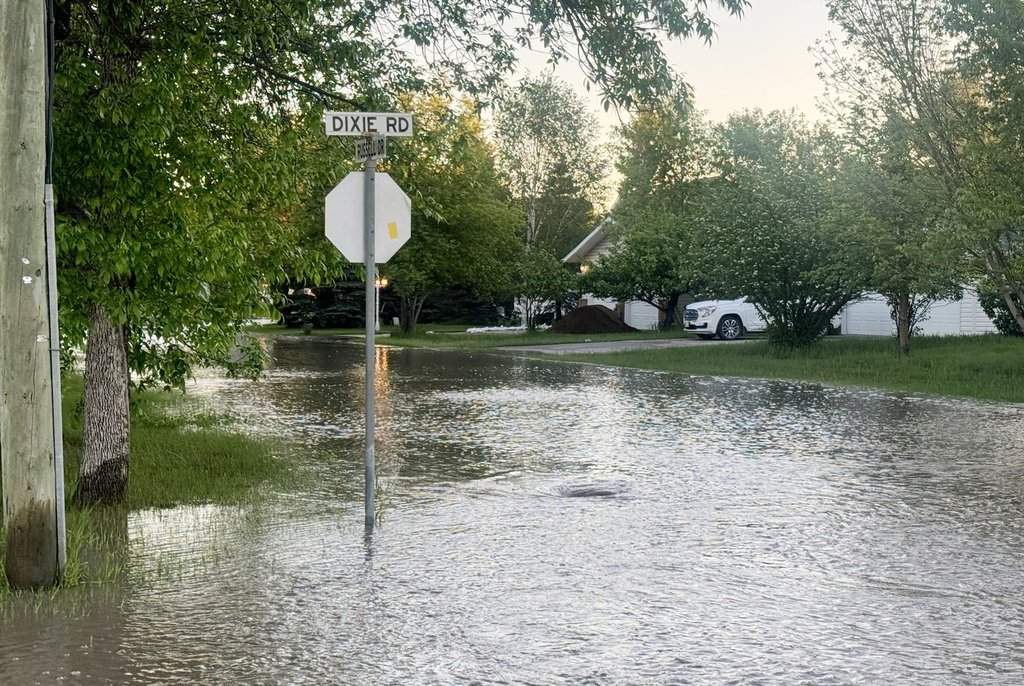
A single month of severe convective storms in June has generated over $1.1 billion in insured losses across Canada, exposing a structural mispricing of climate risk within commercial and residential real estate. This figure does not represent an isolated statistical anomaly; it is the predictable outcome of accelerating atmospheric energy intersecting with expanding urban footprints. Traditional actuarial models routinely understate these losses because they treat weather events as independent variables rather than compounding systemic shocks.
To accurately assess the economic impact of these storms, the damage must be deconstructed into a precise three-part cost function: primary asset degradation, secondary supply chain friction, and tertiary capital reallocation. By analyzing these vectors, we can map how localized atmospheric disruptions translate into macroeconomic volatility.
The Tri-Partite Cost Architecture of Convective Storms
The $1.1 billion baseline reported by insurance networks captures only the immediate liabilities underwritten by the private market. The true economic drain follows a distinct cascading architecture.
1. Primary Asset Degradation
This vector comprises direct physical destruction to capital stock, buildings, and infrastructure. In the June storm cluster, the primary damage was driven by two distinct meteorological phenomena: high-velocity straight-line winds and large-scale hail.
The engineering failure points during these events occur predominantly at the building envelope. Standard residential roofing and commercial cladding systems are rated for historical baselines that fail to account for the kinetic energy of sustained microbursts. When the envelope is breached, water ingress introduces a secondary wave of internal asset destruction, instantly multiplying the initial structural claim by a factor of three to four due to mold remediation and interior asset replacement costs.
2. Secondary Supply Chain Friction
When severe weather hits transport corridors and industrial zones, it creates immediate operational bottlenecks. The June storms disrupted key logistics nodes across Ontario and Western Canada, halting rail freight and grounding commercial air cargo.
The economic cost of a shut down transport link extends far beyond the duration of the storm itself. The backlog creates a bullwhip effect across just-in-time supply chains. Manufacturing facilities face forced downtime due to delayed components, while agricultural sectors suffer localized inventory spoilage when cold-chain logistics lose power grid connectivity. This friction acts as a temporary tax on productivity, reducing regional GDP output through forced operational inefficiency.
3. Tertiary Capital Reallocation
The least understood component of the cost function is the long-term diversion of capital. When $1.1 billion in liquidity is deployed to rebuild existing assets, it is fundamentally a defensive expenditure. This capital is stripped away from offensive investments—such as research and development, capacity expansion, or municipal innovation.
Municipalities are forced to reallocate infrastructure budgets from proactive upgrades to reactive emergency repairs. Similarly, private enterprises must deplete cash reserves or draw down credit lines to cover deductibles and non-insured losses, weakening their balance sheets and lowering their capacity for growth.
The Myth of the Hundred Year Event and Actuarial Drift
The fundamental flaw in current corporate risk management is reliance on stationary statistical distributions. The phrase "100-year storm" is frequently misused to imply an event that occurs once a century. In reality, it signifies a 1% probability of occurrence in any given year.
As atmospheric moisture content rises—driven by a roughly 7% increase in water-holding capacity per degree Celsius of warming—the baseline probability distribution shifts. What was historically a 1% annual probability event is transforming into a 3% to 5% annual probability event.
This phenomenon, known as actuarial drift, creates a dangerous mismatch between risk exposure and capital reserves. Insurance providers are forced to adjust premiums retroactively after catastrophic quarters, leading to rapid capital flight from high-risk zones or a steep increase in deductibles that shifts the financial burden directly onto corporate balance sheets and property owners.
Municipal Infrastructure as a Primary Vulnerability Vector
Urban areas across Canada are highly vulnerable to flash flooding due to a structural deficit in civil engineering: the systemic reliance on impermeable surfaces. Concrete and asphalt prevent natural water infiltration, converting municipal streets into high-velocity drainage channels during high-precipitation June storms.
When a severe convective system drops 50 millimeters of rain in under two hours, municipal stormwater systems face immediate hydraulic overload. Most urban drainage infrastructure in major Canadian metros was engineered under mid-20th-century meteorological assumptions. These systems lack the volumetric capacity to handle contemporary peak flow rates. The result is systemic backflow into residential baselines and commercial subterranean levels, driving up civil liability and commercial property losses.
The Limits of Insurance as a Climate Risk Mitigation Tool
Relying entirely on private insurance to absorb extreme weather shocks is an unsustainable long-term strategy. The insurance mechanism is designed to diversify independent risks across a large pool; it is not built to absorb correlated, systemic shocks that hit entire economic regions simultaneously.
As loss frequencies escalate, the private reinsurance market—the entities that insure the insurance companies—reprices its risk globally. This drives up capital costs for domestic insurers, who then execute two strategic maneuvers to protect their solvency:
- Geographic Exclusion: Insurers completely withdraw underwriting capacity from specific postal codes identified as high-risk flood or hail zones, creating pockets of uninsurable real estate.
- Coverage Erosion: Policy terms are rewritten to introduce strict sub-limits on water damage, wind-driven rain, and overland flooding, leaving property owners exposed despite paying rising premiums.
These actions create a hidden protection gap. The $1.1 billion in insured losses from the June storms represents only the portion of the damage backed by active policies. The uninsured portion, absorbed directly by individuals, corporations, and provincial disaster assistance programs, likely scales the true economic impact significantly higher.
Strategic Imperatives for Corporate Risk and Capital Allocation
Organizations must transition from passive risk transfer (buying insurance) to active risk mitigation and asset hardening. Navigating this volatile environment requires a structured execution framework.
First, corporations must conduct a comprehensive stress test of all physical assets using non-linear climate modeling rather than historical baselines. This includes evaluating the structural integrity of roofs, HVAC systems, and building envelopes against enhanced wind and hail metrics.
Second, supply chain logistics must be decentralized. Relying on a single transport corridor or a centralized distribution hub in a region prone to severe convective weather introduces an unacceptable single point of failure. Developing redundant supply pathways and increasing safety stock buffers for critical components mitigates the secondary friction costs of sudden weather disruptions.
Finally, capital allocation models must explicitly price in carbon and climate risk. Future real estate acquisitions and facility expansions must evaluate local municipal infrastructure resilience. Investing in sites with independent power grids, advanced onsite stormwater management, and resilient structural designs is no longer an optional sustainability initiative; it is a core fiduciary requirement to protect long-term asset valuations.