The traditional retail clearance model relies on progressive margin degradation to purge dead inventory. In contrast, Lululemon’s "We Made Too Much" system operates as a tightly regulated secondary market designed to clear seasonal units while protecting the brand's core equity. Standard shopping guides evaluate consumer sales through a superficial lens of raw discount percentages, which misses the operational logic. Maximizing value within Lululemon's promotional infrastructure requires analyzing the intersection of fabric depreciation, unit volume management, and SKU lifespan.
Corporate strategy adjustments implemented for 2026 have restricted overall unit volumes, maintaining inventory flat or slightly down to drive a return to full-price sales inflection. Consequently, the open-market availability of premium technical lines has narrowed. To exploit this ecosystem efficiently, buyers must shift from emotional consumption to cold algorithmic arbitrage.
The Tri-Particle Fabric Depreciation Framework
The value of any markdown item is dictated by its core textile composition. Lululemon categorizes its inventory by proprietary fabric formulations, each carrying distinct manufacturing costs, utility lifespans, and susceptibility to discounting.
[Textile Categorization]
   │
   ├── Core Performance (Nulu / Everlux) ── Low Markdown Elasticity (High Demand Retention)
   │
   ├── Synthetic Structural (Warpstreme / Swift) ── Medium Markdown Elasticity (Style-Dependent)
   │
   └── Blended Casual (French Terry / Spacer) ── High Markdown Elasticity (Seasonal Overstock)
1. Core Performance Materials: Nulu and Everlux
Nulu (nylon-elastane blend, brushed for a buttery texture) and Everlux (dual-knit fabric optimized for rapid heat dissipation) form the foundational demand layer of the brand. Because the baseline utility of these fabrics remains constant across seasons, their markdown elasticity is low.
When signature styles like the Align High-Rise Skirt or the Fast and Free Singlet enter the markdown pool, the price floor rarely drops below 20% to 30% off original retail. Price compressions here are almost always driven by colorway obsolescence rather than structural defects or low demand for the silhouette.
2. Synthetic Structural Textiles: Warpstreme and Swift
Warpstreme (polyester-elastane warp-knit) and Swift (woven nylon with multi-way stretch) anchor the technical apparel lines, including the ABC Slim-Fit Trouser and the Pace Breaker Short. These fabrics possess exceptional durability and shape retention, making them high-utility acquisitions.
Markdowns in this tier represent peak structural arbitrage. Units enter the sale selection because of structural updates—such as the transition from standard fits to "Updated Classic-Fit" configurations—or seasonal palette rotations. The material integrity remains identical to full-price baseline inventory, while the price collapses by up to 40%.
3. Blended Casual and Spacer Fabrics: French Terry and Smooth Spacer
Cotton-synthetic blends, French Terry, and Smooth Spacer fabrics represent the highest markdown elasticity. These materials are heavily tied to casual lifestyle trends and thermal seasons.
As a result, items like the French Terry Pullover Hoodie or the Smooth Spacer Classic-Fit Crew experience the sharpest price corrections, frequently clearing at 45% to 55% off original retail. This creates an inventory bottleneck for the brand, but provides a high-yield opportunity for consumers prioritizing lifestyle comfort over pure athletic performance.
The Mechanics of Size and Colorway Volatility
The pricing of the "We Made Too Much" system is a function of supply scarcity and localized demand. Standard colorways—specifically Black, True Navy, and Heathered Grey—rarely face systemic overproduction. Price reductions are instead concentrated on experimental palettes, neon treatments, and graphic prints.
This reality introduces the Inverse Size-Scarcity Paradox. In high-demand core silhouettes, standard sizing (Women’s 4–8, Men’s M–L) sees rapid inventory depletion at full retail price. Consequently, markdowns in these sizes are heavily skewed toward high-volatility colorways (e.g., metallic sheen, tie-dye, or highly saturated golds).
Conversely, outlier sizes (Women’s 0–2, 14+; Men’s XS, XXL) regularly see baseline neutrals enter the markdown cycle due to lower aggregate transaction volumes. The strategic shopper must execute a trade-off: optimize for fabric/color or optimize for structural silhouette.
Quantitative Assessment of Current Markdown Inventory
Evaluating the open inventory reveals distinct value clearings across product segments. The following structural breakdown isolates high-yield allocations based on real-time price-to-utility ratios.
High-Yield Athletic Foundations
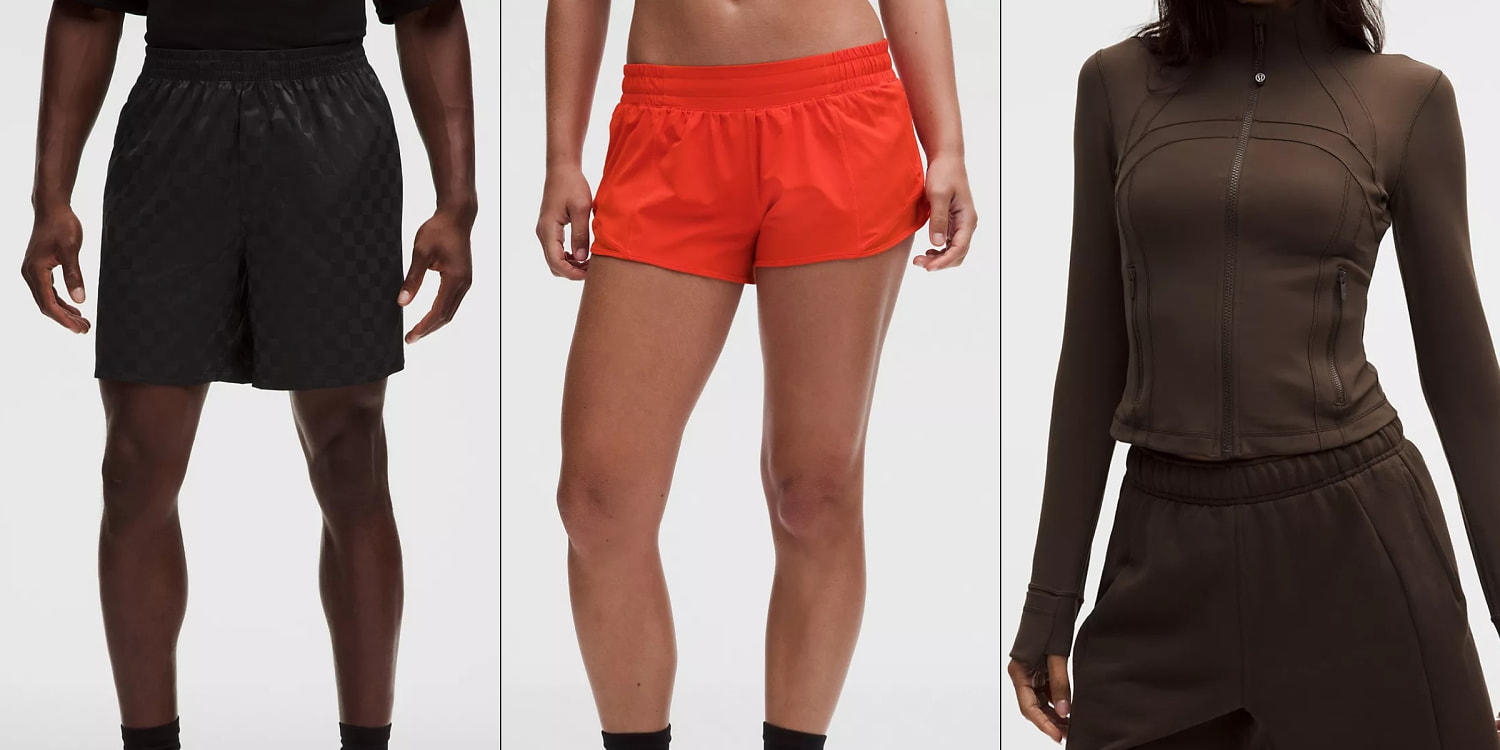
- Pace Breaker Linerless Short (5" and 7"): Markdown pricing hovers at $39 to $49 against a $68 baseline. Utilizing a lightweight Swift fabric variant, these units offer an optimal entry point for high-exertion training gear where colorway deviation does not compromise athletic utility.
- Zeroed In Linerless Short (5"): Positioned at $49 down from $68, this item offers a structured, minimalist profile built for versatile training matrixes, rendering the discount a flat 28% margin gain for the consumer.
- Bend This Scoop and Square Bra: Cleared at $29 from a baseline of $48. This represents a significant 39% reduction in the low-to-medium impact compression category, where performance relies entirely on elastane tensile strength rather than aesthetic trends.
Technical Lifestyle and Commuter Apparel
- ABC Slim-Fit Trouser (Stretch Cotton VersaTwill): Positioned at $69 down from $138. This exactly represents a 50% capital retention step. The VersaTwill fabric blend yields high structural durability, making this the highest-performing asset in the lifestyle segment based on cost-per-wear projections.
- New Venture Long-Sleeve Shirt: Reduced to $69–$79 from $118. The pricing gradient is dictated by the transition to "Updated Classic-Fit" patterns. Buyers who match the historical classic-fit dimensions can capture a premium woven technical shirt at a steep discount.
- Zeroed In Slim-Fit Pant: Cleared at $69–$79 from $118. This acts as a direct substitute for high-end commuter trousers, offering an identical technical profile at a heavily compressed entry price.
High-Depreciation Lifestyle Tops
- Smooth Spacer Classic-Fit Crew & Grand Standard Long-Sleeve Polo: Both units are marked down to $69 from their original $128 baseline. This represents an aggressive 46% markdown, typical of mid-weight insulation layers entering the mid-summer cycle.
- Airing Easy Short-Sleeve Shirt: Scaled down to $39–$59 from $88. This unit relies on woven lightweight synthetics designed specifically for hot-weather thermal management, presenting a seasonal alignment opportunity despite the clearance classification.
System Limitations and Risk Mitigation
Exploiting the markdown ecosystem requires recognizing its structural constraints. The primary risk vector is the Final Sale Constraint. Items purchased under the "We Made Too Much" designation are non-refundable, restricting the consumer's ability to correct fit mismatches. This limitation demands strict adherence to known brand sizing metrics before executing a transaction.
Furthermore, minor production variances can alter fit profiles across different fabrics. For example, a consumer measuring as a true Size 6 in Nulu (due to its high mechanical stretch and low compression) may experience constriction in an identical size in Everlux or Swift woven variants, which feature higher tensile resistance. Sizing decisions must be calibrated to the specific textile knit rather than a universal numerical size.
The final systemic bottleneck is Incomplete SKU Assortments. Markdowns rarely feature a complete sizing run or matching component pieces (such as matching top and bottom sets in identical colorways). Attempting to assemble a coordinated technical uniform exclusively through markdown channels introduces high search costs and low success probabilities.
The Optimal Purchase Matrix
To maximize capital efficiency within the current markdown framework, transactions should be executed based on the following prioritization matrix:
- Prioritize Technical Trousers (ABC/Zeroed In Lines): The combination of a 40–50% price reduction with high-durability fabrics like VersaTwill yields the highest long-term utility yield per dollar spent.
- Acquire Neutral Outlier Sizes: If your structural dimensions sit at the absolute ends of the sizing distribution curve, ignore seasonal colorways and target core black, navy, or grey units that have filtered down due to localized volume drops.
- Deploy Opportunistic Capital on Core Training Shorts: View items like the Pace Breaker as pure performance assets. If the functional objective is training utility, the visual profile of an obtrusive colorway becomes irrelevant, allowing you to capture the underlying fabric technology at its lowest historical price floor.