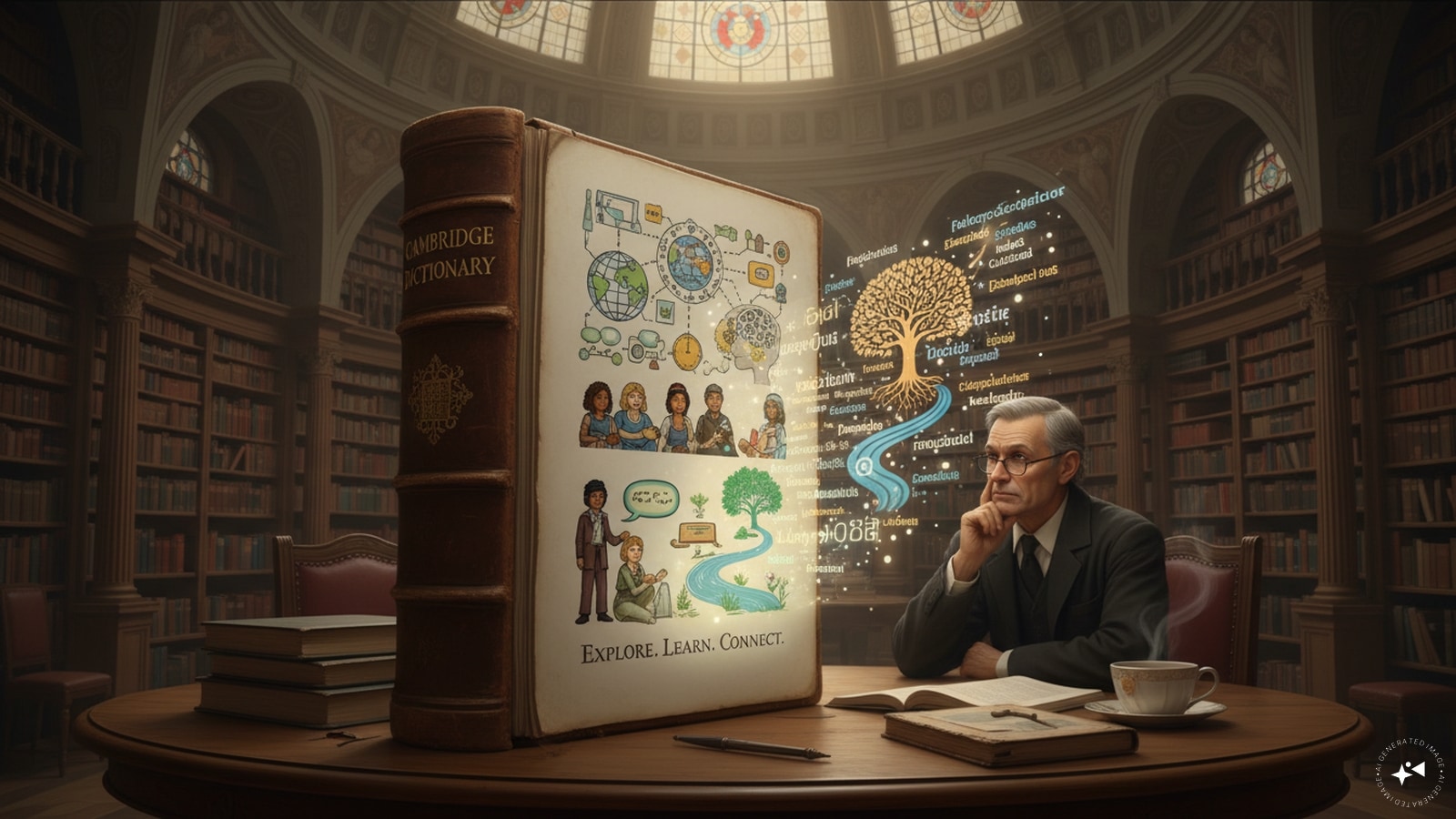
The dictionary is supposed to explain what you do not know. It is not supposed to remind you who you are.
Yet there it sat, staring back from a screen in late autumn: human. Selected by lexicographers at Cambridge Dictionary as a word of the year amid rising anxiety over artificial intelligence. On paper, it sounds like an editorial stunt, a neat little press release designed to spark debate over breakfast coffee. In reality, it feels like a confession.
I have spent years sitting with writers, editors, designers, and engineers who used to talk about their work the way people talk about a stubborn garden—full of dirt under the fingernails, unexpected weeds, and sudden bursts of color that no one could have scheduled on a spreadsheet. Lately, the room feels quieter. Not peaceful quiet. The tight, watchful quiet of people waiting to hear whether the thing they spent ten years learning to do can now be generated in four seconds for a fraction of a cent.
Sometimes I catch myself staring at a blinking cursor at two in the morning, wondering where my own voice ends and a statistical probability begins. That admission is uncomfortable to make, especially for someone who makes a living putting words in order. If I am honest, the speed of modern machine output does not just threaten jobs; it messes with your sense of gravity. When every sentence can be smoothed out, polished, and handed back to you on demand, friction starts to look like a defect.
To see why a word as ancient and ordinary as human suddenly needed a spotlight, it helps to trace how we got cornered into questioning it in the first place.
The Quiet Creep of Frictionless Everything
For decades, technology promised us convenience, and we took the deal without reading the fine print. We traded paper maps for blue dots, physical tickets for barcodes, and long afternoons in libraries for instant search boxes. Most of those trades made sense. Nobody mourns waiting three weeks for a photo to be developed when they can check on a faraway nephew right away.
Then came generative tools that could draft emails, summarize dense reports, write code, compose melodies, and mimic the cadence of a thoughtful essay. Suddenly, the boundary between human effort and machine output stopped looking like a brick wall and started looking like fog.
Consider what happens next when a tool gets good enough at mimicking surface fluency. Language is made of patterns, and large language models are extraordinary pattern engines. They read millions of texts, learn which words tend to travel together, and assemble answers that sound calm, structured, and helpful.
Here is a metaphor to make that mechanism concrete: imagine a master mimic who has memorized every play ever staged in London and can recite lines in any accent, yet has never felt stage fright, never fallen in love during a matinee, and never stood backstage with a racing heart before opening night. The mimic can pass an audition. The mimic cannot tell you what it costs to walk out into the glare.
When machines become fluent at sounding thoughtful, people start doubting their own value if they measure themselves only by speed or polish. Worse, institutions begin treating polished output as proof of real thought. That is where the trouble starts. A smooth paragraph can hide an empty room behind it.
To make this less abstract, let us look at a hypothetical character—someone built from dozens of real conversations I have had over the past two years. Call her Nadia. Nadia spent eight years as a copywriter for a mid-sized brand, learning how to listen to hesitant founders, pull truth out of messy product launches, and write copy that sounded like a real person talking across a kitchen table rather than a billboard shouting from a highway.
One Tuesday morning in October, Nadia sat in a corner booth with a cooling ceramic mug, her laptop open to a brief for a new health app. Across from her, a junior colleague showed her a draft generated in twelve seconds. It had bullet points. It had warm transitions. It had zero typos.
"It's ninety percent there," the colleague said, smiling with genuine relief. "We just need a quick pass."
Nadia read the draft twice. Every sentence was polite. Every claim was safe. Nothing in it was wrong, yet nothing in it bled. There was no trace of the founder's shaky voice when he talked about his mother's recovery, no sharp edge from the arguments the team had over pricing, no risk that might alienate a single reader.
"If we send this," Nadia asked softly, "who is actually speaking to them?"
Nobody in that booth had a clean answer. And that question—who is speaking here?—is the exact fault line that pushed Cambridge Dictionary to crown human as a word of the year.
Why a Dictionary Chose the Most Obvious Word in the Room
Dictionaries do not invent culture; they record the bruises and breakthroughs of how people talk when life shifts underneath their feet. When lexicographers pick a word of the year, they are usually looking for spikes in usage, shifts in meaning, or terms that capture a collective nerve. Choosing human is a different kind of signal. It suggests that when people talked about artificial intelligence, they kept circling back to what separates us from it—and found themselves struggling to define it cleanly.
Historically, whenever a major technological shift arrives, humans have had to renegotiate what makes us irreplaceable. The printing press changed how knowledge spread and forced societies to rethink authority and literacy. The industrial loom changed how cloth was made and forced workers and lawmakers to confront what dignity looked like inside a factory. Each wave asked a version of the same question: What is our role when machines can carry part of the load?
AI is different because it enters spaces we long treated as intimate: writing, teaching, counseling, art, companionship, decision-making. When a machine can draft a condolence note or hold a late-night chat about loneliness, we are forced to confront an unsettling mirror. If a system can simulate empathy, what makes real empathy matter?
A machine can arrange words that look like care. Only a living person can bear the weight of actually caring when it costs time, attention, or vulnerability.
That distinction sounds simple until you try to live by it under deadline pressure. When bosses reward output volume and feeds reward instant reaction, depth gets squeezed out. People start using AI to sound smarter, faster, or more empathetic than they have the bandwidth to be in the moment. Over time, that shortcut creates a strange hollowness. You get messages that sound warm but feel weightless, articles that read cleanly but leave no mark, and conversations where nobody is quite sure who wrote what.
I have felt that hollowness myself. There were weeks when I leaned too heavily on autocomplete and draft assistants to clear a backlog, telling myself I was just saving time for "higher-level thinking." Instead, I noticed my own prose flattening out. My sentences grew safer. My curiosity grew lazier. Editing a machine's draft took less effort than wrestling with a blank page, so I wrestled less. And when you wrestle less, your mental muscles quiet down.
It is easy to blame the software for that drift. Blame is cheap. The harder truth is that software only amplifies the incentives we already built. If we worship speed, AI gives us speed at terrifying scale. If we worship appearances, AI gives us polished surfaces without soul.
The Invisible Stakes Behind Every Prompt
Most public debates over AI focus on dramatic extremes: job displacement charts on one side, utopian promises of curing every disease on the other. Those arguments matter, yet they often miss the quieter stakes unfolding in ordinary rooms every day.
The first stake is agency. When you hand over the first draft of your thinking to a machine before you have even struggled with an idea, you risk outsourcing your own judgment. Thinking is not just arriving at an answer; it is walking through the confusion on the way there. If you skip the confusion, you may get a decent answer faster, but you lose the inner compass that tells you when an answer is shallow or wrong.
The second stake is trust. Human relationships run on shared risk and presence. When you read a letter from a friend, you assume a person chose those words for you. When you read a public statement or a heartfelt post, you look for signs of lived experience. Once synthetic polish becomes cheap and everywhere, genuine effort becomes rarer—and therefore more precious. People begin scanning for telltale phrasing, stiff transitions, or overly neat summaries, wondering whether there is a heartbeat behind the screen.
The third stake is responsibility. Algorithms do not suffer consequences. They do not lose sleep over a bad call, apologize to a grieving family, or stand beside a community when a project fails. Accountability requires a moral agent—someone who can say, I got this wrong, and here is what I am going to do about it.
But the real problem lies elsewhere when we treat human as a badge of superiority rather than a standard of care.
Calling ourselves human does not automatically make us wise, kind, or honest. History offers plenty of proof of how cruel, small-minded, and destructive human beings can be. If we use "being human" merely as a defensive shield against new tools, we will miss real opportunities to learn, heal, and create. The challenge is not to build a moat around our species out of fear. The challenge is to decide what kind of humans we want to be while machines grow more capable around us.
Let us return to Nadia for a moment—still a hypothetical figure, still standing in for a very real dilemma. After that conversation in the coffee shop, she did not throw her laptop into a river or swear off technology forever. Instead, she walked back to her desk and opened a blank document.
She kept one useful outline idea from the machine's draft, cut the rest, and called the health app's founder directly. For forty minutes, she asked questions that no prompt box could have invented: What did you say to your mother on the drive home from the clinic? What part of this app are you secretly afraid users will misunderstand?
The founder paused for a long second, then told a story about a crumpled sticky note taped to his refrigerator—a reminder to breathe and take things one hour at a time.
Nadia built the opening around that sticky note. It was messier than the machine's draft. It took twice as long to write. When the team read it aloud, nobody smiled with relief at the speed. They went quiet because it felt true.
Reclaiming the Weight of Real Presence
If Cambridge Dictionary's choice of human as a word of the year means anything lasting, it is an invitation to stop confusing output with meaning.
Machines are extraordinary at recombination. They can remix what already exists at speeds no human brain can match. Humans do something different when we are fully present: we notice what is missing, we feel what is at stake, and we bring lived context into rooms where numbers alone fall short.
You do not need a grand manifesto to practice that. You can start small, in places where convenience has quietly crept in:
Write a difficult message yourself instead of letting a tool smooth away your honesty. Sit with a problem for ten minutes before asking for a shortcut. Listen closely to someone whose perspective differs from yours, without rushing to compress their story into a tidy summary. Notice when you are performing competence versus actually understanding something.
None of this is glamorous. Real presence rarely looks dramatic on a screen. It looks like paying attention when it would be easier to tune out. It looks like caring enough to get the details right, even when nobody is grading you on the effort.
Fear of AI thrives in the dark, where people feel powerless and replaceable. Clarity grows when we remember what cannot be automated: showing up, taking a stand, risking being misunderstood, and loving things—and people—with real skin in the game.
A word on a page cannot save us from our own habits. Only we can.
The next time you type a sentence, pause for half a second before hitting send or generate, and feel the warmth of your own fingers on the keys—proof enough that you are still here, still awake, and still the one who gets to decide what matters.



