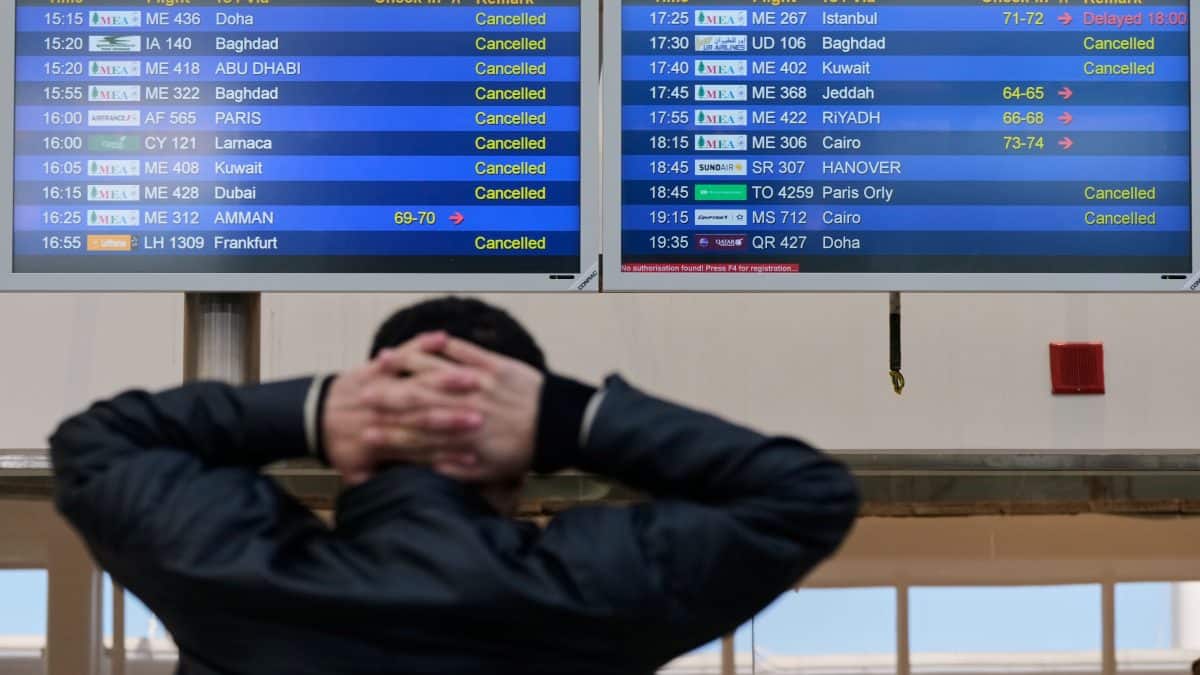
The screen at Dubai International Terminal 3 didn’t just show a delay. It showed a collapse. Thousands of travelers stood paralyzed under the artificial glow of the departures board, watching the word Cancelled bloom across the monitor like a digital contagion.
Usually, the flight from Dubai to Mumbai or Delhi is a routine hop. It is the aerial umbilical cord connecting the Gulf’s gleaming ambition to India’s beating heart. You board, you eat a tray of saffron rice, you watch half a movie, and you land. But when the airspace over Iran turned into a forbidden zone, that three-hour skip across the Arabian Sea became a logistical nightmare that stretched across continents.
Consider a traveler we will call Arjun. He isn’t a high-flying CEO or a diplomat; he is one of the millions of Indian expatriates who keep the gears of the Emirates turning. He had a wedding to attend in Kerala. He had a suit in his garment bag and a gold chain for his sister in his carry-on. For Arjun, the geopolitical chess match between Tehran and its neighbors isn't an abstract headline. It is the reason he is currently sleeping on a cold linoleum floor near Gate B26.
Airplanes do not just fly in straight lines. They follow invisible highways in the sky, dictated by fuel efficiency, wind currents, and—most importantly—sovereign borders. When a "NOTAM" (Notice to Air Missions) is issued closing a specific corridor of sky, the world’s most efficient machines are suddenly rendered as helpless as a car in a dead-end alley.
The Geography of Fear
To understand why your flight was cancelled, you have to look at the map not as a collection of countries, but as a series of narrow pipes. The airspace over Iran and Iraq acts as a primary conduit for traffic moving between Europe, the Middle East, and Asia. When those pipes clog due to military tensions, every other pipe in the region begins to burst under the pressure.
When the news broke that flights were resuming, a collective sigh of relief rippled through the departure lounges. But "resuming" is a deceptive word. It implies a return to the status quo. In reality, it was more like trying to restart a massive engine that had been doused in sand.
The airlines—Emirates, Air India, IndiGo—found themselves playing a high-stakes game of musical chairs. Even as the first planes took off, the ripple effects of the previous forty-eight hours of chaos remained. A plane that was supposed to fly from Dubai to Kochi was currently stuck in Singapore. A crew that was scheduled for a midnight departure had "timed out," their legal working hours exhausted while sitting in traffic on the tarmac.
The math of aviation is unforgiving. If you miss your "slot," you don't just go to the back of the line; you often lose your place in the entire global sequence.
The Invisible Toll of a Re-route
Imagine you are a pilot. Your flight plan used to be a straight shot. Now, you are told you must circumvent the entire Iranian landmass. You have to fly south, hugging the coast of Oman, before swinging wide across the North Arabian Sea.
This isn't just a matter of "taking the scenic route."
A detour of ninety minutes consumes several tons of extra jet fuel. It changes the weight and balance of the aircraft. It might mean offloading cargo—or worse, offloading passengers—to ensure the plane is light enough to carry the extra kerosene required for the long way around. For the airlines, this is a financial hemorrhage. For the passenger, it’s a terrifying uncertainty. Will the fuel hold? Will we have to divert to Muscat because of a headwind we didn't plan for?
The resumption of flights is often a fragile truce with reality. While the headlines shouted that the skies were open, the fine print told a different story. Cancellations continued because the system was exhausted. You cannot stop a machine that moves a million people a day and expect it to hum perfectly the moment you flip the switch back on.
The Human Cost of a "Minor Disruption"
We talk about "disruptions" as if they are inconveniences. We treat them like a slow internet connection or a late pizza delivery. But for the person sitting in Terminal 3, a "disruption" is a missed funeral. It is a job interview that won't be rescheduled. It is the first time a grandmother was supposed to hold her grandson, a moment now lost to the friction of international relations.
There is a specific kind of exhaustion that only exists in an airport during a crisis. It is a mix of recycled air, caffeine jitters, and the low-thrumming anxiety of being trapped in a "non-place." You are between jurisdictions. You are a citizen of no-man's-land, waiting for a gate agent to give you a piece of paper that says you are allowed to leave.
By the time the second wave of flights began to depart for India, the mood had shifted from frustration to a weary, cynical gratitude. People boarded the planes not with the excitement of travel, but with the grim determination of survivors.
The Fragility of the Bridge
This crisis exposed a truth we often choose to ignore: our global connectivity is a miracle built on a glass foundation. We have become so used to the idea of "The World is Flat" that we forget the mountains of history and the trenches of conflict that still define the ground beneath us.
The Dubai-India corridor is one of the busiest in the world. It is a bridge of gold, labor, and family. Yet, it can be severed by a single command from a military outpost hundreds of miles away.
When you finally board that flight, and the wheels leave the hot tarmac of the desert, you feel a momentary sense of triumph. You think you’ve beaten the system. But as the plane tilts and you see the vast, dark expanse of the Gulf below, you realize how small the "open" corridor actually is. You are flying through a needle's eye.
The cancellations didn't stop because the tension disappeared. They stopped because the airlines found a way to work around the scars of the earth. They found a way to keep the bridge standing, even if it meant taking the long way home.
The next time you see a "minor delay" on a screen, remember Arjun. Remember the suit in the garment bag. Remember that every flight is a victory over geography, and sometimes, geography fights back.
The sky is never truly empty; it is crowded with the ghosts of the routes we can no longer take.