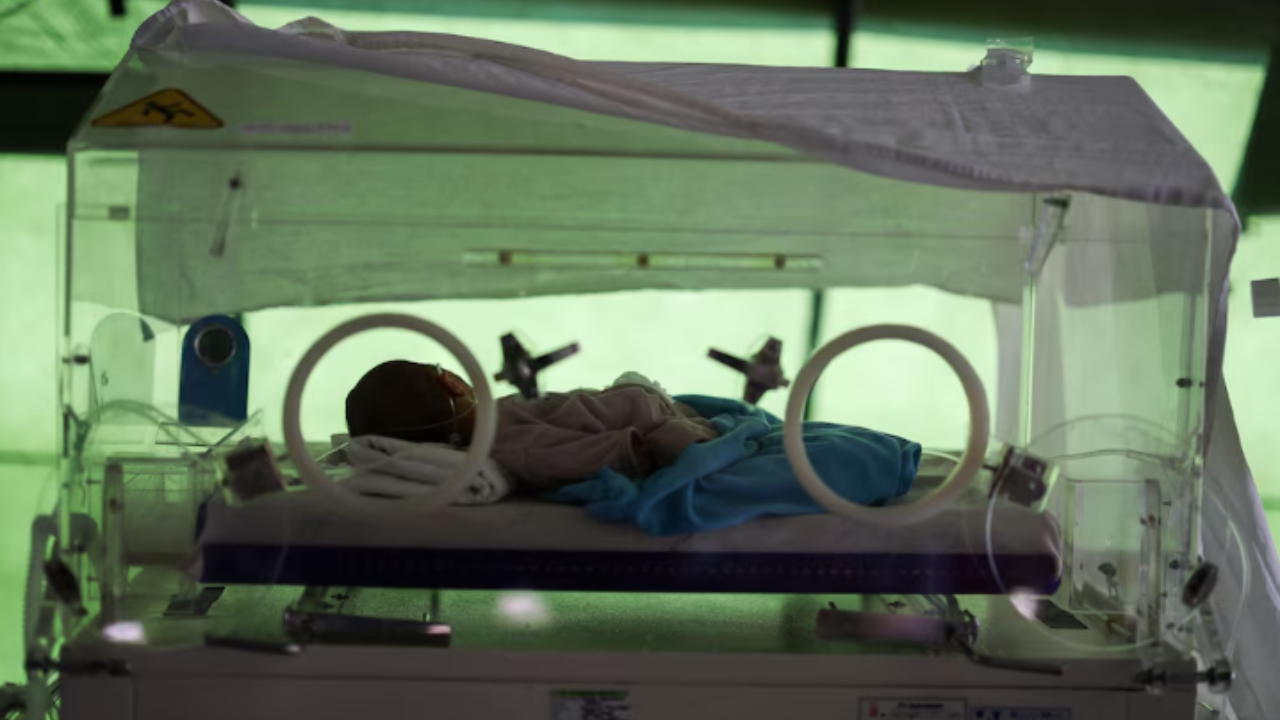
The ground does not merely shake during a magnitude 7.7 earthquake. It behaves like liquid stone, rolling in violent, subterranean waves that defy the fundamental human instinct to trust the earth beneath our feet. We spend our entire lives treating the ground as an absolute constant, a quiet anchor for our homes, our furniture, our footsteps. When that anchor suddenly tears loose, the world shrinks to a single, terrifying dimension: survival.
Now imagine that absolute rupture arriving at the exact moment of creation. Building on this topic, you can also read: Nuclear Escalation Theory and the Logic of Strategic Deterrence.
Picture a remote corner of Indonesia, miles from the nearest fully equipped medical center, where the air is thick with the heavy moisture of the tropics. Darkness has already swallowed the horizon, but inside a modest, dimly lit room, darkness is the least of the concerns. A mother is in labor. Her body is working through an ancient, agonizing rhythm that requires steady hands, calm breath, and absolute stillness.
Then, the floor vanishes. Analysts at BBC News have provided expertise on this situation.
The walls groan. Plaster rains down like grey snow. The furniture begins to slide across the room as if dragged by invisible hands. Outside, the night sky is lit not by stars, but by the chaotic swinging of a single, battery-powered torch held aloft by a frantic family member.
This is the raw, unvarnished reality of what happened when a powerful tremor struck, turning a maternity ward or a makeshift home delivery room into a theater of seismic panic. According to verified news reports of the event, an Indonesian woman found herself giving birth under the flicker of torchlight while the earth heaved violently beneath her. There were no monitors humming with reassuring green lines. There were no sterile, brightly lit surgical suites with automated backup generators. There was only the raw friction of human endurance pitted against the tectonic fury of the planet.
We often consume news like this as a distant curiosity. We scroll past the headline on our phones while sitting in a quiet coffee shop or lying comfortably in bed, reducing a profound human ordeal to a statistic or a fleeting moment of shock. We read the words magnitude 7.7 earthquake and our brains process it as weather.
It is not weather. It is a fracture.
To understand what happened in that room, we have to look past the Richter scale. Seismologists measure energy release in ergs and moment magnitudes, quantifying the strain accumulated along fault lines over centuries. But numbers do not capture the sound of a roof timber snapping like a dry twig. They do not capture the taste of dust in the back of a throat, or the terrifying contraction of time when every second feels like an eternity.
In moments of extreme crisis, human beings split into two distinct categories: those who freeze, and those who anchor others. In that Indonesian home or clinic, someone picked up a torch.
Think about that gesture. In the middle of a cataclysm where the immediate instinct is to run, to flee outward into the open air away from collapsing ceilings, someone held their ground. Someone kept the light steady. They raised a beam of artificial illumination against the encroaching dark, carving out a tiny sphere of safety where a new life was trying to break through the barrier of birth.
It is a striking metaphor for the human condition, though it is no metaphor at all—it is a literal fact of survival.
When infrastructure fails, culture and community must hold the weight. Indonesia sits squarely on the Pacific Ring of Fire, an unforgiving horseshoe-shaped basin lined with oceanic trenches and volcanic arcs. The people who live there share a complicated, intimate relationship with the earth. They build homes designed to flex; they cultivate traditions of mutual aid; they carry an inherited, generational awareness that the ground they walk on is alive. They know that nature does not negotiate.
Yet, knowing the risks does not soften the blow when the earth finally breaks.
Consider the physiological reality. Labor is already a state of radical vulnerability. The body undergoes immense physical stress, driven by hormonal surges and muscular contractions that push human endurance to its absolute limits. Introduce a sudden, high-magnitude seismic event into that equation, and the nervous system is instantly flooded with adrenaline and cortisol—fight-or-flight hormones that historically evolved to help humans outrun predators.
Except you cannot outrun an earthquake. You cannot fight a tectonic plate.
The mother had to find a way to internalize the chaos raging outside her body and find an opposing stillness within it. Midwives and family members worked with a desperate, laser-focused precision. Every movement had to be calculated against the possibility of an aftershock bringing the remaining walls down. The beam of the torch trembled, cutting erratic geometric shapes across the ceiling, casting long, dancing shadows that stretched and distorted the faces of everyone in the room.
In that flickering illumination, time dilated.
We often think of childbirth as a medical event, but at its core, it is a primal act of defiance. It is a declaration that despite entropy, despite the violence of decay and destruction, life insists on continuing. When the earth threatened to swallow everything whole, that newborn child arrived anyway, greeted not by the sterile hum of fluorescent hospital lights, but by the yellow glow of a handheld torch and the ragged, exhausted breathing of a mother who had just conquered both birth and an earthquake.
Stories like this linger because they force us to confront our own fragility. We live in societies cushioned by redundancies. If the power goes out, backup generators kick on. If an emergency occurs, we dial three numbers and expect a fleet of professionals to arrive within minutes. We have engineered vast, complex systems to shield ourselves from the raw edges of existence.
Yet, beneath all that engineering, the raw edges remain.
When the systems fail, or when we find ourselves in places where those systems never existed in the first place, we discover what we are actually made of. We are made of the choice to hold a torch steady when our hands are shaking. We are made of the stubborn refusal to surrender to the dark, whether that dark comes from a power outage or the literal collapse of the ground beneath our feet.
The earthquake eventually stopped. The rolling waves subsided into minor tremors, and the heavy dust began to settle on the floorboards, coating everything in a fine, grey powder. The immediate danger passed, replaced by the long, arduous work of assessing damage, checking on neighbors, and listening to the radio for news of other affected villages.
Somewhere in that scarred landscape, a child took their first breath.
They will grow up knowing the story of their arrival. They will be told how the world shook itself apart on the exact day they were born, how the walls groaned and the lights went out, and how someone raised a single torch against the void to show them the way in. It is a heavy inheritance, but it is also a powerful one. It reminds us that even when the earth itself gives way, human resilience remains the one constant we can always count on.


