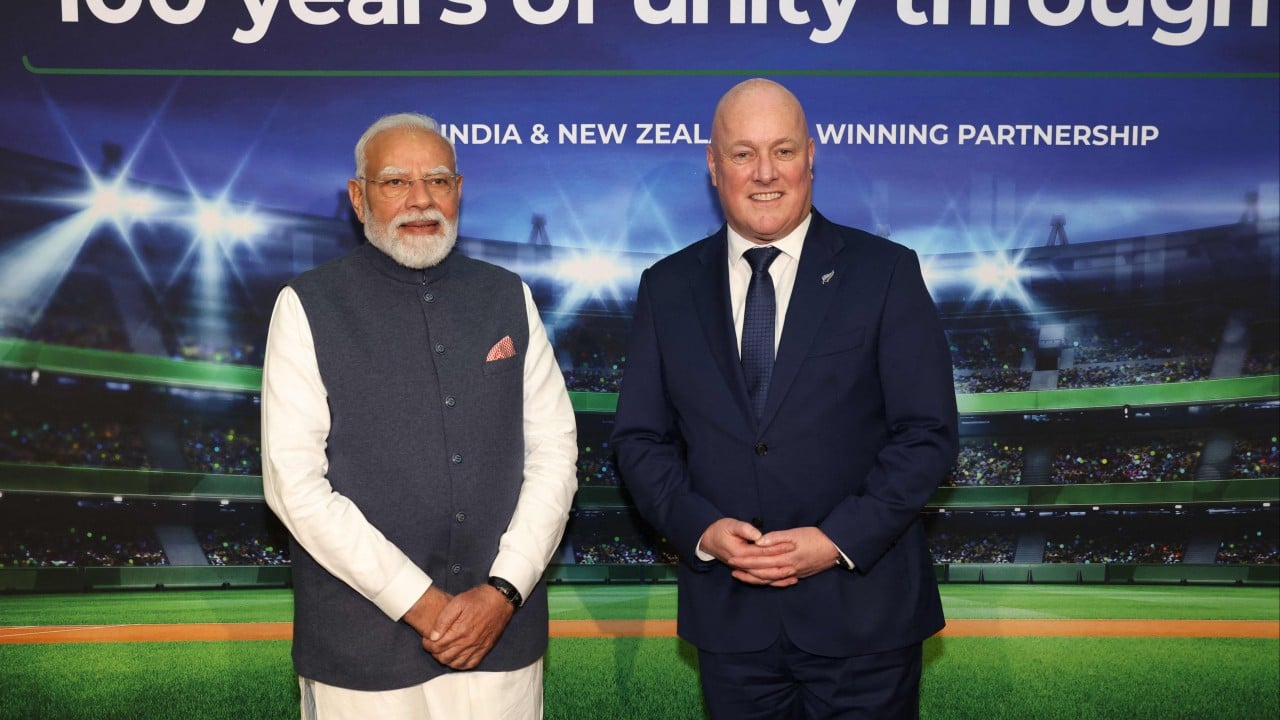
The winter air in Auckland carries a sharp, saline bite, the kind that forces you to pull your collar tight against your neck. But inside the formal enclosure at Government House, the atmosphere defied the season. Two men, representing nations separated by nearly twelve thousand kilometers of deep ocean and vastly different geopolitical realities, stepped toward each other. There was a brief pause, a firm handshake, and then an unexpected, warm embrace.
New Zealand Prime Minister Christopher Luxon and Indian Prime Minister Narendra Modi just signed an expansive series of bilateral agreements, officially elevating their relationship to a Strategic Partnership. It is the first time an Indian Prime Minister has set foot on New Zealand soil in forty years.
For decades, the relationship between these two democracies resembled a polite, distant acquaintance. They shared a history of British colonial influence, a mutual obsession with cricket, and a quiet appreciation for each other from afar. But appreciation does not pay the bills, nor does it secure shipping lanes in an increasingly volatile ocean. The sudden acceleration of their diplomatic courtship—resulting in 18 distinct agreements, a comprehensive Free Trade Agreement, and a defense pact—tells a story not of sudden affection, but of shared, urgent necessity.
Consider the view from a small orchard in the Bay of Plenty. A hypothetical third-generation orchardist, let us call him Peter, watches the horizon. For years, Peter has known that relying heavily on a single, massive East Asian market for exports is a dangerous gamble. If a political whim or a sudden trade barrier closes a port overnight, his fruit rots on the trees. His livelihood vanishes.
Peter does not read geopolitical white papers. He feels them. He feels them in the rising cost of fertilizer, the shifting freight rates, and the nagging worry that his children will not be able to afford to keep the family farm. For people like Peter, India has always been a shimmering, unattainable mirage. It is a market of 1.4 billion consumers, yes, but one historically guarded by formidable tariff walls designed to protect its own millions of small-scale farmers.
To bridge that chasm, negotiators had to move with unprecedented speed. The current coalition government in Wellington made an Indian trade deal its primary economic objective. It took less than nine months from the formal launch of negotiations to hammer out the details of the Free Trade Agreement.
The centerpiece of this diplomatic sprint is an ambitious economic target. The two nations intend to double their bilateral trade in goods and services to 7 billion New Zealand dollars by 2030. New Zealand is also welcoming a massive 20-billion-dollar investment commitment into India, creating a pathway for Kiwi companies to anchor themselves in the world’s fastest-growing major economy.
But a trade agreement is never just about commerce. It is a blueprint of trust.
To make this numbers game work, the two countries had to look beyond simple buying and selling. They had to talk about knowledge. New Zealand is lending its niche expertise to help lift agricultural productivity inside India, focusing on cold-chain logistics and post-harvest systems for kiwifruit, apples, and honey. It is a subtle shift from transactional trade to deep institutional integration. If you help a partner grow their own food better, they are far more likely to keep their doors open to yours.
Yet, as the ink dried on the economic papers in Auckland, a different kind of anxiety hovered over the celebration. Trade requires open water. And right now, the global commons are looking increasingly fragile.
Turn your gaze from the orchards to the rolling, grey expanse of the Western Indian Ocean. Last year, a New Zealand naval officer stood on the bridge of a vessel commanding Combined Task Force 150, directing operations to deter narcotics smuggling and maritime piracy. Sitting right beside him, as the deputy commander, was an officer from the Indian Navy.
That raw, operational experience in the Middle Eastern waters has now been institutionalized. Alongside the trade deal, Luxon and Modi signed a Mutual Logistics Support Arrangement and a Maritime Cooperation Arrangement.
For New Zealand, a small island nation entirely dependent on sea lines of communication, the vulnerability is existential. The stability of global supply routes is not an abstract academic theory; when a major shipping lane is choked by conflict or piracy, the shockwaves hit the South Pacific within days. Fuel prices spike. Shipping containers vanish. The cost of running an electricity grid or a fishing fleet on a remote Pacific island becomes ruinous.
By signing a defense pact with New Delhi, Wellington is acknowledging a hard truth. It can no longer afford to be a passive bystander in the Indo-Pacific. It needs big, capable friends who share an interest in a rules-based order, freedom of navigation, and the peaceful resolution of disputes under international law.
Not everyone back home is cheering without reservation. In the halls of the New Zealand Parliament, the domestic political landscape is complicated. The opposition has already signaled its intent to stringently review the finer details of the FTA, questioning what structural vulnerabilities the rapid deal might introduce. Out in the public sphere, debates over immigration and population growth simmer constantly, with some domestic political factions quietly warning against any policy shifts that might drastically alter talent mobility or labor markets.
The leaders chose to navigate around those domestic landmines during their public appearances, focusing instead on the undeniable gravitational pull drawing their nations together.
As the formal ceremonies concluded and the dignitaries prepared for a massive community celebration at Spark Arena, the true scale of the shift became clear. This is not a temporary marriage of convenience. It is a calculated, long-term repositioning for an unpredictable decade.
The image that remains is not the stack of signed treaties or the official joint statements detailing counter-terrorism cooperation and hydrographic data sharing. It is the memory of two leaders from opposite ends of an ocean, stepping away from the cold podiums to share a brief, human moment of connection in the Auckland chill. They have committed their nations to a shared path, knowing full well that the waters ahead are deep, uncertain, and entirely unavoidable.